
On this page
- What AI governance means in a healthcare practice
- Why a clinic needs it
- The risks a program should cover
- Federal rules that touch clinic AI
- Building the program in seven steps
- Training, consent and incident response
- A fictional example: lab extraction under governance
- Our perspective
- Where the software fits

Key takeaways
- Governance is an operating routine (inventory, ownership, review, monitoring, incident response), not a statement of ethical principles.
- Every AI output that touches a patient decision should pass through a licensed clinician before it reaches the chart or the patient.
- Ask each vendor, including your EHR vendor, for testing and validation information, data-handling terms and a BAA before turning an AI feature on.
- Federal rules on AI in patient care apply differently depending on whether you receive federal funds, so confirm your status with counsel.
- A small clinic can run this with one accountable lead, a one-page policy per tool and a quarterly review.
AI healthcare governance is the set of policies, roles and review routines that decide which AI tools a practice uses, how they are checked before use, who answers for them, and how problems are caught afterward. For a cash-pay longevity, functional medicine, concierge or hormone clinic, it does not require a hospital-scale committee. It requires a written inventory of every AI tool, a named owner, a vendor review, human sign-off on anything clinical, and a routine for watching performance over time.
This guide is general information for clinic owners and operators, not legal, clinical or compliance advice. Have counsel and a qualified compliance professional review your final policies.
What AI governance means in a healthcare practice
The term gets used loosely, so it helps to separate two layers. Principles say what good looks like. Governance is the machinery that makes it happen.
The World Health Organization's guidance on the ethics and governance of AI for health sets out six principles: protecting autonomy, promoting safety and well-being, ensuring transparency and explainability, fostering responsibility and accountability, ensuring inclusiveness and equity, and promoting responsive and sustainable AI. Those are useful, but they do not tell a front-desk manager what to do on Monday.
A 2025 paper in npj Digital Medicine describes governance as the frameworks, policies and processes that guide the responsible design, development, procurement, deployment and use of AI in healthcare. A clinic rarely designs models, so your scope is mostly procurement, deployment and use. Broader overviews of AI data governance make the same point: governance starts with knowing which tools staff are already using and what data goes into them.
Where small clinics usually start
Most cash-pay clinics already use AI without a formal decision to do so. Common examples:
- A note-drafting or ambient scribe tool
- Lab report parsing or biomarker summaries
- Chatbots or text assistants for patient messages
- AI features inside the EHR, scheduling or marketing platform
- General-purpose chat tools that staff use on their own to draft letters or summarize records
That last item is the highest-risk one, because it sits outside any vendor agreement. A governance policy has to cover it explicitly.
Why a clinic needs it
The Joint Commission's guidance on the responsible use of AI in healthcare frames governance as the way organizations manage risks such as algorithmic bias, clinical error, privacy breaches and over-reliance on automated output. It also stresses accountability and oversight so that AI does not become a safety hazard as regulations evolve.
There is also a practical business reason. Longevity care is built on trust, high-touch relationships and patients paying out of pocket. A single wrong reference range, a misattributed lab value or a privacy lapse costs more in reputation than it would in a large system. A documented process lets you explain what you did and why if a patient, a licensing board or an insurer ever asks.
The risks a program should cover
The same Joint Commission guidance points to a set of risks a governance program should address. Translated to a small clinic:
| Risk | What it looks like in a longevity clinic | Control to put in place |
|---|---|---|
| Patient safety | An extracted lab value is wrong and a protocol is adjusted on it | Clinician review of every AI-extracted result before it is final |
| Bias | A tool performs worse for some patient groups or age ranges | Ask the vendor about testing populations, then spot-check your own patients |
| Privacy and security | PHI pasted into a tool with no BAA | Approved-tools list, BAA before any PHI is shared, staff rules |
| Transparency | Nobody can say how a recommendation was produced | Keep source documents and the clinician's reasoning in the chart |
| Consent | Patients do not know AI touched their records | Plain-language disclosure in intake and consent forms |
| Accountability | No one owns a tool after the demo | Named owner per tool, with a review date |
| Drift and misuse | Output quality changes after a vendor update, or staff use a tool for tasks it was not approved for | Change log, periodic sampling, usage rules |
Federal rules that touch clinic AI
For US practices, the legal picture is a patchwork, and some of it applies only to certain organizations. Treat the following as orientation, then confirm with a healthcare attorney.
- HIPAA. Any AI vendor that creates, receives, maintains or transmits PHI for you is generally handled as a business associate, which means a business associate agreement should be in place before PHI flows.
- Section 1557 of the Affordable Care Act. HHS's 2024 final rule prohibits discrimination through patient care decision support tools, and as summarized by the National Health Law Program, it covers a broader category than clinical algorithms alone. The provision took effect on May 1, 2025, and it reaches health programs that receive federal financial assistance. A purely cash-pay clinic may or may not be covered, for example if it accepts Medicare or Medicaid payments or participates in other federally funded programs, so ask counsel rather than assume. The same analysis notes that whether an entity made reasonable efforts depends partly on whether it has a process, such as governance, for evaluating the tool.
- FDA oversight. Software that goes beyond supporting a clinician and instead drives a diagnosis or treatment can be regulated as a device. Whether a given feature qualifies is a regulatory question for the vendor and your counsel, not a judgment for front-line staff.
- State law. Several states have adopted or proposed rules on AI disclosure and use in care. Check your state medical board and attorney general guidance for the states where you license and see patients, including telehealth patients.
Outside the US, regulators have taken different paths. One 2026 academic comparison characterizes the EU approach as precautionary and front-loaded, while the US relies more on iterative adaptation after deployment. The practical consequence for a US clinic is that more of the judgment falls on the practice itself.
Building the program in seven steps
The FUTURE-AI international consensus guideline offers 30 best practices across technical, clinical, socioethical and legal dimensions. That is more than a small clinic will formalize, but its lifecycle logic scales down well.
1. Name an accountable lead and a small review group
The Joint Commission guidance recommends a multidisciplinary structure with a designated technology lead. In a clinic of three providers, that can be the medical director as decision-maker, the practice manager as operations owner, and a compliance or privacy contact (internal or outsourced). FUTURE-AI also recommends engaging interdisciplinary stakeholders across the lifecycle, so include someone who sees patients and someone who handles billing and records.
2. Build an inventory
List every tool that uses AI, including features inside tools you already pay for. For each, record:
- What it does and which workflow it sits in
- Whether it sees PHI
- Whether a BAA is signed
- Who owns it
- Whether its output is clinical, administrative or patient-facing
- The date of the last review
3. Classify by risk
A tool that drafts an appointment reminder is not the same as one that extracts lab values or proposes a care plan. Sort tools into tiers. Higher tiers get more scrutiny before launch and more frequent review afterward.
4. Review the vendor before you switch anything on
The Joint Commission guidance says EHR-native AI should be included in risk-based procurement and oversight, and that practices should request vendor testing and validation information. A short questionnaire works:
- What does the feature do, and what does it explicitly not do?
- How was it tested, and on what kinds of data or patients?
- Where does PHI go, who can access it, and is a BAA available?
- Is patient data used to train models, and can that be turned off?
- How are model or feature changes communicated to customers?
- What audit trail exists for who reviewed or changed an AI output?
- How do I export my data if I leave?
Unclear or evasive answers are a finding in themselves.
5. Validate locally before full use
Vendor testing does not tell you how a tool behaves on your lab formats, your patient mix and your reference ranges. Run a pilot: process a set of de-identified or fictional records, compare the output with a clinician's own reading, and write down the error types you see. Guidance on testing AI tools properly emphasizes defined test cases and repeatable checks, which is the right habit even at small scale.
6. Keep a human decision-maker in every clinical loop
Preserve clinician judgment as a written rule: AI proposes, a licensed provider reviews and decides. The reviewer should be able to see the source document next to the AI output. If review is a rubber stamp, the control does not exist.
7. Monitor, update and retire
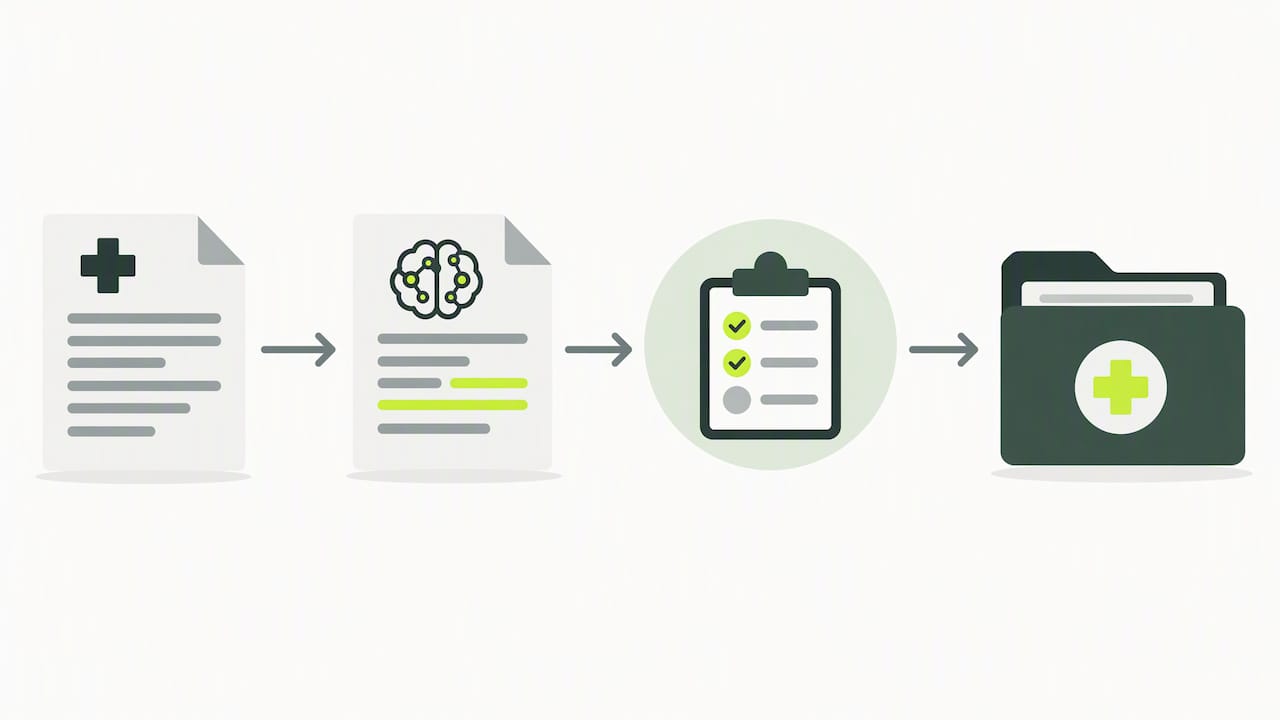
FUTURE-AI describes traceability as documenting a tool's full trajectory from development and validation through deployment and use. For a clinic, that means a simple log: version or date of each notable vendor change, results of periodic sampling, incidents, and the decision to keep, restrict or retire the tool. Quarterly sampling of a handful of cases per tool is a workable starting cadence. Retire a tool when error rates rise, the vendor changes terms in ways you cannot accept, or the workflow no longer needs it, and confirm that data is returned or deleted per your agreement.
Training, consent and incident response
Training. Staff need to know what each approved tool can and cannot do, which tools are off limits for PHI, and how to flag a suspected error. Document attendance and repeat at onboarding and after major changes.
Consent and disclosure. Tell patients in plain language when AI assists with their records, labs or communications, and who reviews the output. Wording belongs in your intake and consent documents and should be reviewed by counsel for your state.
Incident response. The Joint Commission guidance calls for processes to report adverse events and ongoing errors. Define what counts as an AI incident (a wrong value reaching a patient, PHI sent to an unapproved tool, a biased pattern noticed), who is told within what timeframe, how the tool is paused, and how affected patients are informed. Where PHI is involved, coordinate with your privacy officer on HIPAA breach analysis.
A fictional example: lab extraction under governance
Consider a fictional patient, "Patient A," whose outside lab PDF arrives before a follow-up visit. The clinic's policy says AI extraction is a Tier 2 tool: it touches PHI, it is covered by a BAA, and its output is clinical.
- The PDF is uploaded and values are extracted into the clinic's own biomarker ranges.
- The provider opens the extracted values beside the original report and checks flagged or unusual results.
- Any correction is made before the values are final, and the provider signs off.
- Once a quarter, the clinic samples several records, compares extraction to source, and logs error types.
Nothing about this is exotic. It is the same loop you would apply to a human medical assistant transcribing results.
Our perspective
We build software for cash-pay longevity, functional medicine, concierge and hormone clinics. AI tools are easy to adopt because the time savings are obvious, so governance can easily arrive later, after a surprise. We think the order should be reversed, and that it can be done without bureaucracy.
Our view is that the most useful safeguard is structural, not procedural. If AI output lands in a draft state where a provider has to review it against the source document before it becomes part of the record, review happens by design. That is why our lab extraction maps results into the clinic's own biomarker ranges and keeps provider review in the workflow, and why care plans are built from the clinic's own templates rather than generated from nothing.
We also think clinics should ask every vendor, us included, hard questions about data handling. Our compliance language is deliberately narrow: HIPAA, with a BAA on request. Ask for it, read it, and file it with your inventory.
Finally, governance should be proportionate. A three-provider clinic does not need a twelve-page policy for each tool. It needs one accountable person, a short written rule per tool, and the discipline to look at the results every quarter.
Where the software fits
Software cannot do governance for you, but it can make the routine easier to follow. If you are evaluating platforms, look for clear review steps, role-based access and a documented compliance position. LongevityEHR is a white-label EHR for cash-pay longevity clinics that includes AI lab extraction into your own biomarker ranges, care plans from your templates, clinical notes, intake forms, scheduling with video visits, memberships and payments through your own Stripe account, and a branded patient portal. You can read how we describe HIPAA support and the BAA and look at AI lab extraction before deciding.
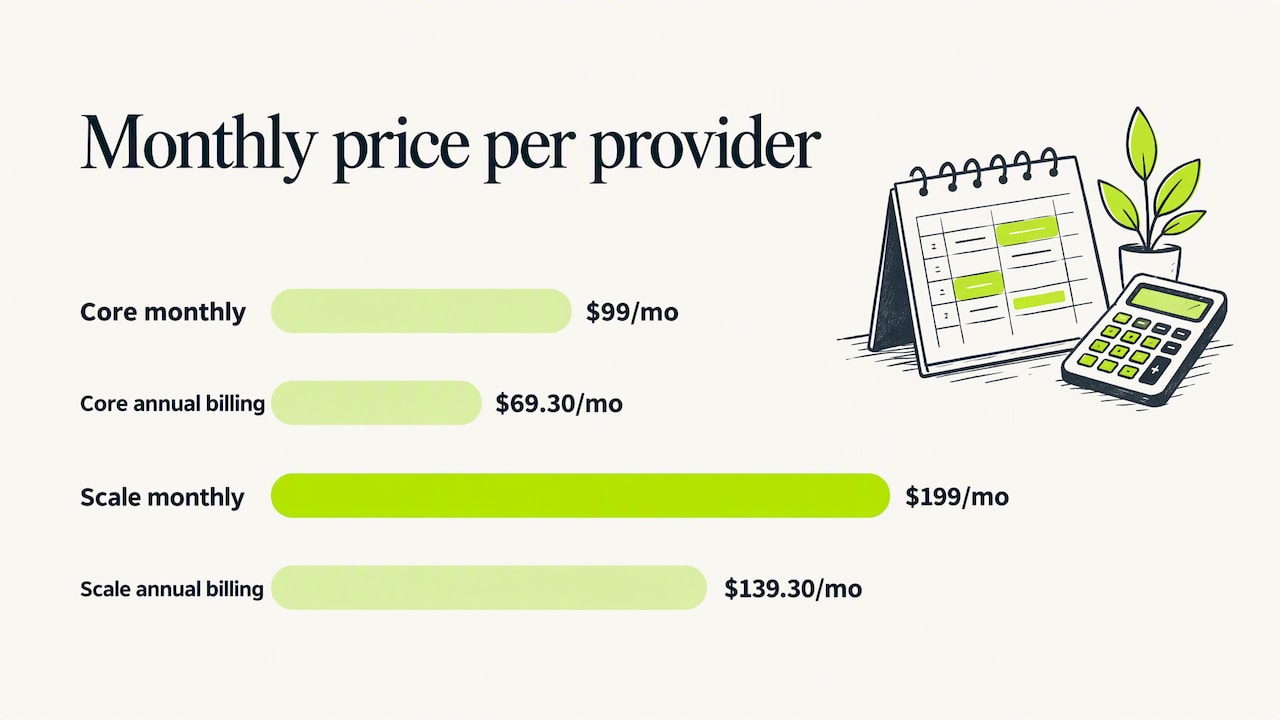
Pricing is per provider, and every plan has unlimited patients. The Trial plan is $0 for 15 days. Core is $99 per provider a month, or $69.30 a month billed annually ($831.60 a year). Scale is $199 per provider a month, or $139.30 a month billed annually ($1,671.60 a year). Annual billing is 30% off. Enterprise is custom pricing. Details are on the pricing page.

Run your longevity clinic on one system
- AI lab extraction with provider review
- Your ranges, every result as a trend
- Memberships through your own Stripe
15-day free trial. BAA on request.
Sources
- WHO: Ethics and governance of artificial intelligence for health
- npj Digital Medicine: Scaling enterprise AI in healthcare
- Joint Commission: The Responsible Use of AI in Healthcare
- FUTURE-AI international consensus guideline
- National Health Law Program: 1557 Final Rule and algorithm bias
- McDermott: Section 1557 patient care decision support tools
- Frontiers in Medicine: EU and US regulatory approaches to AI in health