
On this page
Key takeaways
- In ONC's 2011 explainer, an EMR is a digital version of the paper chart inside one practice, and an EHR is built to share information beyond it, including with patients.
- In everyday use the terms overlap: a federal glossary lists electronic medical record as another name for an EHR.
- Since the 21st Century Cures Act, sharing electronic health information is the expected norm, and information blocking rules apply to health care providers as well as to health IT developers.
- For a cash-pay longevity clinic, the better test is practical: do lab results become structured data, can you set your own ranges, and can patients see their results under your brand?
EHR vs EMR: the short answer
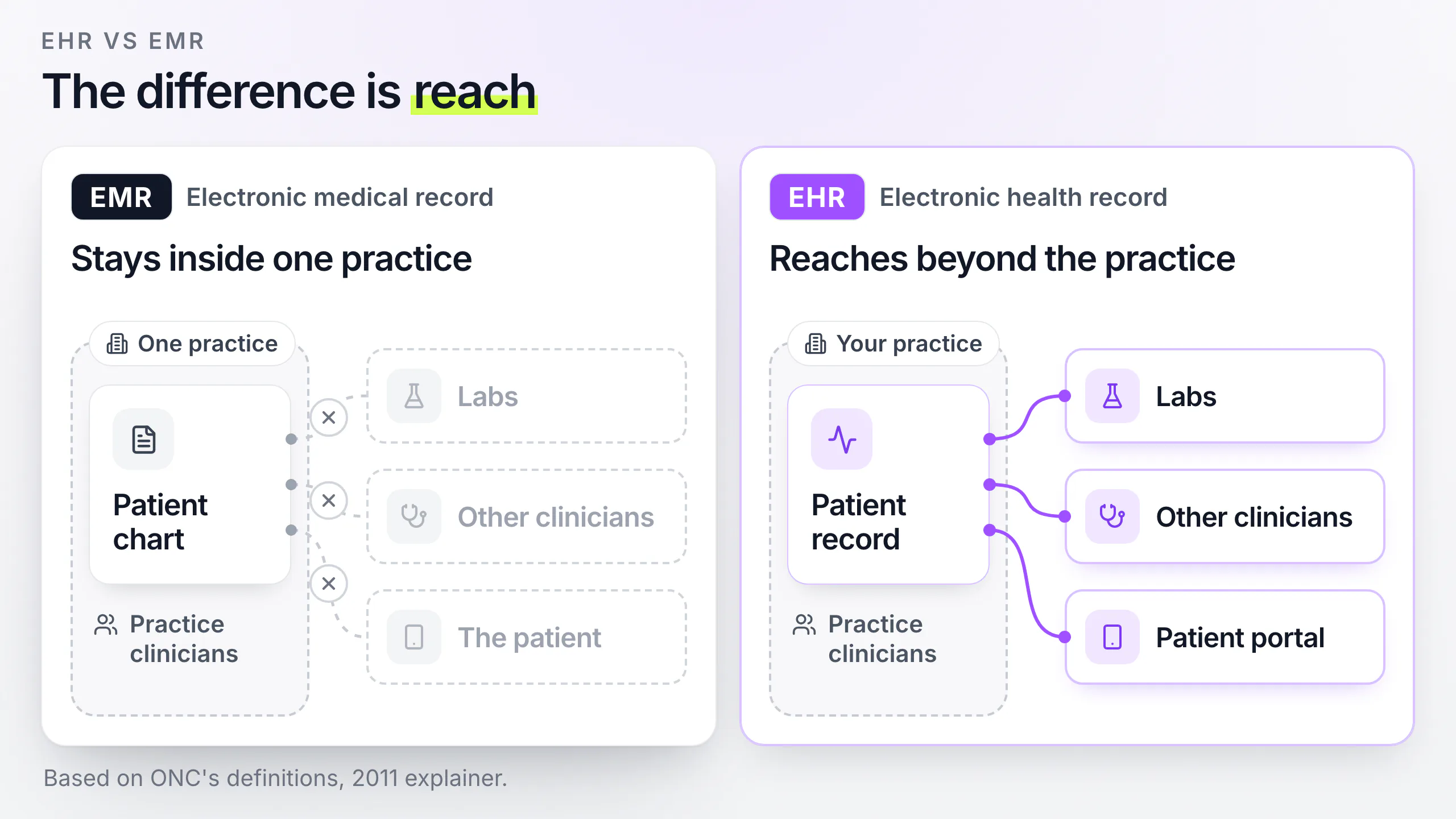
EHR vs EMR is mostly a question of reach. An electronic medical record (EMR) is the digital version of the chart a practice keeps for its own use. An electronic health record (EHR) holds the same clinical information but is designed to travel: to labs, to other clinicians and to the patient.
That is the distinction the Office of the National Coordinator for Health Information Technology (ONC) drew in a 2011 explainer, and it still holds as a way to judge software. In daily use the line is blurry. Vendors use both terms, and a federal glossary from the eCQI Resource Center lists "electronic medical record" as one of the other names for an EHR.
What is an EMR?
ONC describes an EMR as a digital version of the paper charts in a clinician's office. It holds the medical and treatment history of patients within one practice, and it is used mainly by that practice's own clinicians for diagnosis and treatment.
Moving from paper to an EMR still brings real benefits. According to ONC, an EMR lets clinicians:
- Track data over time.
- Identify patients who are due for preventive screenings or checkups.
- See how patients are doing on measures such as blood pressure readings or vaccinations.
- Monitor and improve the overall quality of care within the practice.
The limitation ONC points to is portability. Information in an EMR does not travel easily out of the practice. If a specialist needs it, the record may still be printed and mailed, which makes it, in ONC's words, not much better than a paper record for that purpose.
What is an EHR?
The eCQI Resource Center, a federal glossary hosted on healthit.gov, defines an EHR as a digital record of a patient's health information created over time, from one or more visits and across care settings. ONC adds the part that separates it from an EMR: an EHR is built to share information with other health care providers, such as laboratories and specialists, and it is designed to be accessed by everyone involved in the patient's care, including the patient.
In other words, an EHR does everything an EMR does and focuses on the patient's total health, not only the data collected in one office. A lab result can arrive from outside, a clinician at another organization can see the relevant history, and the patient can read their own results.
Where a patient portal fits
A patient portal is a common way to meet the patient-access part of the definition. It is where patients read their own results, notes and plans without calling the front desk.
The difference between EHR and EMR, side by side
| EMR | EHR | |
|---|---|---|
| What it is | A digital version of one practice's paper chart | A record of the patient's health across visits and care settings |
| Who uses it | The clinicians in that practice | Every authorized clinician involved in the patient's care, and the patient |
| Sharing | Does not travel easily outside the practice | Built to share with labs, specialists and other providers |
| Patient access | Not part of the definition | Designed in, often through a patient portal |
| Typical use of the term today | Often used loosely for any clinical charting system | The term used by federal health IT programs |
The practical takeaway: when you compare systems, treat "EHR" as a set of capabilities to check, not a category you can take on trust.
Why the line has blurred, and what still matters
Two federal developments pushed the whole market toward the EHR side of the definition.
Certification
The ONC Health IT Certification Program, launched in 2010, certifies health IT against criteria adopted by HHS. ONC describes it as a voluntary program. Use of certified health IT is required by the CMS Promoting Interoperability Programs (formerly the Medicare and Medicaid EHR Incentive Programs), and ONC notes that other government and non-government programs have adopted it too. If your clinic is cash-pay, check whether any program you take part in requires certified technology before you treat certification as a must-have or a non-issue.
Information blocking
In 2016, the 21st Century Cures Act made sharing electronic health information the expected norm in health care. ONC defines information blocking as a practice likely to interfere with the access, exchange or use of electronic health information, except as required by law or covered by an exception. The rules apply to health care providers, to developers of certified health IT and to health information exchanges and networks.
For a clinic owner, the direction is clear: the rules favor patients getting access to their own information. A system that keeps everything behind the front desk is an EMR in the old sense, whatever it calls itself.
What a longevity clinic needs from an EHR
A cash-pay longevity, functional or concierge practice runs on its own loop: a lab result arrives, it is read against the clinic's ranges, it changes the plan, and the next result shows whether the plan worked. Measured against that loop, these are the questions that matter:
- Lab results as data. Can results from any lab become structured values, or does someone retype them? See how AI lab extraction handles a PDF from any lab.
- Your own ranges. Can you grade results against ranges your clinic sets, per sex, instead of only the lab's reference interval? Our guide to optimal vs reference ranges covers why this matters.
- Trends, not snapshots. Does every value join a trend you can show the patient? See biomarker tracking.
- Plans that follow results. Can a care plan be built from your templates and updated as new results arrive?
- Patient access under your brand. Can patients see their results, notes and plans in a portal that carries your logo and colors?
- The business side. Can patients pay for memberships, bundles and one-off services through your own payment account, with no insurance billing to configure?
- The basics. Roles and permissions, an audit trail, HIPAA compliance and a BAA.
If your clinic prescribes or orders labs, ask how the system handles both today and what is on the roadmap. A clear answer about what is live and what is still in development is worth more than a long feature list.
Where LongevityEHR fits
LongevityEHR is a standalone EHR and white-label patient portal for cash-pay longevity, functional medicine, concierge and hormone optimization clinics. It is built around the loop above: upload a lab PDF or image, review the extracted values, release them to the patient, and follow them as trends against your own ranges. Care plans, SOAP notes, intake forms, scheduling with video visits, and memberships and payments through your clinic's own Stripe account run in the same system.
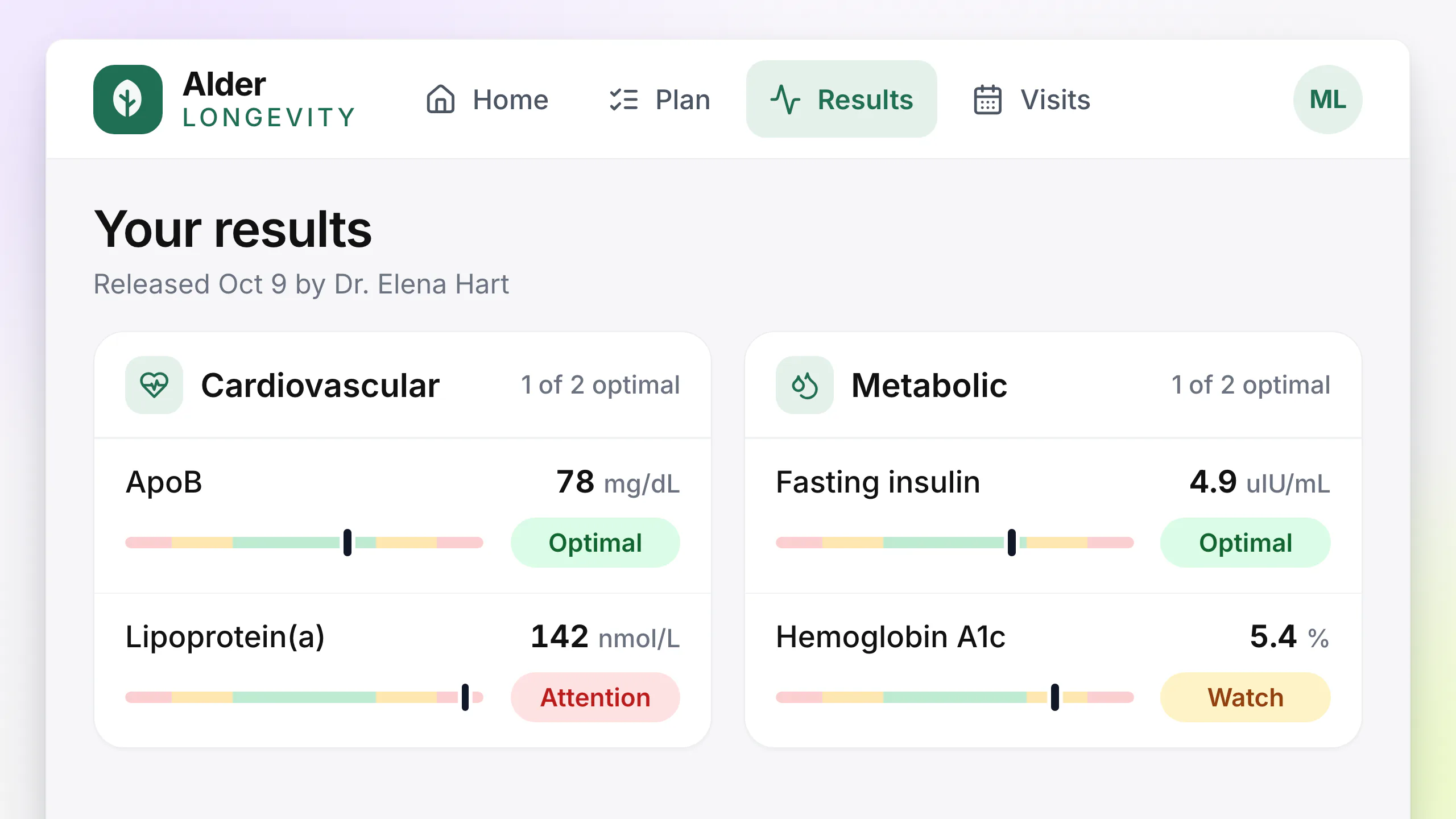
On the patient-access side of ONC's definition, lab results, care plans, forms and appointments appear in a white-label patient portal under your logo. Results from any lab come in by upload today. Lab ordering and e-prescribing are in development and not yet available.
If you are comparing systems for a longevity practice, our page on the EHR for longevity clinics walks through the full workflow, and pricing is published per provider with unlimited patients.

Run your longevity clinic on one system
- AI lab extraction with provider review
- Your ranges, every result as a trend
- Memberships through your own Stripe
15-day free trial. BAA on request.
Sources
- ONC, EMR vs EHR: What is the Difference? (Garrett and Seidman) (accessed October 21, 2026)
- eCQI Resource Center, Electronic health record (EHR) (accessed October 21, 2026)
- ONC, About the ONC Health IT Certification Program (accessed October 21, 2026)
- ONC, Information Blocking (accessed October 21, 2026)