
On this page
- Is there a board certification in longevity medicine?
- How to judge a longevity medicine credential
- A4M certification and the Fellowship in Longevity Medicine
- AMMG Certification in Age Management Medicine
- Shorter longevity medicine courses
- Adjacent boards worth knowing about
- Longevity medicine training paths compared
- From training to a running longevity practice
Key takeaways
- None of the 24 ABMS Member Boards offers a certificate in longevity, anti-aging, functional or integrative medicine. Geriatric Medicine and Preventive Medicine are the closest ABMS-recognized areas.
- ABAARM, from the American Academy of Anti-Aging Medicine (A4M), is a private board certification with a written exam, an oral exam and a set of eligibility requirements for MD and DO physicians.
- A4M's Fellowship in Longevity Medicine is a five-module program. A4M states that the fellowship requires ABAARM and ABAAHP certification testing.
- Other paths include AMMG's Certification in Age Management Medicine, free online courses with a certificate of completion, and adjacent boards in obesity, lifestyle and integrative medicine.
- Program details change often. Confirm current requirements, fees and dates with each provider before you enroll.
Is there a board certification in longevity medicine?
Not from the American Board of Medical Specialties (ABMS). ABMS has 24 Member Boards, which certify physicians in 38 specialties and 90 subspecialties. None of those certificates is in longevity, anti-aging, functional or integrative medicine. So when a program offers a longevity medicine certification, it is a credential issued by a professional society or a private organization, not an ABMS specialty certificate.
That does not make those credentials worthless. It means you should judge each one on what it actually requires: who can apply, how knowledge is assessed, whether the education is CME-accredited, and what it takes to keep the credential.
The closest ABMS-recognized areas
- Geriatric Medicine. A subspecialty certificate offered by both the American Board of Internal Medicine and the American Board of Family Medicine.
- Preventive Medicine. Its own ABMS Member Board, the American Board of Preventive Medicine.
Longevity training from the programs below sits on top of your primary specialty, not in place of it. If you want to understand the field itself before choosing a credential, start with our guide on what longevity medicine is.
How to judge a longevity medicine credential
Before you compare programs, decide what you need the credential to do. A structured curriculum, a credential to show patients and a peer network are different goals, and different programs serve them. These questions help:
- Who issues it? A society, a private company or a university. Check whether the issuer also sells the review materials and events the credential requires.
- Who is eligible? Some programs are open only to MD and DO physicians, others to nurse practitioners, physician assistants, pharmacists and other licensed clinicians.
- How is knowledge assessed? A proctored written exam, an oral case exam, a chart review, or only course completion.
- Is the education CME-accredited? If you need credits, confirm the accreditation for the specific courses you will take.
- What does it take to keep it? Membership, annual fees, conference attendance and ongoing CME are common maintenance requirements.
- What does it not change? A credential does not change your scope of practice. Your license does.
A4M certification and the Fellowship in Longevity Medicine
The American Academy of Anti-Aging Medicine (A4M) offers two board certification tracks and a fellowship. When people say A4M certification, they usually mean the physician track, ABAARM.
ABAARM: for MD and DO physicians
The American Board of Anti-Aging and Regenerative Medicine (ABAARM) offers board certification to physicians with MD or DO degrees. The process has three parts:
- Part I, written exam. 120 multiple choice questions over 3 hours, focused on diagnostic and therapeutic interventions, nutritional therapies, pharmaceuticals, endocrinology, neurophysiology and cancer. A4M's content outline also covers cardiovascular disease, cognitive and neurodegenerative disease, metabolic disease and the mechanisms of aging.
- Part II, oral exam. A live interview with one or two examiners on a standardized mock case, lasting 40 to 60 minutes. It must be taken on a separate date and at a separate venue from the written exam, within two years of passing it.
- Part III, eligibility requirements. Submitted within 6 months of passing the oral exam.
The Part III requirements listed by A4M include:
- A4M membership and attendance at 2 or more A4M approved or sponsored conferences or live events.
- An MD or DO degree from an accredited medical school and an active medical license.
- No significant disciplinary actions, or a written appeal with full disclosure.
- A CV showing at least 5 years of clinical practice (residency training counts).
- At least 200 hours of CME in the past 8 years related to clinical practice and metabolic, nutritional, anti-aging or diagnostic medicine.
- Five multiple choice exam questions with referenced answers, and 6 patient charts for board review.
A physician who passes the written exam can use the title "Diplomate" while a current A4M member. The title "Board Certified" in Anti-Aging Medicine comes only after the oral exam and the remaining requirements. Keeping the certification requires A4M membership in good standing and an annual credentialing fee. A4M's own FAQ says it hopes a growing number of certified physicians will help it achieve formal subspecialty recognition, which confirms that recognition does not exist today.
ABAAHP: for other health practitioners
The American Board of Anti-Aging Health Practitioners (ABAAHP) is A4M's track for qualified non-physician practitioners, such as DCs, dentists, NDs, pharmacists, NPs, PAs, RNs and PhDs. It uses a review kit, a written exam and CME or CEU requirements, and leads to Diplomate status.
The A4M longevity medicine fellowship
A4M's Fellowship in Longevity Medicine is built on five core modules:
- Module I: Endocrine and Cardiometabolic Mastery.
- Module II: Neurovascular and Metabolic Synergy.
- Module III: Frontiers in Brain-First Longevity: Environmental Triggers, Neuroprotection and Detox.
- Module IV: Gastro-Nutritional Strategies for Longevity.
- Module V: Clinical Protocols: A Systems Biology Approach in Longevity Medicine (listed as non-CME).
Modules I to IV are listed with in-person and on-demand options, and Module V in person. A4M states that the fellowship requires ABAARM and ABAAHP certification testing. A4M did not publish fellowship or exam fees on the pages we reviewed, so ask an A4M advisor for current pricing.
AMMG Certification in Age Management Medicine
The Age Management Medicine Group (AMMG) offers a Certification in Age Management Medicine, with up to 45 AMA PRA Category 1 Credits for participants who complete all requirements. The program has three modules:
- Module I: online self-study in the essential knowledge of age management medicine, ending in a proficiency exam. Topics include patient evaluation and lab testing, nutrition, fitness and exercise, hormone optimization and therapies, supplementation, stress management and preventive medicine protocols.
- Module II: two days of live lectures and case studies on advanced topics.
- Module III: a comprehensive web-based, case-focused final exam.
AMMG also requires current membership and 45 hours at AMMG educational conferences, of which up to 15 can be designated online courses. The registration package includes attendance at 3 AMMG conferences and a 2-year membership. Graduates can use AMMG's certification logo while they remain active members.
Shorter longevity medicine courses
If you want the science before you commit to a credential, a short longevity medicine course is a low-cost place to start. One example is Longevity Medicine 201 from the Longevity Education Hub, created by Alex Zhavoronkov, PhD, and Evelyne Bischof, MD, PhD. It is free, runs about 3 hours across 16 lectures, and issues a certificate of completion after a final graded test. It covers theories and hallmarks of aging, biomarkers of aging and aging clocks, longevity pathways and geroprotective interventions.
A certificate of completion shows you finished a course. It is not a certification, and it is fair to describe it that way to patients.
Adjacent boards worth knowing about
Much of what longevity clinics do overlaps with fields that have their own certifying boards. None of these is an ABMS Member Board, but each publishes its own eligibility rules and certification exam.
- Obesity medicine (ABOM). Certifies physicians trained and practicing in the US or Canada who already hold ABMS or osteopathic board certification. Candidates qualify through a CME pathway (60 credits) or an obesity medicine fellowship, and the exam is offered once a year at Pearson VUE centers.
- Lifestyle medicine (ABLM). Certifies physicians in lifestyle medicine through experiential and educational pathways, and also manages exams for PhD and master's level health professionals.
- Integrative medicine (ABOIM). Offered through the American Board of Physician Specialties to MD and DO physicians who completed an accredited residency, hold board certification and finished an approved integrative medicine fellowship or another accepted training option.
- Functional medicine (IFM). The Institute for Functional Medicine's certification program is open to physicians and other licensed clinicians. Our functional medicine certification guide covers it in detail.
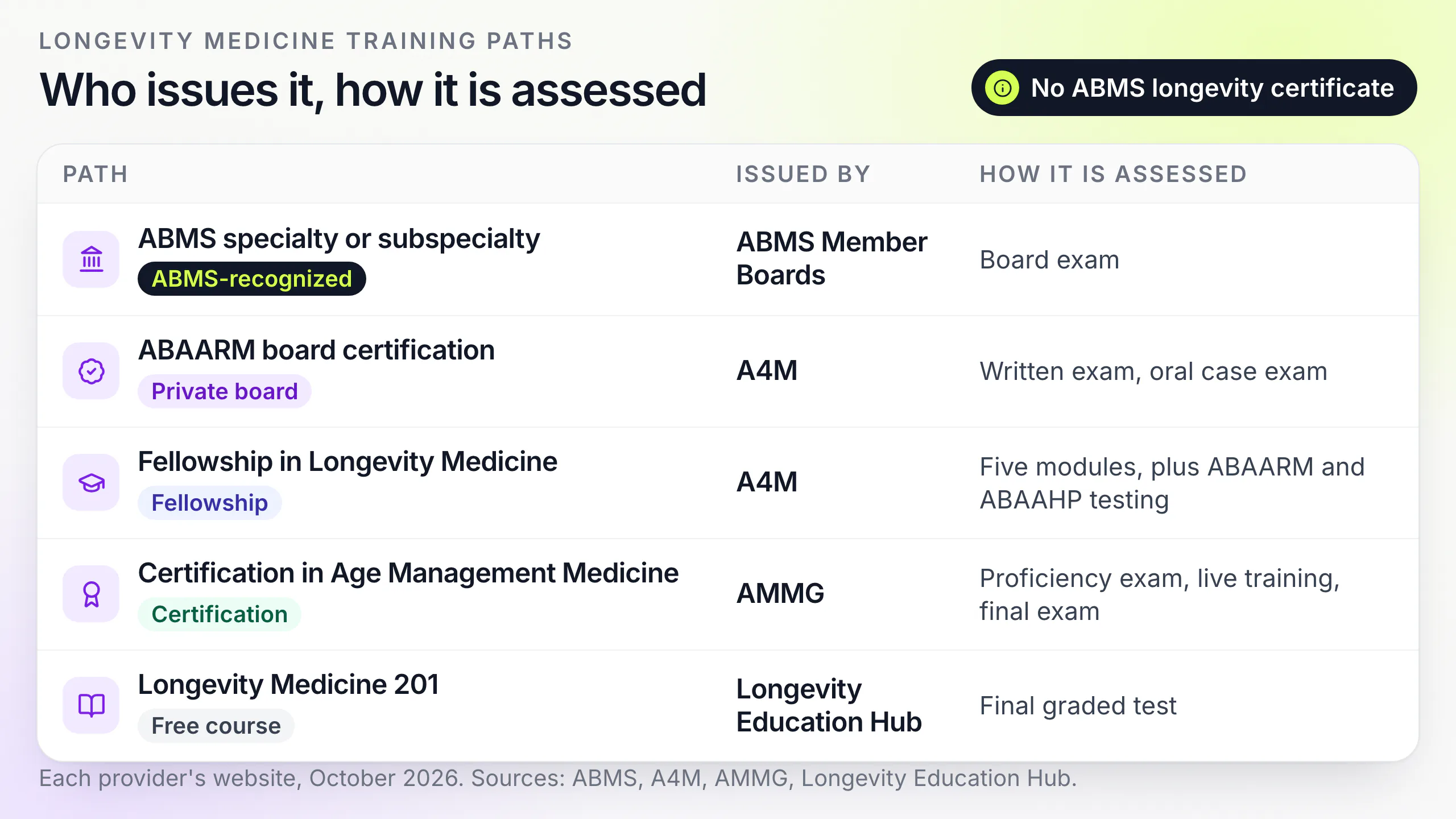
Longevity medicine training paths compared
| Path | Issued by | Who can apply | How it is assessed |
|---|---|---|---|
| ABMS specialty or subspecialty (e.g. Geriatric Medicine) | ABMS Member Boards | Physicians completing accredited training | Board exam |
| ABAARM board certification | A4M | MD and DO physicians | Written exam, oral case exam, charts and requirements |
| ABAAHP Diplomate | A4M | Non-physician health practitioners | Written exam and requirements |
| Fellowship in Longevity Medicine | A4M | See A4M for eligibility | Five modules plus ABAARM and ABAAHP testing |
| Certification in Age Management Medicine | AMMG | See AMMG for eligibility | Proficiency exam, live training, final exam |
| Longevity Medicine 201 | Longevity Education Hub | Physicians (free course) | Final graded test, certificate of completion |
From training to a running longevity practice
Every one of these programs teaches what to measure and how to read it. None of them sets up the operation that turns that knowledge into a practice: lab panels coming back from different labs, ranges your clinic decides on, plans that change when results change, and a patient who can see all of it.
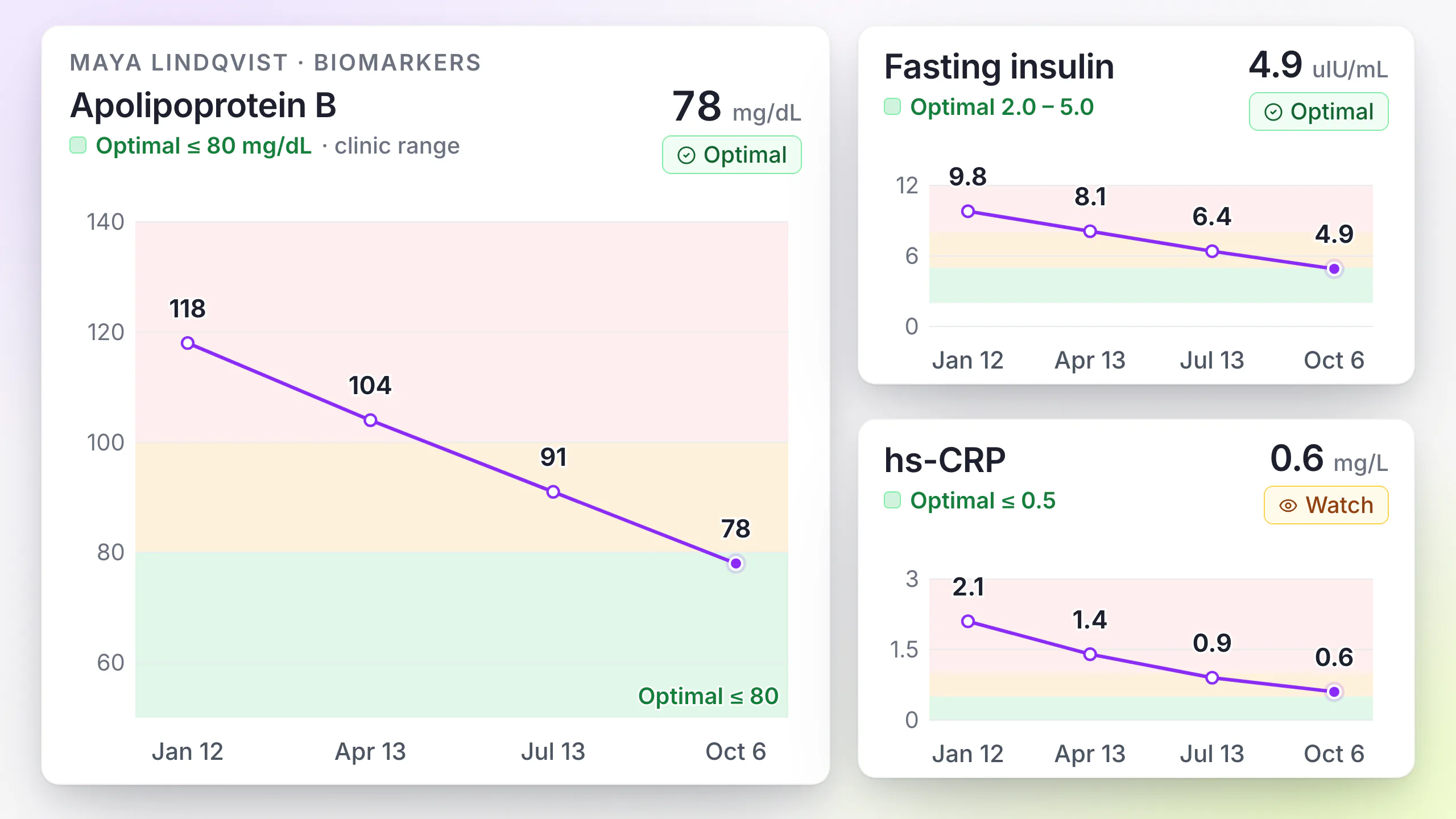
That is the part software has to carry. LongevityEHR is a standalone EHR built for it. You upload a lab PDF and AI lab extraction turns it into structured values for your team to review. Results are graded against ranges your clinic defines and followed as biomarker trends. Care plans come from your templates and are personalized per patient, and everything released appears in a portal under your brand.
If you are building the practice alongside your training, our guide on how to start a longevity clinic covers the model, team, testing and pricing decisions in order.

Run your longevity clinic on one system
- AI lab extraction with provider review
- Your ranges, every result as a trend
- Memberships through your own Stripe
15-day free trial. BAA on request.
Sources
- ABMS, Member Boards (accessed October 21, 2026)
- ABMS, Specialty and Subspecialty Certificates (accessed October 21, 2026)
- A4M, ABAARM Board Certification (accessed October 21, 2026)
- A4M, ABAARM Requirements (accessed October 21, 2026)
- A4M, ABAARM Written Exam Information (accessed October 21, 2026)
- A4M, ABAARM Frequently Asked Questions (accessed October 21, 2026)
- A4M, ABAARM and ABAAHP Board Certification (accessed October 21, 2026)
- A4M, Fellowship in Longevity Medicine (accessed October 21, 2026)
- A4M, International Programs and Certifications (accessed October 21, 2026)
- Age Management Medicine Group, Certification in Age Management Medicine (accessed October 21, 2026)
- Longevity Education Hub, Longevity Medicine 201 (accessed October 21, 2026)
- American Board of Obesity Medicine (accessed October 21, 2026)
- American Board of Lifestyle Medicine (accessed October 21, 2026)
- American Board of Physician Specialties, Integrative Medicine (ABOIM) (accessed October 21, 2026)