
On this page
Key takeaways
- Lp(a) levels are more than 90% genetically determined, according to the 2022 EAS consensus statement.
- The EAS and the NLA both recommend measuring Lp(a) at least once in adults.
- Major sources use paired cut-offs of 30 mg/dL (75 nmol/L) and 50 mg/dL (125 nmol/L), but they are risk categories, not a conversion.
- mg/dL and nmol/L are not interchangeable. The EAS panel does not recommend a standard factor to convert between them.
- What it measures
- Lipoprotein(a), an LDL-like particle that carries apolipoprotein(a) and one apoB-100
- Sample
- Blood draw. The EAS lists no effect of fasting on Lp(a)
- Common units
- nmol/L (molar) or mg/dL (mass). Not interchangeable
- How often
- At least once in adults, per the 2022 EAS statement and the 2024 NLA update
- Main guideline references
- EAS consensus statement 2022, NLA focused update 2024, 2018 AHA/ACC cholesterol guideline
What lipoprotein(a) is
Lipoprotein(a), written Lp(a), is a lipoprotein particle that carries one apoB-100 molecule, like LDL, plus a second protein called apolipoprotein(a). Its cholesterol is reported as part of a standard LDL-C result, so a routine lipid panel does not show it separately. An Lp(a) test measures it directly.
The 2022 European Atherosclerosis Society (EAS) consensus statement describes Lp(a) as predominantly determined by genetics (more than 90%), more than any other lipoprotein. Adult levels are usually reached by about age 5 and may rise until adulthood. In men they stay relatively constant. In women they tend to rise at menopause.
Levels also differ by ancestry. The EAS statement cites UK Biobank medians of 16, 19, 31 and 75 nmol/L in people of Chinese, White, South Asian and Black ancestry respectively. The 2024 National Lipid Association (NLA) update estimates that about 1 in 5 people have high Lp(a), and notes that measurement rates are low.
Who gets an Lp(a) test, and how often
- EAS 2022: Lp(a) should be measured at least once in adults. Repeat measurement is not required because it does not improve risk prediction, with exceptions that include kidney or liver disease and acute infections.
- NLA 2024: the evidence supports measuring Lp(a) at least once in every adult for risk stratification, and cascade screening of first-degree relatives of patients with high Lp(a).
- AHA/ACC 2018: a family history of premature ASCVD is a relative indication for measuring Lp(a).
Because the result is usually a one-time number, it is easy to lose. A value from years ago sitting in a scanned PDF does nobody any good at the next visit. That is the practical case for keeping it in a structured field rather than an attachment.
Lp(a) levels: the cut-offs each source uses
The EAS stresses that the link between Lp(a) and cardiovascular risk is continuous. The cut-offs below are pragmatic categories, and each source asks clinicians to read them alongside the patient's overall risk.
| Source | Lower category | Middle category | Higher category |
|---|---|---|---|
| EAS 2022 | Rule out: below 30 mg/dL or below 75 nmol/L | Grey zone: 30 to 50 mg/dL, 75 to 125 nmol/L | Rule in: above 50 mg/dL or above 125 nmol/L |
| NLA 2024 | Low risk: below 75 nmol/L (30 mg/dL) | Intermediate: 75 to 125 nmol/L (30 to 50 mg/dL) | High risk: 125 nmol/L (50 mg/dL) or higher |
| AHA/ACC 2018 | Not defined | Not defined | Risk-enhancing factor: 50 mg/dL or higher, or 125 nmol/L or higher |
The EAS adds a higher marker: levels above 180 mg/dL or above 430 nmol/L identify people whose lifetime ASCVD risk is equivalent to untreated heterozygous familial hypercholesterolemia.
Why mg/dL and nmol/L are not interchangeable
Lp(a) can be reported as a mass (mg/dL) or as a particle concentration (nmol/L). The two do not map onto each other with a fixed factor, because apolipoprotein(a) comes in many sizes. Its structure varies in the number of repeated segments, called kringle IV repeats, so particles of different sizes carry different mass.
The EAS panel states it does not recommend using a standard factor to convert between mg/dL and nmol/L, because assays vary extensively. It calls a factor of 2 to 2.5 a best guess where both units are in use. It also notes that assays based on polyclonal antibodies cannot report molar units and may overestimate or underestimate Lp(a) depending on isoform size. Its recommendation is to measure in molar units when available, with assays traceable to official reference materials.
What this means in practice
- Record the value in the unit the laboratory reported it in.
- Do not convert a patient's historical result to compare it with a new one in a different unit.
- Read the paired guideline cut-offs (for example 50 mg/dL and 125 nmol/L) as two parallel categories, not as proof that 50 mg/dL equals 125 nmol/L for a given patient.
- If a patient's results switch units or laboratories, treat the new value as the start of a separate series.
How Lp(a) relates to ApoB and LDL-C
Every Lp(a) particle carries one apoB molecule, so Lp(a) particles are counted inside an ApoB test. Their cholesterol is also included in reported LDL-C. The EAS panel does not recommend routinely correcting LDL-C for Lp(a) cholesterol.
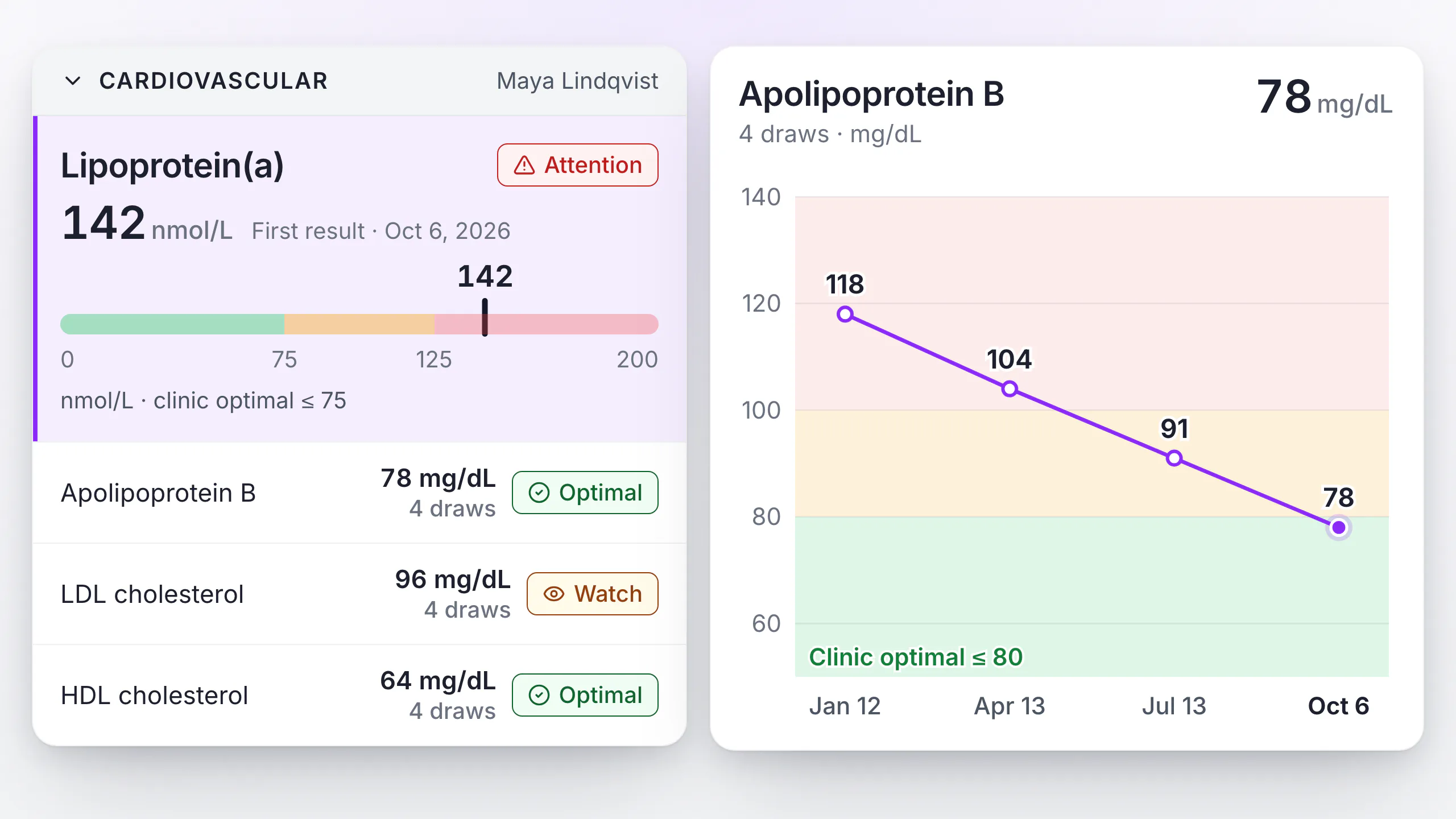
For a clinic, the practical point is that Lp(a) answers a different question from the rest of the lipid panel. ApoB and LDL-C are followed across draws. Lp(a) is usually measured once and carried forward as context.
Keeping Lp(a) results straight in LongevityEHR
LongevityEHR is an EHR for cash-pay longevity, functional and concierge clinics. It does not interpret Lp(a) or recommend treatment. It is built to keep the number, its unit and the clinic's reading of it intact.
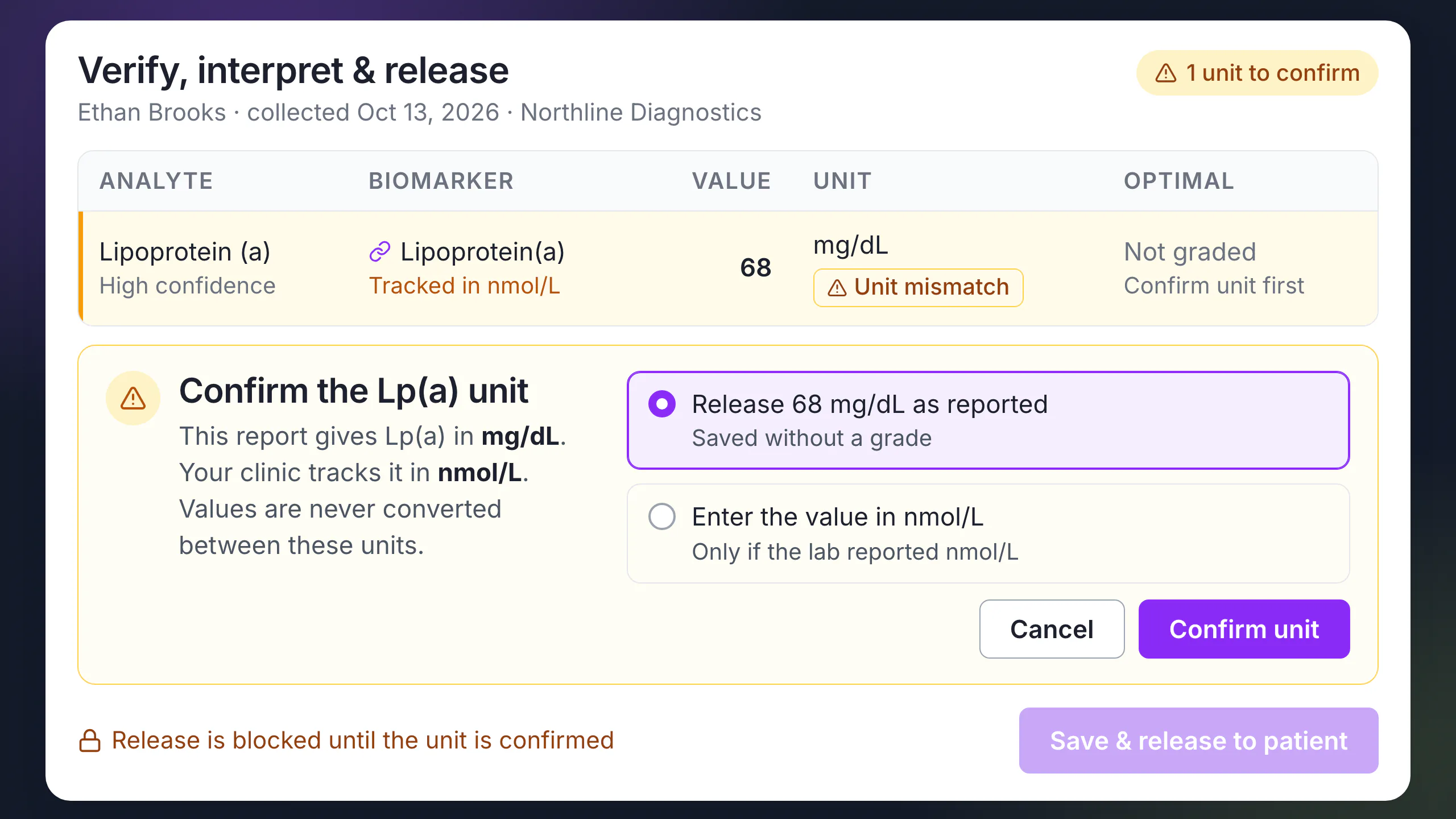
- Units are never converted. When AI lab extraction reads an Lp(a) value whose unit does not match the unit your clinic tracks, it flags the mismatch. Release is blocked until a provider confirms, and the value releases unclassified rather than graded against the wrong band.
- A unit change splits the trend. If a patient's Lp(a) arrives in a different unit later, the trend shows a visible split with the unit labeled on each segment. Values are never mixed on one axis.
- Your clinic's bands. The clinic owner sets optimal, borderline and critical bands for Lp(a), per sex if needed. See biomarker tracking.
- Review before release. Extracted results wait for your team. Extracted values reach the patient portal only after a provider releases them.
- History stays as it was. Each released value keeps a snapshot of the range that applied that day, even if you change the band later.
If you are deciding where to draw your own bands, our guide to optimal vs reference ranges covers how to document them and who in the clinic should own them.

Run your longevity clinic on one system
- AI lab extraction with provider review
- Your ranges, every result as a trend
- Memberships through your own Stripe
15-day free trial. BAA on request.
Sources
- Kronenberg F, Mora S, Stroes ESG, et al. Lipoprotein(a) in atherosclerotic cardiovascular disease and aortic stenosis: a European Atherosclerosis Society consensus statement. Eur Heart J. 2022;43(39):3925-3946 (accessed October 21, 2026)
- Koschinsky ML, Bajaj A, Boffa MB, et al. A focused update to the 2019 NLA scientific statement on use of lipoprotein(a) in clinical practice. J Clin Lipidol. 2024;18(3):e308-e319 (accessed October 21, 2026)
- Grundy SM, Stone NJ, Bailey AL, et al. 2018 AHA/ACC/AACVPR/AAPA/ABC/ACPM/ADA/AGS/APhA/ASPC/NLA/PCNA Guideline on the Management of Blood Cholesterol. Circulation. 2019;139(25):e1082-e1143 (accessed October 21, 2026)
- Soffer DE, Marston NA, Maki KC, et al. Role of apolipoprotein B in the clinical management of cardiovascular risk in adults: an expert clinical consensus from the National Lipid Association. J Clin Lipidol. 2024;18(5):e647-e663 (accessed October 21, 2026)
This page is educational content for clinicians and clinic operators. It is not medical advice and does not replace clinical judgment. Ranges and thresholds vary by laboratory, method and guideline.