
On this page
- What you are building when you open a longevity clinic
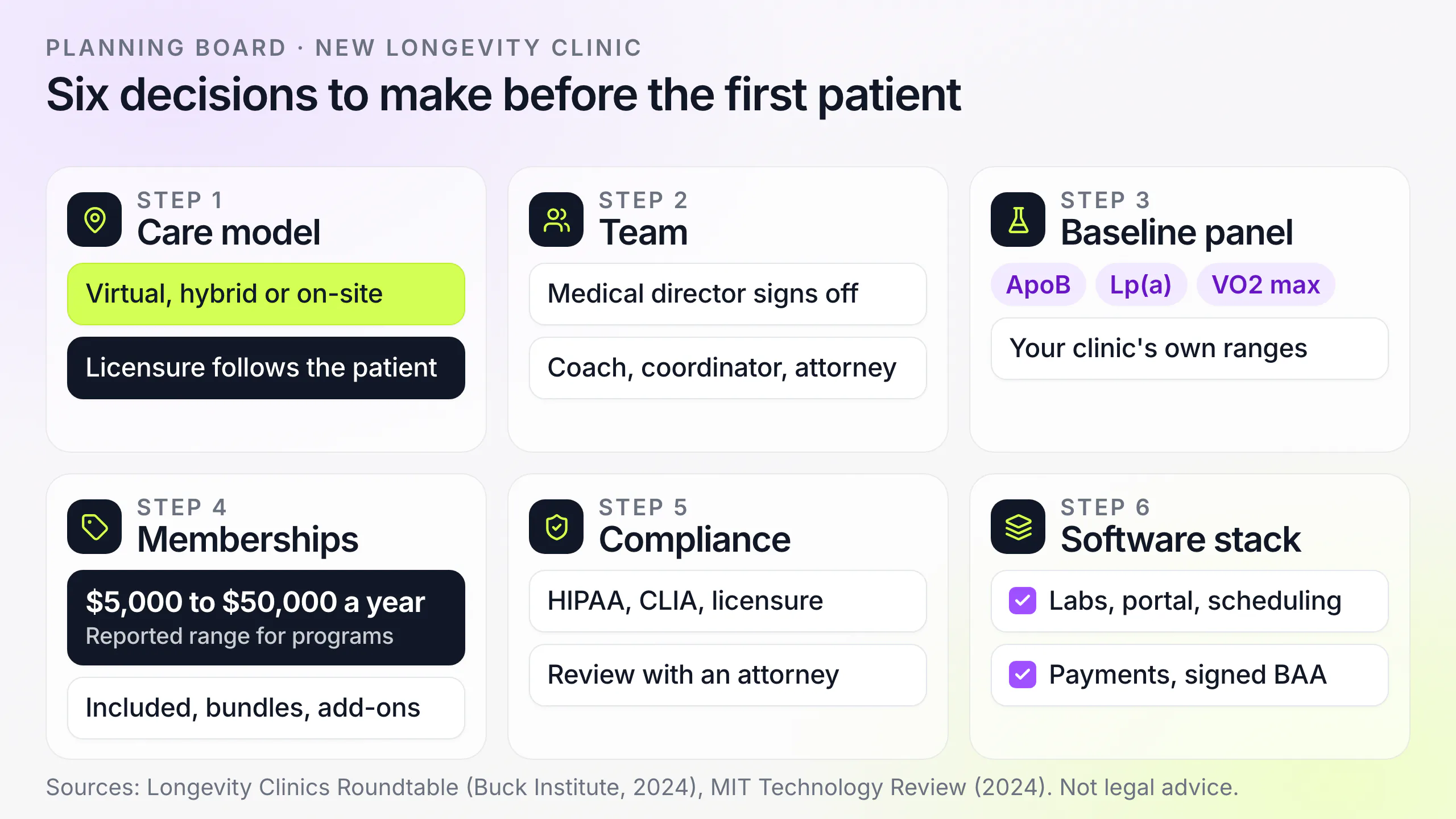
- Choose a care model: virtual, hybrid or on-site
- Clinical leadership and the team you need
- Design the diagnostics program
- Pricing and memberships
- Compliance: HIPAA, state rules and the questions to take to counsel
- Longevity clinic startup costs and the path to profit
- Choose the software stack before you see your first patient
Key takeaways
- Decide the care model first (virtual, hybrid or on-site). It drives licensure, staffing, testing logistics and cost.
- Ownership and clinical control are state questions. Corporate practice of medicine rules, scope of practice for nurse practitioners and telehealth licensure all vary, so budget for a healthcare attorney before you sign leases or contracts.
- Build the program around a repeatable loop: baseline assessment, a written plan, re-testing and review. That loop is what patients renew for.
- There is no reliable public benchmark for longevity clinic startup costs, and only 39% of clinics in a 2025 industry survey said they were turning a profit. Model your own numbers conservatively.
What you are building when you open a longevity clinic
If you want to know how to start a longevity clinic, start with a definition, because the field does not have a settled one. A 2024 white paper from the first Longevity Clinics Roundtable, hosted by the Buck Institute, says healthy longevity medicine aims to optimize health by counteracting aging processes across the lifespan, and admits that consensus on what a longevity clinic is has not been reached. For a fuller picture of the field, read our guide to what longevity medicine is.
In practice, the same white paper describes a common pattern: a comprehensive baseline assessment, a personalized action plan, and re-testing to see whether the plan worked, sometimes with health coaching or a longer program of regular check-ins. MIT Technology Review reported in 2024 that testing sessions at many clinics take four to six hours and can include blood work, body composition, VO2 max and cognitive assessments.
That pattern matters for your business plan. Patients do not buy a single visit. They buy a cycle of measurement, a plan and follow-up, usually through a membership. Everything below (team, testing, pricing, software) should serve that cycle.
Choose a care model: virtual, hybrid or on-site
The care model is the first real decision in a longevity clinic business plan. It sets where your clinicians need licenses, how labs get drawn, how much space you lease and how many patients one provider can follow.
| Model | How it works | What to plan for |
|---|---|---|
| Virtual | Video visits, labs drawn at a commercial draw site or at home, results reviewed remotely. | Licensure in every state where patients are located, a reliable lab draw network, and a strong patient portal because the portal is the clinic. |
| Hybrid | An in-person baseline assessment, then follow-ups by video between re-tests. | Space for the baseline visit, scheduling across visit types, and a clear rule for which visits must be in person. |
| On-site | Assessments, testing and follow-ups at your location. | Lease and build-out, equipment, CLIA requirements if you run tests in-house, and a local patient base large enough to fill the calendar. |
For virtual care, licensure follows the patient. The Federation of State Medical Boards' model telemedicine policy says a physician must be licensed by the board in the state where the patient is located at the time of care. State boards decide how to apply it, so check each state you plan to serve. The Interstate Medical Licensure Compact offers an expedited path to separate state licenses and lists 44 member states plus 2 US territories on its website.
Clinical leadership and the team you need
A longevity clinic needs a licensed clinician who owns the clinical program: which tests are offered, how results are read, which interventions are in scope and when to refer out. Whoever holds that role, often titled medical director, needs the authority to say no to a test or a treatment.
Who can own the clinic
Ownership is not only a business question. A 2025 Columbia Law Review note summarizes that most states have laws prohibiting corporations from owning healthcare practices or employing physicians, together known as the corporate practice of medicine doctrine. If a non-physician founder or investor is involved, structures such as a physician-owned practice paired with a management services organization are common, and they are exactly what a healthcare attorney should review in your state.
Scope of practice for nurse practitioners and physician assistants
Nurse practitioners can extend a small clinic's capacity, but their scope depends on the state. The American Association of Nurse Practitioners classifies states by practice environment: full practice, reduced practice (state law limits at least one element of NP practice, for example through a career-long collaborative agreement) and restricted practice (career-long supervision, delegation or team management by another provider is required). Check where your state sits before you plan staffing around NPs.
A typical starting team
- Lead clinician or medical director. Owns protocols, ranges and sign-off on results.
- Additional providers (physicians, NPs or PAs, depending on state rules) as the panel grows.
- Health coach or dietitian. Turns the plan into weekly habits and keeps patients engaged between re-tests.
- Patient coordinator. Scheduling, intake, lab logistics and membership questions.
- Outside advisors. A healthcare attorney, an accountant who knows cash-pay practices and malpractice coverage that fits your services.
Design the diagnostics program
Your baseline panel is the product patients see first. Decide which biomarkers you test at baseline, which you repeat and how often, and which ranges your clinicians will grade results against. If your clinicians want to grade results against their own target ranges rather than the lab's reference intervals, document how each range was chosen. Our explainer on optimal vs reference ranges covers how to do that carefully, and the biomarker library covers markers such as ApoB and Lp(a).
- Labs. Without in-house testing, you will rely on a commercial reference lab plus a draw site or mobile phlebotomy. Results often arrive as PDFs that someone has to get into the chart.
- In-house testing. The CDC notes that laboratory testing on human specimens for health assessment is regulated under CLIA, and that even sites running only simple waived tests need a CLIA certificate and must follow the manufacturer's instructions. Confirm requirements with your state agency before you buy analyzers.
- Imaging and advanced tests. Add them deliberately. The Roundtable white paper warns that advanced diagnostics can lead to overdiagnosis and false positives, with follow-up procedures, cost and stress for the patient.
- Biological age tests. The same white paper reports that only 47% of 51 surveyed clinics agreed that clinics should measure biological age. Treat these tests as optional and explain their limits.
Pricing and memberships
Because the care runs as a cycle, it is easiest to sell as a membership or a defined annual program rather than per visit. MIT Technology Review reported in 2024 that clinics charge $5,000 to $50,000 a year. That range is wide because programs differ: a membership built around blood work and quarterly follow-ups is a different product from one with full-body imaging and genome sequencing.
Price from your own costs and capacity, not from the market headline. List what the membership includes, what each item costs you (labs, provider time, coaching time) and how many members one provider can follow well. Then decide what is included, what is sold as a bundle and what is a one-off add-on. Our guide to longevity clinic membership pricing goes through the models and the sourced price points in detail.
Compliance: HIPAA, state rules and the questions to take to counsel
This section is a checklist of topics, not legal advice. Rules vary by state, and a healthcare attorney in each state you operate in should review your structure before you open.
- HIPAA. CMS explains that health care providers become HIPAA covered entities when they conduct standard transactions, such as claims, electronically. A strictly cash-pay clinic should confirm its status with counsel. If you are covered, HIPAA requires written business associate agreements with vendors that handle protected health information on your behalf, including your EHR.
- Corporate practice of medicine. Who may own the practice and how management fees can be structured, as covered above.
- Licensure and telehealth. Licenses in every state where your patients are located when you see them.
- Controlled substances. DEA lists testosterone among the anabolic steroids in schedule III. Telemedicine prescribing of controlled substances without a prior in-person visit currently runs on temporary DEA flexibilities, extended through December 31, 2026. Check the status before you build a virtual protocol on it.
- Laboratory testing. CLIA certification for anything you test in-house.
- Marketing claims. The FTC's health products guidance says health benefit claims need competent and reliable scientific evidence. Describe what you measure and how you follow up, and avoid promising outcomes.
- Memberships. In some states, a prepaid arrangement can raise insurance regulation questions. Ask counsel how your membership terms are treated where you operate.
Longevity clinic startup costs and the path to profit
We looked for a reliable, published figure for longevity clinic startup costs and did not find one we could stand behind. Costs depend heavily on the care model: a virtual clinic and an on-site clinic with imaging are different businesses. Build your own budget from the categories below.
| Cost category | What drives it |
|---|---|
| Legal and entity setup | Corporate practice of medicine structure, contracts, state registrations |
| Licensure and credentialing | Number of states and clinicians |
| Space and build-out | On-site or hybrid model, treatment and draw rooms |
| Equipment | In-house testing, body composition, fitness testing, imaging |
| Clinical team | Provider hours, coaching and coordination staff |
| Insurance | Malpractice and general liability for your service mix |
| Software | EHR, patient portal, scheduling, payments, video visits |
| Marketing | Patient acquisition before the panel is full |
Plan for a slow ramp. In a survey of 82 longevity clinics by Longevity.Technology, reported by MIT Technology Review in 2025, 39% said they were turning a profit, 30% were approaching breakeven and 16% were operating at a loss. A conservative model, with cash for the months before memberships fill, is the safer starting point.
Choose the software stack before you see your first patient
When you open a longevity clinic, the software decides how much of the loop runs by hand. At minimum you need a clinical record, a way to get lab results in as structured data, a patient portal, scheduling with video visits, intake forms and a way to charge memberships. Stitching separate tools together means staff time spent copying data between them and keeping them in sync.
- Can lab PDFs from any lab become structured, reviewable biomarker values without retyping?
- Can your clinicians set their own ranges per biomarker and follow each value as a trend?
- Can you build care plans from templates and personalize them per patient?
- Do patients see results, plans, forms and appointments in a portal with your brand?
- Can you sell memberships and bundles with the money going to your own account?
- Will the vendor sign a business associate agreement?
LongevityEHR was built for this checklist. It is a standalone EHR for cash-pay clinics with one to five providers: AI lab extraction with provider review, biomarker tracking against your clinic's ranges, care plans, SOAP notes, intake forms, scheduling with video visits, a white-label patient portal and memberships and payments through your clinic's own Stripe account. E-prescribing and lab ordering are in development. A BAA is available on request, and plans are listed on the pricing page.

Run your longevity clinic on one system
- AI lab extraction with provider review
- Your ranges, every result as a trend
- Memberships through your own Stripe
15-day free trial. BAA on request.
Sources
- International Institute of Longevity and Buck Institute, In search of best practices for Longevity Clinics (white paper, 2024) (accessed October 21, 2026)
- MIT Technology Review, The quest to legitimize longevity medicine (March 18, 2024) (accessed October 21, 2026)
- MIT Technology Review, Longevity clinics around the world are selling unproven treatments (April 18, 2025) (accessed October 21, 2026)
- McGuireWoods, FSMB model policy guidelines for telemedicine (2014) (accessed October 21, 2026)
- Interstate Medical Licensure Compact (accessed October 21, 2026)
- Xusong Du, Enforcing the Corporate Practice of Medicine Doctrine Through False Claim Liability, Columbia Law Review (2025) (accessed October 21, 2026)
- American Association of Nurse Practitioners, State practice environment (accessed October 21, 2026)
- CDC, Waived tests (CLIA) (accessed October 21, 2026)
- CDC, CLIA test complexities (accessed October 21, 2026)
- CMS, HIPAA covered entities (accessed October 21, 2026)
- 45 CFR 164.502(e), Disclosures to business associates (Cornell Legal Information Institute) (accessed October 21, 2026)
- DEA Diversion Control Division, Anabolic steroids drug fact sheet (accessed October 21, 2026)
- Holland & Knight, DEA and HHS extend telemedicine prescribing flexibilities through 2026 (January 13, 2026) (accessed October 21, 2026)
- Federal Trade Commission, Health products compliance guidance (accessed October 21, 2026)
- McDermott Will & Emery, Direct primary care arrangements 50-state survey (updated April 2024) (accessed October 21, 2026)