
On this page
Key takeaways
- HOMA-IR is calculated, not measured: fasting insulin in µU/mL times fasting glucose in mmol/L, divided by 22.5.
- With glucose in mg/dL, the same calculation divides by 405 instead of 22.5.
- There is no universal HOMA-IR cutoff. Published thresholds range from about 1.5 to 3.8 depending on the population and method.
- Insulin assays differ enough that the same sample can give different HOMA-IR values in different laboratories.
- What it estimates
- Insulin resistance, from fasting plasma glucose and fasting insulin
- Sample
- Fasting blood draw. Glucose and insulin come from the same sample
- Formula
- Fasting insulin (µU/mL) × fasting glucose (mmol/L) ÷ 22.5
- Unit
- A unitless index
- Main reference
- Matthews et al., Diabetologia, 1985
What HOMA-IR is
HOMA-IR stands for homeostasis model assessment of insulin resistance. It was introduced by Matthews and colleagues in 1985. Their starting point was that fasting glucose and fasting insulin settle into a steady state set by the feedback loop between them. Comparing a patient's fasting values with what a computer-solved model of that loop predicts gives an estimate of insulin resistance and of beta-cell function.
In the original paper, the HOMA estimate of insulin resistance correlated with the euglycemic clamp, a more direct and far more demanding laboratory method (Rs = 0.88). The authors also reported low precision, with a coefficient of variation of 31% for the insulin resistance estimate, and wrote that this limits its use.
So HOMA-IR is not a direct insulin resistance test. It is an estimate built from two common fasting tests, which is why it is cheap, widely used and easy to misread.
The HOMA-IR formula, with a calculator example
The form most papers use is a simple product of the two fasting values, as written for example in the EPIRCE study of a Spanish adult population:
US laboratories usually report glucose in mg/dL. One mmol/L of glucose is about 18 mg/dL, and 22.5 × 18 = 405, so the same calculation with glucose in mg/dL is fasting insulin (µU/mL) × fasting glucose (mg/dL) ÷ 405. Both lines give the same result, so a HOMA-IR calculator only needs to know which glucose unit you entered.
Working it through by hand
- Confirm both values come from the same fasting draw.
- Check the insulin unit. The formula expects µU/mL. If your laboratory reports insulin in pmol/L, ask it which conversion factor to use before calculating.
- Check the glucose unit and pick the matching divisor: 22.5 for mmol/L, 405 for mg/dL.
- Multiply insulin by glucose, then divide by the divisor.
| Input | Glucose in mmol/L | Glucose in mg/dL |
|---|---|---|
| Fasting insulin | 8 µU/mL | 8 µU/mL |
| Fasting glucose | 5.0 mmol/L | 90 mg/dL |
| Calculation | 8 × 5.0 ÷ 22.5 | 8 × 90 ÷ 405 |
| HOMA-IR | 1.78 | 1.78 |
Why there is no universal HOMA-IR cutoff
The literature does not offer one number for a "normal" HOMA-IR. Thresholds depend on who was studied, how the reference group was chosen and which insulin assay was used.
| Study | Population | Published value |
|---|---|---|
| Gayoso-Diz et al., 2013 (EPIRCE) | General adult population, Spain | Cutoffs against metabolic syndrome (Youden index): 1.85 (ATP III) and 2.05 (IDF) in non-diabetic men, and about 2.05 to 2.53 in non-diabetic women, depending on age and criteria. The authors cite 3.46 as the 90th percentile from earlier EPIRCE work |
| Isokuortti et al., 2017 | Healthy adults in two Finnish cohorts | Upper 95th percentile of 1.9 and 2.0 |
| Matli et al., 2021 | Strictly selected reference group, Gutenberg Health Study, Germany | Median 1.09, 97.5th percentile 2.35, for one specific insulin assay |
The EPIRCE authors put it plainly: there is great variability in the threshold HOMA-IR levels used to define insulin resistance, and cutoffs differ by ethnicity and clinical method. Their own thresholds had to be adjusted for age in non-diabetic women.
The insulin assay problem
HOMA-IR inherits the weaknesses of its inputs, and insulin is the weaker one. In the Isokuortti study, samples from ten people were analyzed in seven European laboratories. A HOMA-IR of 2.0 measured in Helsinki corresponded to 1.3, 1.6, 1.8, 1.8, 2.0 and 2.1 in the other six. The inter-laboratory coefficient of variation was 25%, driven by insulin (25%) rather than glucose (5%). The authors concluded that standardizing insulin assays would be the first step toward defining normal HOMA-IR values.
Matli and colleagues compared three insulin immunoassays and found unsatisfactory correlation and systematic differences in the calculated HOMA-IR. They concluded that assay-specific reference intervals are required.
For a clinic tracking HOMA-IR over time, this has a practical consequence: a change between two draws at two different laboratories may reflect the assay, not the patient. Keeping a patient on the same laboratory, and noting when that changes, makes a trend easier to read.
Other limits worth knowing
- It assumes a fasting steady state. The model was built on basal, fasting glucose and insulin. A non-fasting sample breaks that assumption.
- It is imprecise in individuals. The original authors reported a 31% coefficient of variation for the insulin resistance estimate.
- Some groups need care. A 2010 review in World Journal of Diabetes notes that HOMA-IR may not suit patients whose beta-cell function is deranged, and that its use in patients treated with insulin needs further validation.
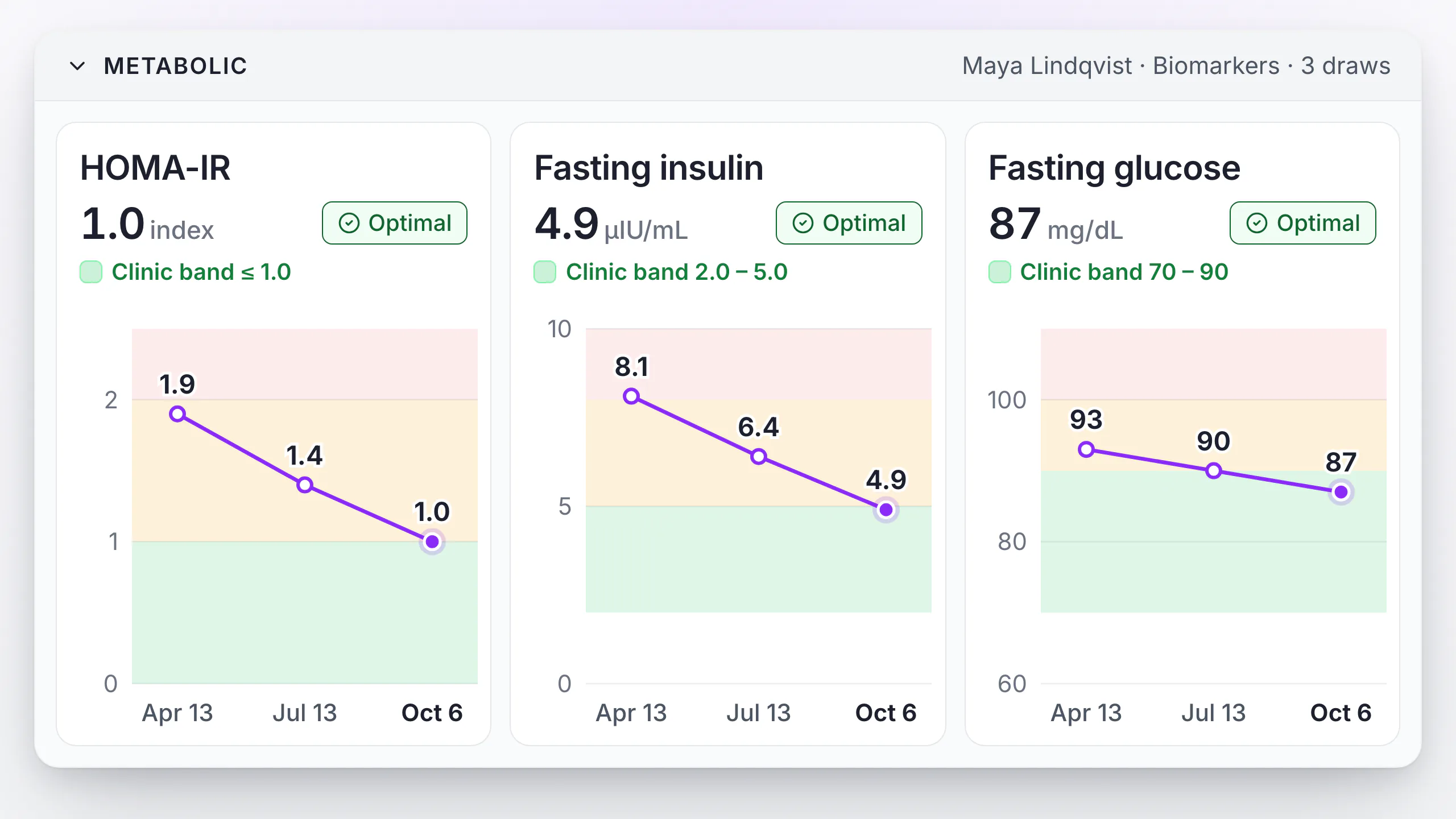
Many clinics read HOMA-IR next to its inputs rather than on its own. Fasting insulin and fasting glucose, followed across draws, show which side of the equation moved.
Tracking HOMA-IR in LongevityEHR
LongevityEHR is an EHR for cash-pay longevity, functional and concierge clinics. It does not interpret HOMA-IR or diagnose insulin resistance. It records the value, grades it against your clinic's band and keeps it on a trend next to fasting glucose and fasting insulin.
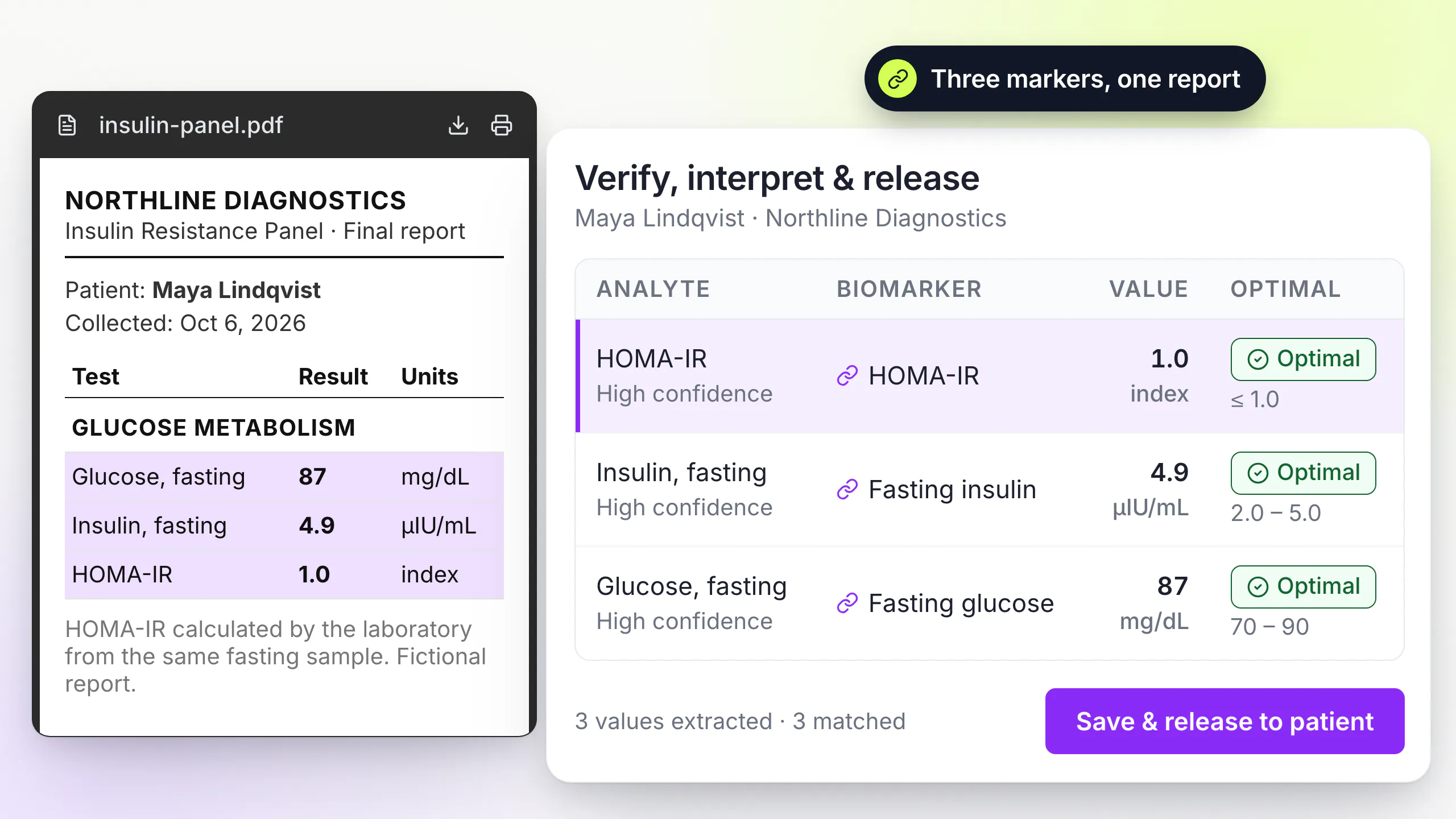
- The value your laboratory reports. When a report includes HOMA-IR, AI lab extraction reads it, matches it to your HOMA-IR biomarker and flags anything uncertain. LongevityEHR does not calculate the index from glucose and insulin today.
- Your clinic's band. Because no cutoff is universal, the clinic owner sets the optimal, borderline and critical bands for HOMA-IR, per sex if needed, and documents why. Our guide to optimal vs reference ranges covers how.
- Review before release. Extracted values wait in a review queue, and extracted values reach the patient portal only after a provider releases them.
- Trends that keep their meaning. Each released value keeps the range that applied that day, so editing your band later never regrades past results. See biomarker tracking.

Run your longevity clinic on one system
- AI lab extraction with provider review
- Your ranges, every result as a trend
- Memberships through your own Stripe
15-day free trial. BAA on request.
Sources
- Matthews DR, Hosker JP, Rudenski AS, et al. Homeostasis model assessment: insulin resistance and beta-cell function from fasting plasma glucose and insulin concentrations in man. Diabetologia. 1985;28(7):412-419 (accessed October 21, 2026)
- Gayoso-Diz P, Otero-González A, Rodriguez-Alvarez MX, et al. Insulin resistance (HOMA-IR) cut-off values and the metabolic syndrome in a general adult population: effect of gender and age. EPIRCE cross-sectional study. BMC Endocr Disord. 2013;13:47 (accessed October 21, 2026)
- Isokuortti E, Zhou Y, Peltonen M, et al. Use of HOMA-IR to diagnose non-alcoholic fatty liver disease: a population-based and inter-laboratory study. Diabetologia. 2017;60(10):1873-1882 (accessed October 21, 2026)
- Matli B, Schulz A, Koeck T, et al. Distribution of HOMA-IR in a population-based cohort and proposal for reference intervals. Clin Chem Lab Med. 2021;59(11):1844-1851 (accessed October 21, 2026)
- Singh B, Saxena A. Surrogate markers of insulin resistance: a review. World J Diabetes. 2010;1(2):36-47 (accessed October 21, 2026)
This page is educational content for clinicians and clinic operators. It is not medical advice and does not replace clinical judgment. Ranges and thresholds vary by laboratory, method and guideline.