
On this page
Key takeaways
- A fasting insulin test measures insulin after an overnight fast and is one of the inputs to surrogate indexes of insulin resistance such as HOMA-IR.
- Insulin assays are not standardized. An American Diabetes Association workgroup found among-assay variation from 12% to 66% across commercial methods.
- We found no major guideline that sets a diagnostic cutoff for fasting insulin. Lab reference intervals reflect each lab's method.
- Compare results from the same lab and method, and treat any optimal range as a documented clinic decision.
- What it measures
- Circulating insulin after an overnight fast.
- Sample
- Serum or plasma, drawn fasting.
- Common units
- µIU/mL (also written mU/L) or pmol/L. Conversion factors vary between sources.
- Main guideline reference
- American Diabetes Association workgroup reports on insulin assay standardization. We found no major guideline that sets a diagnostic cutoff.
What a fasting insulin test measures
A fasting insulin test measures the concentration of insulin in serum or plasma after an overnight fast. Insulin is released by the pancreas into the portal vein, and a large share of it is cleared by the liver before it reaches the general circulation. A 2022 review in the journal Obesity puts hepatic uptake at roughly 60% to 70%, so the number on the report reflects both how much insulin is secreted and how quickly it is cleared.
Because of that, fasting insulin levels are an indirect signal. They reflect secretion and clearance together, and they do not measure insulin sensitivity directly.
Fasting insulin and insulin resistance
Insulin resistance means tissues respond less to a given amount of insulin. The reference method for measuring it is the hyperinsulinemic euglycemic glucose clamp, which a review by Muniyappa and colleagues describes as labor and time intensive. That is why clinical practice relies on simpler surrogates.
Several surrogate indexes are built from fasting values: HOMA-IR, QUICKI and the simple reciprocal of fasting insulin among them. Others use insulin and glucose measured during an oral glucose tolerance test. Each has advantages and limits, and the right choice depends on the question being asked. Our page on HOMA-IR covers the most common fasting index.
Clinics that add the fasting insulin test to a fasting panel usually read it next to fasting glucose as one more metabolic signal. How much weight that signal can carry for a given patient depends heavily on how the insulin was measured.
Assay variability and the lack of standardization
This is the most important caveat for anyone reading fasting insulin levels. Unlike glucose, insulin is measured with immunoassays that are not standardized to a common reference.
| Source | What it found |
|---|---|
| ADA Insulin Standardization Workgroup (Marcovina et al., 2007) | 12 commercial insulin methods from 9 manufacturers. Among-assay coefficients of variation ranged from 12% to 66%, with a median of 24%. A common insulin reference preparation did not improve agreement. |
| ADA workgroup follow-up (Miller et al., 2009) | Against a mass spectrometry reference procedure, 7 of 10 methods showed bias above 15.5% in 36% to 100% of individual samples. Calibration with a panel of native sera improved agreement. |
| Review in Obesity (Gastaldelli, 2022) | Reports large interlaboratory variation in insulin measurement (about 25%), compared with 5% to 10% for standardized analytes such as glucose and triglycerides. |
Units add a second layer. Labs report insulin in µIU/mL or in pmol/L, and a 2019 commentary by Knopp and colleagues notes at least two accepted conversion factors between them, with the most widely used one underreporting insulin by about 15%. A value converted by hand can drift from the value the lab measured.
Reading fasting insulin levels
We found no major clinical guideline that sets a diagnostic cutoff for fasting insulin, and the ADA workgroup notes that the lack of assay standardization hinders consistent measures for treatment guidelines. The reference interval printed on a report is set by that lab for its own method, and laboratories differ on how to interpret the result.
Research cutoffs do exist. The Gastaldelli review, for example, uses a fasting insulin limit of 12.2 mU/L published by McAuley and colleagues to derive cutoffs for several surrogate indexes. Cutoffs like this come from specific study populations measured on specific assays, so they do not transfer cleanly to another lab's results.
- Confirm the sample was truly fasting. A non-fasting draw is not a fasting insulin result.
- Read insulin next to fasting glucose from the same draw, not on its own.
- Check the units and the lab before comparing with any earlier value.
- Look at the direction across several draws on one method rather than one number in isolation.
Setting an optimal range for fasting insulin
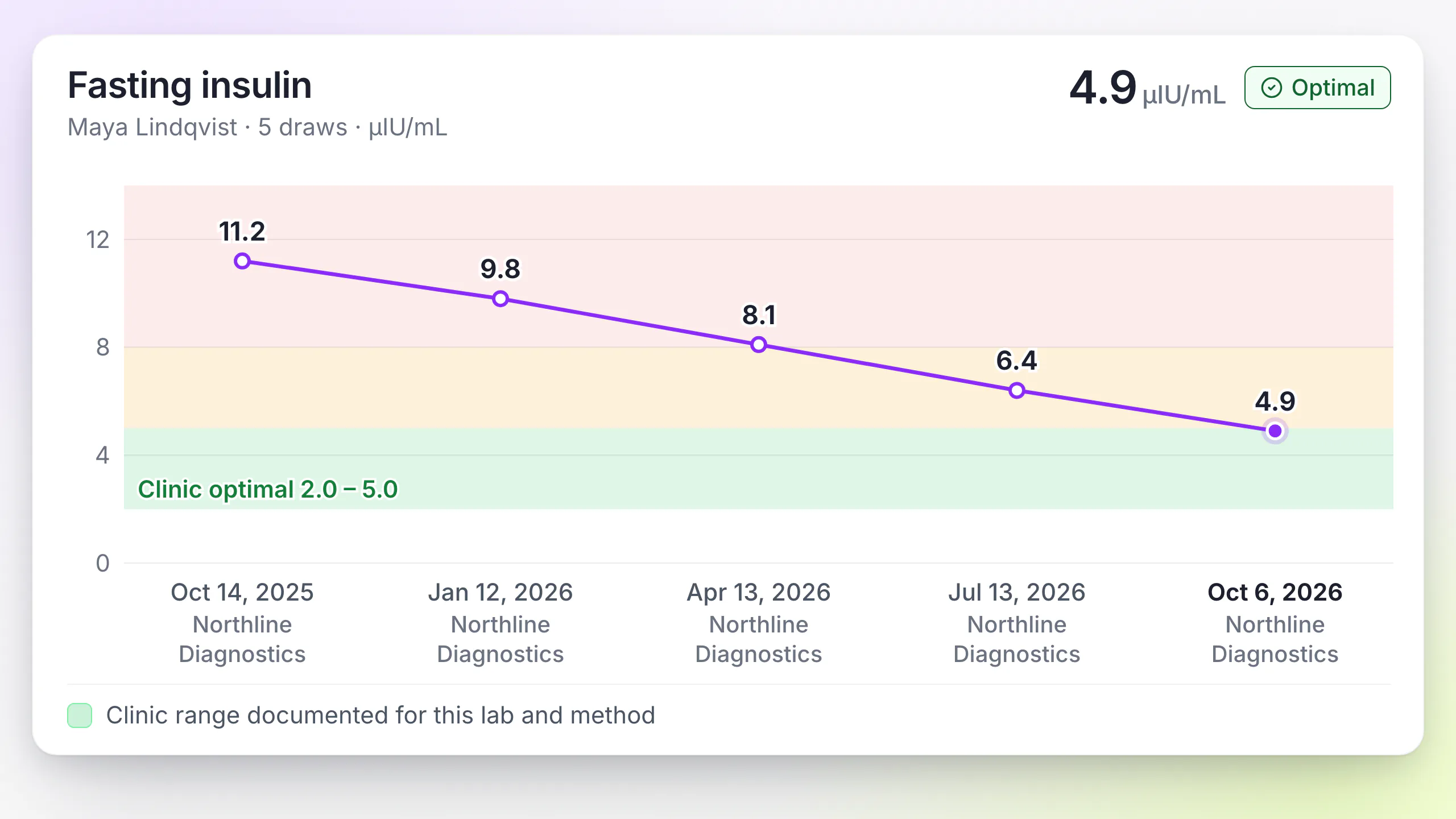
Some longevity clinics read fasting insulin against a tighter band than the lab's reference interval. That is a clinical decision, and with an unstandardized assay it needs to be written down carefully. A documented range should say which lab and method it applies to, which units it uses, what evidence the clinic relied on and when it will be reviewed.
Our guide to optimal vs reference ranges walks through how to set and document a clinic range. For fasting insulin in particular, tie the range to one assay. If your main lab changes method, revisit the range before the next result is graded.
Tracking fasting insulin in LongevityEHR
LongevityEHR is built for the way longevity clinics follow markers like this one. Your clinic sets its own range for fasting insulin, split by sex if you choose, and every released value is graded against it and added to a trend across draws. Each value keeps a snapshot of the range that applied when it was recorded, so tightening a range later does not regrade old results. See biomarker tracking for how ranges and trends work.
Results arrive through AI lab extraction: upload the lab PDF or an image of it, and values are matched to your biomarkers. A unit that doesn't match the biomarker's configured unit is flagged for review and never silently converted, which matters for insulin given the conversion problem above. A provider reviews every result before it is released to the patient's portal.
LongevityEHR classifies values against your ranges. It does not interpret them. Your providers write every word of interpretation, and changes to the plan live in the patient's care plan.

Run your longevity clinic on one system
- AI lab extraction with provider review
- Your ranges, every result as a trend
- Memberships through your own Stripe
15-day free trial. BAA on request.
Sources
- Marcovina S, et al. Standardization of insulin immunoassays: report of the American Diabetes Association Workgroup. Clin Chem. 2007, 53(4):711-716. (accessed October 21, 2026)
- Miller WG, et al. Toward standardization of insulin immunoassays. Clin Chem. 2009, 55(5):1011-1018. (accessed October 21, 2026)
- Gastaldelli A. Measuring and estimating insulin resistance in clinical and research settings. Obesity. 2022, 30(8):1549-1563. (accessed October 21, 2026)
- Muniyappa R, et al. Current approaches for assessing insulin sensitivity and resistance in vivo. Am J Physiol Endocrinol Metab. 2008, 294(1):E15-E26. (accessed October 21, 2026)
- Knopp JL, et al. Insulin units and conversion factors: a story of truth, boots, and faster half-truths. J Diabetes Sci Technol. 2019, 13(3):597-600. (accessed October 21, 2026)
This page is educational content for clinicians and clinic operators. It is not medical advice and does not replace clinical judgment. Ranges and thresholds vary by laboratory, method and guideline.