
On this page
Key takeaways
- An ApoB test estimates the number of atherogenic lipoprotein particles, because each one carries a single apoB molecule.
- The 2018 AHA/ACC guideline lists ApoB of 130 mg/dL or higher as a risk-enhancing factor when it is measured.
- The 2024 NLA consensus proposes ApoB thresholds of 60, 70 and 90 mg/dL to consider when intensifying therapy, by risk category.
- There is no single ApoB normal range. Laboratories and guidelines differ, and any optimal target is a choice the clinic makes and documents.
- What it measures
- Apolipoprotein B, one molecule per atherogenic particle (LDL, VLDL, IDL and Lp(a))
- Sample
- Blood draw. The NLA reports minimal change between fasting and non-fasting states
- Common units
- mg/dL in US guidance. Some labs report g/L (1 g/L equals 100 mg/dL)
- Main guideline references
- 2018 AHA/ACC cholesterol guideline and the 2024 NLA expert clinical consensus on apoB
What an ApoB test measures
Apolipoprotein B is the main structural protein on the lipoproteins that can lodge in an artery wall. The National Lipid Association (NLA) describes it as the single nonexchangeable apolipoprotein on these particles: LDL, VLDL, IDL and Lp(a) each carry exactly one apoB-100 molecule. Chylomicrons and their remnants carry a shorter form, apoB-48.
Because the ratio is one molecule per particle, an ApoB test is effectively a particle count. LDL cholesterol (LDL-C) measures something different: how much cholesterol those particles carry. Two people with the same LDL-C can have very different numbers of particles, which is why clinics that focus on long-term cardiovascular risk often order both.
When ApoB and LDL-C disagree
At the population level, ApoB and LDL-C move together. In individuals, they can diverge. The NLA consensus states that when they are discordant, atherosclerotic cardiovascular disease (ASCVD) risk generally aligns better with ApoB or non-HDL cholesterol, and that ApoB stratifies risk more accurately than LDL-C both before and during lipid-lowering therapy.
What US guidelines say about apolipoprotein B
Two documents carry most of the weight for US clinicians. They frame ApoB differently, so it helps to read them side by side.
- 2018 AHA/ACC cholesterol guideline. ApoB appears in the table of risk-enhancing factors, under markers to consider "if measured". It names triglycerides of 200 mg/dL or higher as a relative indication for measuring it. Its summary lists ApoB among markers measured in selected individuals, not in every patient.
- 2024 NLA expert clinical consensus. In its summary of the consensus, the NLA strongly supports ApoB for regular and specialty clinical use, as an alternative or a complement to LDL-C. It also notes practical limits, including gaps in understanding its role in care and the high charges for the test.
Both agree that ApoB carries information about risk. They differ on how routinely to order it, which is one reason clinics set their own testing policy and write it down.
ApoB normal range and guideline thresholds
People search for an "ApoB normal range", but guidelines publish something else: thresholds tied to a clinical decision. A laboratory's printed reference interval describes its reference population. A guideline threshold describes a point where risk or treatment changes. Neither is a personal target.
| Source | ApoB value | How the source uses it |
|---|---|---|
| 2018 AHA/ACC guideline | 130 mg/dL or higher | Risk-enhancing factor. The guideline notes it corresponds to an LDL-C of 160 mg/dL or higher. |
| 2024 NLA consensus, very high risk | 60 mg/dL | Threshold to consider intensifying lipid-lowering therapy |
| 2024 NLA consensus, high risk | 70 mg/dL | Threshold to consider intensifying lipid-lowering therapy |
| 2024 NLA consensus, borderline to intermediate risk | 90 mg/dL | Threshold to consider intensifying lipid-lowering therapy |
The NLA explains how it got there. None of the randomized trials behind the 2018 US cholesterol guideline used ApoB as a primary enrollment criterion, so its thresholds were extrapolated: the authors predicted the ApoB that corresponds to the US guideline LDL-C thresholds of 55, 70 and 100 mg/dL in treated and untreated adults, averaged the two and rounded to the nearest ten. The consensus also places an ApoB of about 130 mg/dL near the 90th percentile of untreated US adults.
How the ApoB test performs
ApoB is a direct measurement rather than a calculated value. The NLA cites College of American Pathologists survey data showing bias below 4 mg/dL for most ApoB tests, with a coefficient of variation usually between 5% and 6%. It also reports minimal change between fasting and non-fasting samples, because more than 95% of circulating ApoB is apoB-100 even after a meal in people without severe hypertriglyceridemia.
Those figures matter when you read a trend. A difference between two draws that is close to the test's own variability may be noise. Drawing at the same laboratory, and noting when a patient switches labs, makes a series easier to interpret.
Setting an ApoB target in a longevity clinic
Many longevity and preventive practices read ApoB against a target tighter than a lab's reference interval. That target is a clinical criterion the practice authors, so it should have an owner, a written source and a review date. Some clinics anchor it to a guideline threshold, others to their own reading of the evidence. Either way, the reasoning should be on paper before it shows up as a colored band in a chart.
Our guide to optimal vs reference ranges covers how reference intervals are built, why clinics define their own targets and how to document and govern them.
ApoB rarely travels alone. Lp(a) particles also carry apoB, so clinics that order ApoB often test lipoprotein(a) at least once as well.
Tracking ApoB over time in LongevityEHR
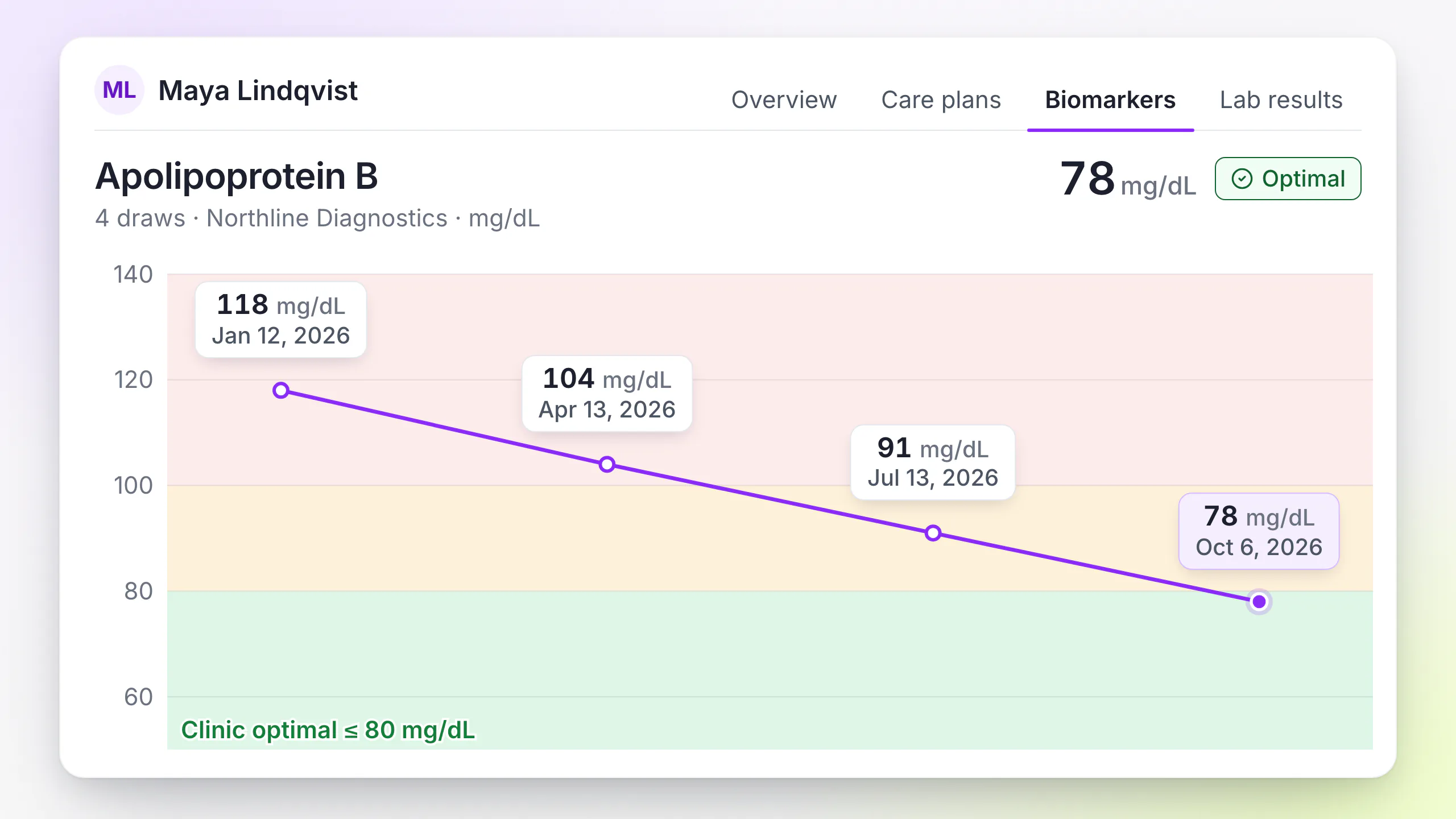
LongevityEHR is an EHR for cash-pay longevity, functional and concierge clinics. It does not interpret ApoB or recommend treatment. It records the value, grades it against the band your clinic set and keeps every draw on one trend.
- Your ranges, per clinic and per sex. The clinic owner sets optimal, borderline and critical bands for ApoB, and can split them by sex. See biomarker tracking.
- Values from the lab PDF. Upload the report and AI lab extraction reads the ApoB value and its unit, matches it to your biomarker and flags low-confidence values, unit mismatches and duplicates.
- Provider review before release. Extracted values wait in a review queue. Extracted values reach the patient's portal only after your team releases them.
- History that keeps its meaning. Each released value stores the range that applied that day. If you tighten your ApoB band next year, past results keep their original grade.
- A trend across draws. Every release adds a point, so the provider and, once released, the patient see the same series.
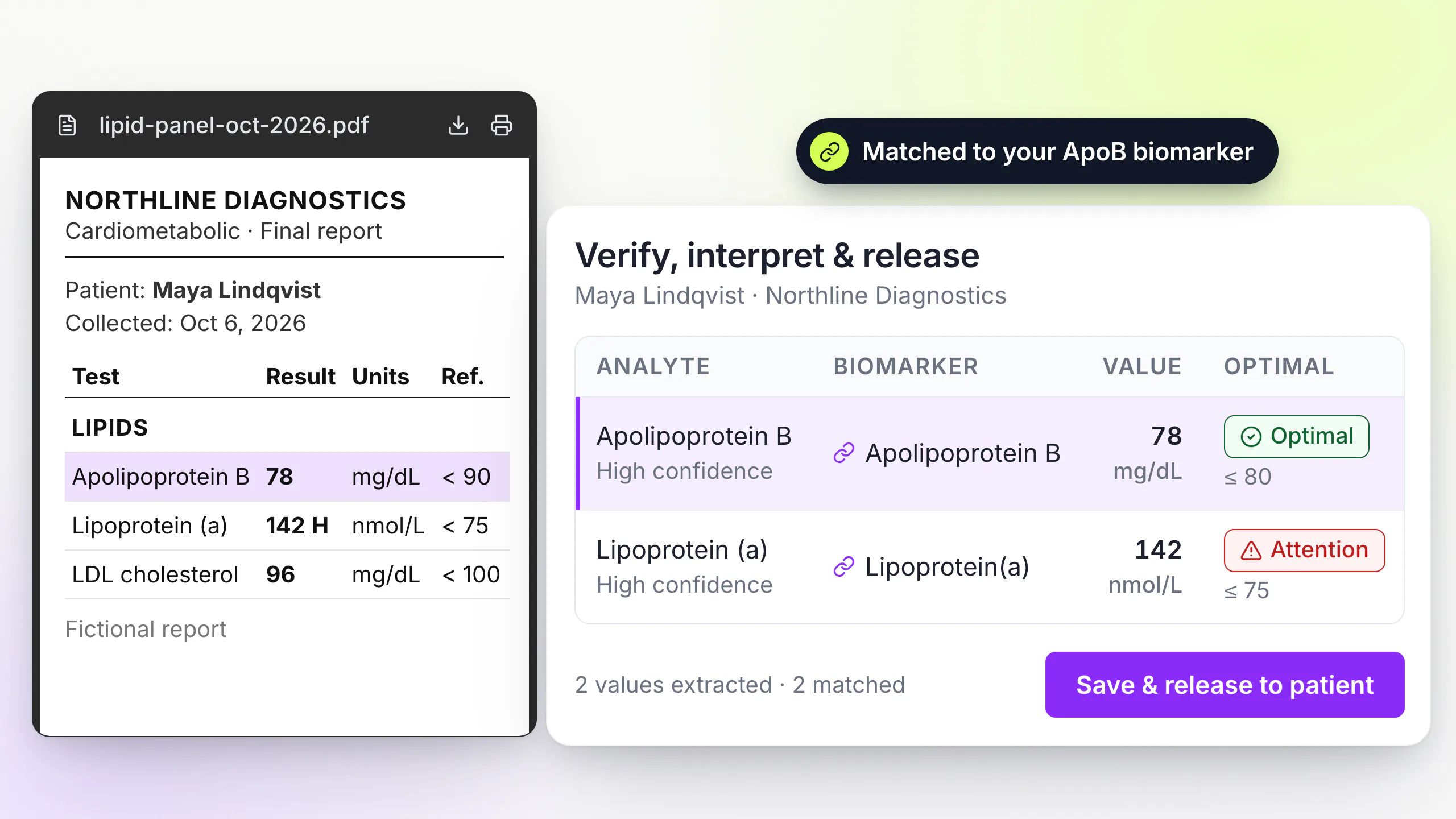
Every word of interpretation is written by the provider. Classification against the clinic's band is deterministic: the same value and the same range always give the same grade.

Run your longevity clinic on one system
- AI lab extraction with provider review
- Your ranges, every result as a trend
- Memberships through your own Stripe
15-day free trial. BAA on request.
Sources
- Soffer DE, Marston NA, Maki KC, et al. Role of apolipoprotein B in the clinical management of cardiovascular risk in adults: an expert clinical consensus from the National Lipid Association. J Clin Lipidol. 2024;18(5):e647-e663 (accessed October 21, 2026)
- National Lipid Association. Role of ApoB in clinical management of cardiovascular risk in adults (summary tearsheet) (accessed October 21, 2026)
- Grundy SM, Stone NJ, Bailey AL, et al. 2018 AHA/ACC/AACVPR/AAPA/ABC/ACPM/ADA/AGS/APhA/ASPC/NLA/PCNA Guideline on the Management of Blood Cholesterol. Circulation. 2019;139(25):e1082-e1143 (accessed October 21, 2026)
This page is educational content for clinicians and clinic operators. It is not medical advice and does not replace clinical judgment. Ranges and thresholds vary by laboratory, method and guideline.