
On this page
- What is longevity medicine? A working definition
- Healthspan vs lifespan: the gap the field targets
- The science behind longevity medicine
- What is a longevity clinic and what does it do?
- Where the evidence is strong, and where it is not
- How to practice longevity medicine responsibly
- Where software fits in longevity medicine
Key takeaways
- Longevity medicine aims to extend healthspan, the years lived in good health, by addressing risk and aging processes before disease appears. There is no consensus definition yet.
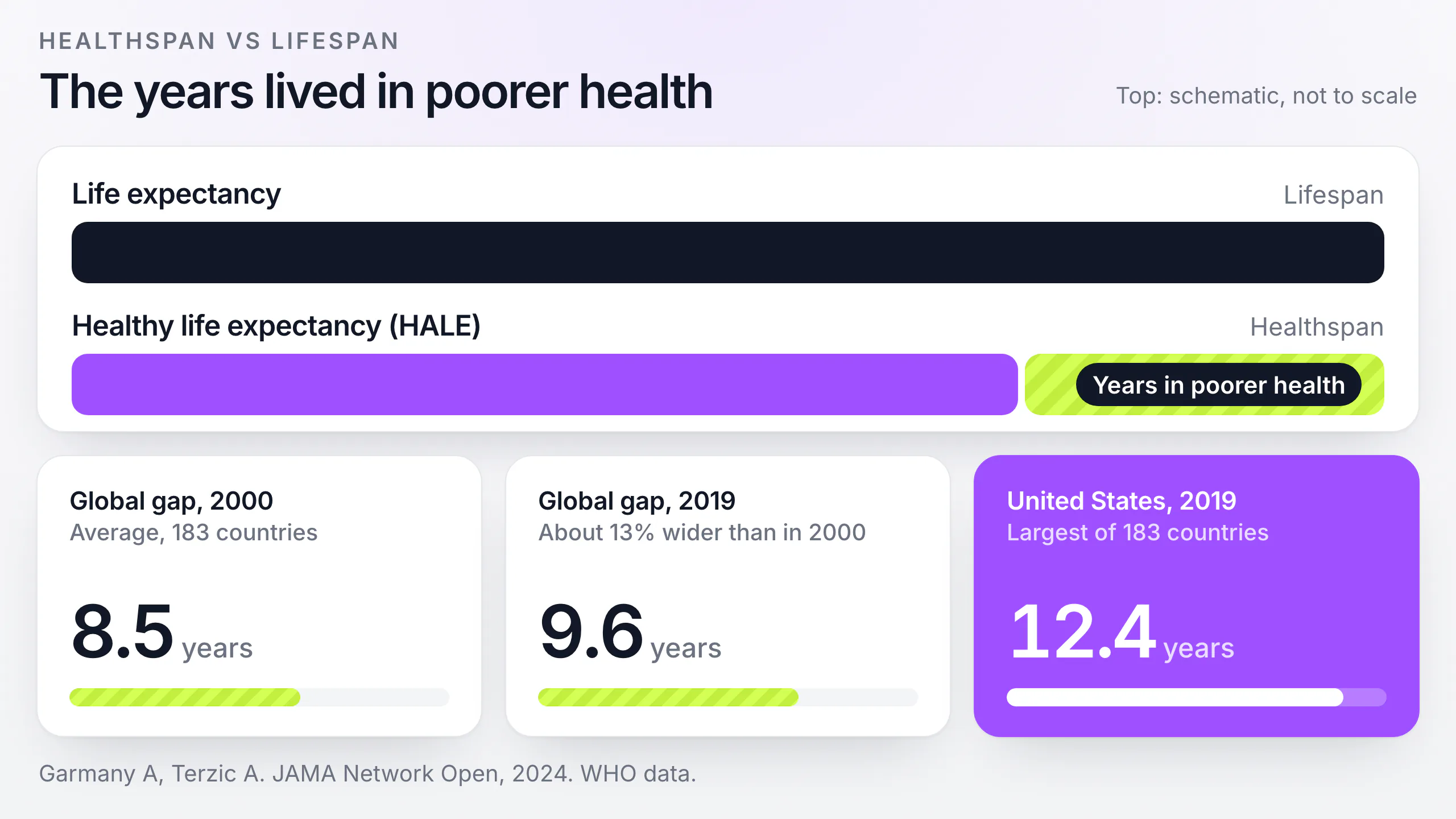
- The gap between lifespan and healthspan is real and measurable: a 2024 study of 183 WHO member states put the global average at 9.6 years, and the US gap at 12.4 years, the largest of any country.
- Lifestyle interventions such as exercise have the strongest support. Supplements, drugs targeting aging and biological age clocks are earlier in the evidence.
- Responsible practice means measuring over time, documenting how ranges are chosen, avoiding overdiagnosis and never promising outcomes.
What is longevity medicine? A working definition
Longevity medicine is a clinical approach that tries to keep people healthy for longer, rather than waiting to treat disease once it appears. Andrea Maier, president of the Healthy Longevity Medicine Society, described healthy longevity medicine to MIT Technology Review in 2024 as optimizing health and healthspan while antagonizing aging processes across the lifespan.
The field is open about the fact that this is still a working definition. In a 2022 interview, the society's vice president, Evelyne Bischof, said there is no consensus and nobody claims to have the ultimate definition. A 2024 white paper from the first Longevity Clinics Roundtable, hosted by the Buck Institute, states that healthy longevity medicine is not an official medical branch and has no practice guidelines yet.
Healthspan vs lifespan: the gap the field targets
Lifespan is how long a person lives. Healthspan is how long they live in good health. The World Health Organization measures the second with healthy life expectancy (HALE), the average number of years a person can expect to live in full health, given the rates of death and illness in their population at the time.
The distance between the two is growing. In a 2024 study in JAMA Network Open, Armin Garmany and Andre Terzic of Mayo Clinic compared life expectancy and healthy life expectancy across 183 WHO member states using WHO data.
| Finding | Value |
|---|---|
| Global average healthspan-lifespan gap, 2019 | 9.6 years |
| Global gap in 2000 | 8.5 years (about a 13% increase since) |
| United States gap, 2019 | 12.4 years, the largest of the 183 countries |
| Women compared with men | Gap 2.4 years wider on average |
That gap is the core argument for longevity medicine. The goal is not mainly a longer life but more of it spent well. The Roundtable white paper makes the same point: the field's primary focus is healthspan, not lifespan.
The science behind longevity medicine
Longevity medicine draws on geroscience, the research field that studies aging as a driver of chronic disease. In its coverage of the 2023 NIH Geroscience Summit, the NIH Catalyst describes geroscience as the search for ways to translate knowledge of the molecular and cellular mechanisms of aging into better health later in life, founded on the observation that age is the major risk factor for many diseases. The same coverage notes that clinicians have no universally accepted meaning for geroscience itself, which hinders the design of clinical trials and, in turn, direct clinical use.
One framework the field uses is the hallmarks of aging. In a 2023 review in Cell, López-Otín and colleagues proposed twelve interconnected hallmarks, including genomic instability, telomere attrition and chronic inflammation, each meeting three premises: it appears with age, accentuating it experimentally accelerates aging, and intervening on it offers a chance to slow, stop or reverse aging.
What is a longevity clinic and what does it do?
A longevity clinic is a practice that delivers this model of care, usually on a cash-pay basis. The Roundtable white paper describes a common pattern across clinics:
- A comprehensive baseline assessment. Medical history, physical and psychological health, blood work and, at some clinics, tests related to the hallmarks of aging or biological age.
- A personalized action plan. Lifestyle changes, possible interventions and a schedule for re-testing.
- Follow-up and re-testing. Some clinics use health coaches, others enroll patients in longer programs with regular physician check-ins.
- Reassessment. Comparing new results with the baseline to see what changed.
MIT Technology Review reported in 2024 that testing sessions at many clinics take four to six hours and can include blood work, body composition, VO2 max, cognitive assessments and sometimes genome or microbiome analysis. A 2025 survey of 82 clinics, reported by the same publication, found that more than 80% were overseen by a medical doctor with over ten years of clinical experience, and that 28% offered Botox and 38% offered facial rejuvenation procedures. Andrea Maier wrote that the line between longevity and aesthetic medicine remains blurred.
If you are planning a practice of your own, our guide on how to start a longevity clinic covers the model, team, compliance and software decisions.
Where the evidence is strong, and where it is not
Longevity medicine is often described as evidence-based, and parts of it are. Other parts are early. A 2024 narrative review in Frontiers in Aging, Climbing the longevity pyramid, sorts interventions into levels that make the difference easy to see.
| Area | State of the evidence (per the review) |
|---|---|
| Exercise and lifestyle | The strongest support. The review calls exercise the foremost lifestyle intervention for longevity, though much of the evidence is observational. |
| Dietary supplements | Early. The review says effects of NAD+ precursors such as nicotinamide riboside still need confirmation in humans. |
| Drugs targeting aging | Under investigation. Rapamycin's implications for human longevity are still being studied, and the review describes the TAME trial as exploring metformin. |
| Biological age tests | No single test can precisely assess biological age. Results depend on the markers and methods used. |
| Experimental therapies | Gene editing, stem cells and similar approaches sit at the experimental top of the pyramid. |
Reporting on the field points the same way. MIT Technology Review wrote in 2025 that no drugs or supplements have yet been proved to extend human lifespan. Its 2024 article reported that many clinics use aging clocks even though they do not work well, citing a test in which one blood sample sent to ten companies came back with estimated biological ages from 25 to 66. The Roundtable white paper also warns that advanced diagnostics, such as AI-driven MRI scans, carry a real risk of overdiagnosis and false positives that lead to unnecessary procedures, cost and stress.
How to practice longevity medicine responsibly
- Prefer markers with established clinical meaning. Our biomarker library covers what current guidelines say about markers such as ApoB, Lp(a) and HOMA-IR.
- Document your ranges. If your clinic grades results against target ranges that differ from the lab's reference intervals, write down where each one came from. Our explainer on optimal vs reference ranges covers how.
- Measure over time. One result is a snapshot. The value of the model is in the trend after a change in the plan.
- Test with a reason. Add imaging or advanced panels when the result will change a decision, not because it is available.
- Separate evidence tiers in conversations with patients. Be clear about what is well supported and what is experimental.
- Do not promise outcomes. Describe what you measure and how you follow up.
Where software fits in longevity medicine
Longevity medicine runs on repeated measurement, so the record has to handle data over years, not just a single visit. Results arrive from different labs, have to be graded against the clinic's own ranges, and need to change the patient's plan when they move.
That is the loop LongevityEHR is built around. AI lab extraction turns lab PDFs into structured values that a provider reviews before release. Biomarker tracking grades each value against ranges your clinic sets and shows it as a trend. Care plans turn the result into steps the patient follows in your branded portal. Classification against your ranges is deterministic, and the interpretation is always written by your clinicians. The software does not interpret results or make clinical decisions.

Run your longevity clinic on one system
- AI lab extraction with provider review
- Your ranges, every result as a trend
- Memberships through your own Stripe
15-day free trial. BAA on request.
Sources
- MIT Technology Review, The quest to legitimize longevity medicine (March 18, 2024) (accessed October 21, 2026)
- MIT Technology Review, Longevity clinics around the world are selling unproven treatments (April 18, 2025) (accessed October 21, 2026)
- Lifespan.io, Prof. Evelyne Yehudit Bischof on Longevity Medicine (September 30, 2022) (accessed October 21, 2026)
- International Institute of Longevity and Buck Institute, In search of best practices for Longevity Clinics (white paper, 2024) (accessed October 21, 2026)
- World Health Organization, Healthy life expectancy (HALE) at birth (accessed October 21, 2026)
- Garmany A, Terzic A. Global Healthspan-Lifespan Gaps Among 183 World Health Organization Member States. JAMA Network Open, 2024 (accessed October 21, 2026)
- NIH Catalyst, Conference probes essence of aging, frailty and disease (2023) (accessed October 21, 2026)
- López-Otín C, Blasco MA, Partridge L, Serrano M, Kroemer G. Hallmarks of aging: An expanding universe. Cell, 2023 (accessed October 21, 2026)
- Martinović A, et al. Climbing the longevity pyramid: overview of evidence-driven healthcare prevention strategies for human longevity. Frontiers in Aging, 2024 (accessed October 21, 2026)