
On this page
- Why longevity care is sold as a membership
- What the market charges: sourced price points
- Concierge membership pricing models and how they compare
- How to price a longevity membership from your own numbers
- Designing tiers patients understand
- Legal and tax questions to check before you launch
- Running memberships without a second billing system
Key takeaways
- Public price points span two orders of magnitude, from direct primary care memberships near $100 a month to longevity programs reported at $5,000 to $50,000 a year or more. They are not like-for-like products.
- Price from what the membership includes, what each item costs you and how many members one provider can follow well, then compare with the market.
- A practical structure combines a base membership with bundles and one-off add-ons. Credits make the included visits and labs easy to track.
- Check with counsel how your state treats prepaid memberships, and do not assume a longevity membership qualifies under the new HSA rules for direct primary care.
Why longevity care is sold as a membership
Longevity clinic membership pricing follows from how the care works. A patient gets a baseline assessment, a written plan and repeated testing to see whether the plan is working. A 2024 white paper from the first Longevity Clinics Roundtable describes that pattern, with some clinics adding health coaching or longer programs of regular check-ins. Selling it one visit at a time makes the patient decide again at every step. A longevity membership packages the whole cycle for a period, usually a year.
For the clinic, a membership turns uneven visit revenue into predictable recurring revenue and makes capacity planning possible. For the patient, it sets clear expectations: what is included, how often they will be re-tested and how they reach their care team. If you are still designing the clinic itself, start with our guide on how to start a longevity clinic.
What the market charges: sourced price points
Published prices are scarce. Some programs, Fountain Life among them, quote only on request. The figures below come from public sources we checked on October 21, 2026. They describe different products, from a primary care membership to a consumer lab subscription to a full longevity program, so read them as reference points rather than a ladder.
| Program type | Reported price | What it covers | Source |
|---|---|---|---|
| Direct primary care | Average $98.46 per month | Primary care membership. 76.4% of practices use some form of tiered pricing. | Direct Primary Care Alliance 2024 survey, 465 physicians, via Medical Economics |
| Concierge medicine (2005 data) | $60 to $15,000 per year, most often $1,500 | Membership fee in exchange for enhanced services | US GAO survey of concierge physicians, 2005 |
| Functional and integrative membership | $275 per month self-pay, 12-month commitment | Parsley Health membership. Lab testing, specialty tests and imaging are billed separately. | Parsley Health cost breakdown page |
| Consumer lab subscription | $199 to $365 per year | Superpower lists 100+ biomarkers once a year at $199. Function Health lists 160+ lab tests, tested twice a year, at $365. | Superpower and Function Health websites |
| Longevity clinic programs | $5,000 to $50,000 per year | Multi-hour assessments, testing, coaching and follow-up | MIT Technology Review, 2024 |
| Longevity clinics (Fountain Life figure) | $10,000 to $150,000 per year | Annual cost of attending a longevity clinic, according to Fountain Life | MIT Technology Review, 2025 |
Two patterns stand out. First, tiering is normal: most direct primary care practices in the DPCA survey use tiers, and Fountain Life's membership page lists four named memberships (Core, APEX, APEX Family and Executive Health) with services marked as included, available à la carte or not covered. Second, consumer lab subscriptions now sit at the low end of what patients compare against. A clinical membership has to explain what a clinician adds on top of a panel: interpretation, a plan, follow-up and someone accountable for the patient.
Concierge membership pricing models and how they compare
In practice you will likely combine two or three of these models. The right mix depends on how predictable your patients' needs are and how much of your cost is fixed per member.
| Model | How it bills | Works well when | Watch for |
|---|---|---|---|
| Annual program | One price for a defined year: baseline, re-tests and follow-ups | The program is the same for most members | Members who drop off mid-year and still expect the remaining services |
| Tiered membership | Two to four levels billed monthly or yearly | Patients differ in how much testing and access they want | Too many tiers. Each one needs a clear reason to upgrade. |
| Bundles | Paid once for a set of visits and lab draws | Short protocols with a clear start and end | Unused bundles. Set how long credits stay valid. |
| Credits | Membership or bundle grants credits that are spent on visits and labs | You want what was bought to match what can be booked | Rules for cancellations and expiry need to be explicit |
| À la carte add-ons | Single services sold on top of a membership | Imaging, specialty tests or extra visits only some members need | Add-ons that every member ends up buying belong in the base price |
| Executive health program | An employer or the individual pays for an annual assessment program | You can deliver an intensive assessment day and a written report | Corporate contracts, invoicing and confidentiality of results from the employer |
An executive health program deserves a note. In this model the product is a comprehensive annual assessment for senior leaders, and the company may be the payer. If you sell to employers, decide up front what the employer receives (for example, invoices and participation, not results) and put it in the contract.
How to price a longevity membership from your own numbers
Market prices tell you what patients will tolerate. Your costs and capacity tell you what you can afford to deliver. Work through both.
- List everything included for one member for one year: baseline visit, follow-up visits, lab draws and panels, coaching sessions, care plan reviews and any imaging.
- Put a cost on each item. Lab cost per panel, provider time per visit at a loaded hourly cost, coaching time and supplies.
- Add the fixed costs per member. Divide software, space and admin staff by your expected member count.
- Set a capacity limit. Decide how many members one provider can follow at your visit and re-test cadence, and check that your revenue target fits within it.
- Choose a margin and test the price. Annual price should cover direct costs plus fixed costs per member, with room for your target margin. Compare the result with the reference points above.
- Decide what sits outside the membership. Anything only some members need is an add-on or a bundle.
Monthly or annual billing
Annual billing improves cash flow and matches the yearly testing cycle. Monthly billing lowers the barrier to joining. You can offer both, for example with a discount or a commitment on annual. Parsley Health, for example, lists its membership with a 12-month commitment and both monthly and annual payment options.
Designing tiers patients understand
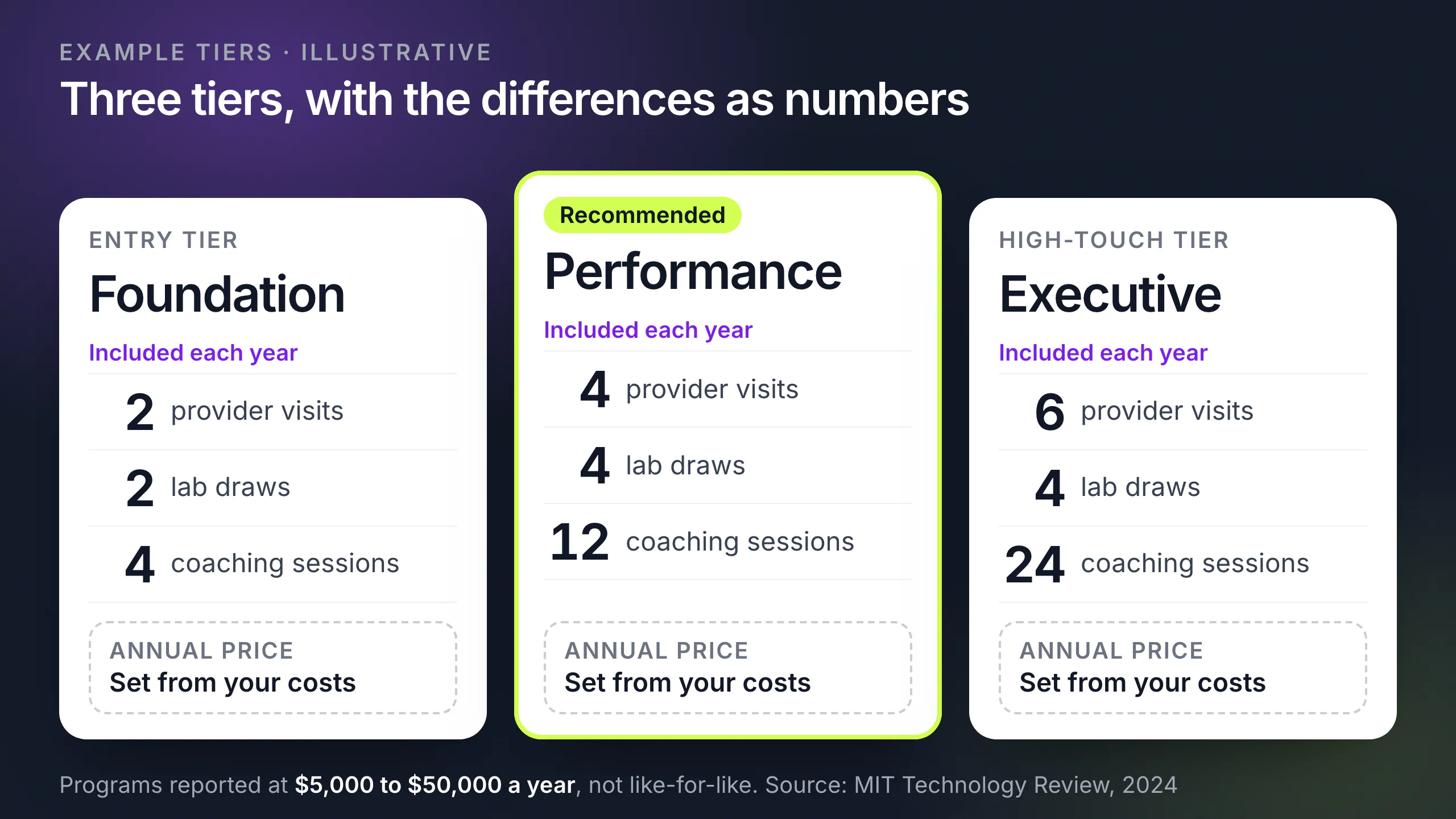
- Keep it to three tiers or fewer to start. One entry tier, one recommended tier and one high-touch tier is enough to learn from.
- Make the difference concrete. More re-tests per year, more provider visits, coaching sessions or faster access, stated as numbers.
- Name tiers by what they do. Patients compare inclusions, not brand names.
- Consider a family or couples option if your patients ask for it. Fountain Life, for example, lists an APEX Family membership.
- Write the terms in plain language: renewal, cancellation, what happens to unused credits and what happens if a payment fails.
Legal and tax questions to check before you launch
These are questions for your healthcare attorney and accountant, not legal or tax advice.
- Insurance regulation. A prepaid membership that promises future care can raise insurance law questions. McDermott Will & Emery's 50-state survey notes that about half of US states have laws exempting direct primary care arrangements from insurance regulation, often for a narrow scope of arrangements. Ask how your membership is treated where you operate.
- HSA rules for direct primary care. For months beginning after December 31, 2025, a direct primary care service arrangement with aggregate fees up to $150 a month ($300 if it covers more than one person) no longer prevents a patient in a high deductible health plan from contributing to an HSA, as IRS Revenue Procedure 2026-24 restates. As Manatt summarizes the IRS guidance, primary care here excludes prescription drugs other than vaccines and lab services not typically administered in an ambulatory care setting, and the fixed periodic fee must be the sole compensation for that care. A longevity membership with extensive testing or separate billing may not qualify, so do not market it as HSA-compatible without advice.
- Consumer terms. Auto-renewal, cancellation and refund terms should be clear at signup.
Running memberships without a second billing system
A membership only works if what a patient bought matches what they can book. When billing sits in a separate tool, someone has to reconcile payments against appointments and labs by hand.
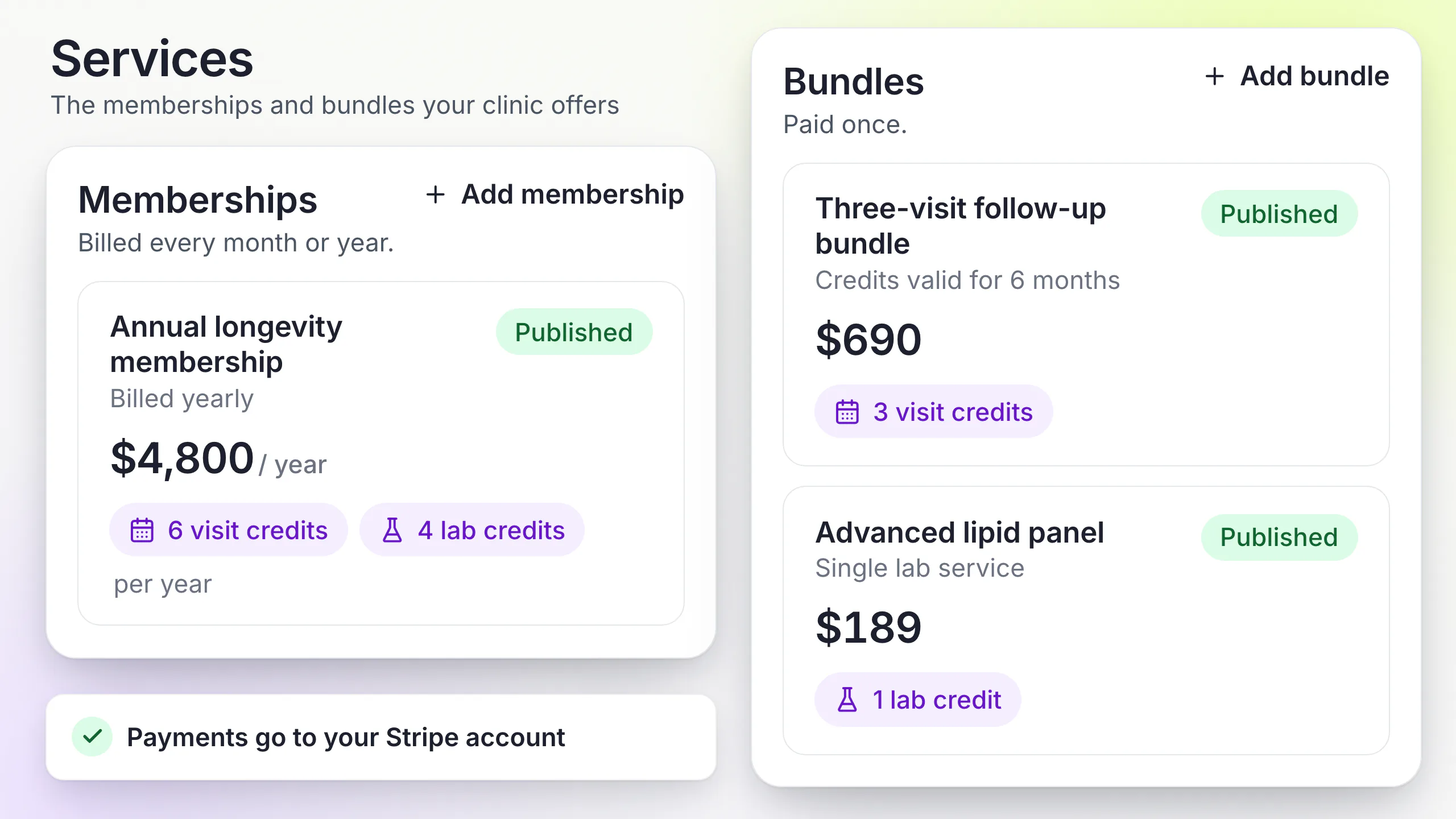
In LongevityEHR, memberships and payments run inside the same system as the chart. You sell monthly or yearly memberships, bundles and one-off services in your white-label patient portal, and every charge goes to your clinic's own Stripe account. Memberships and bundles grant credits for appointments and lab steps in a care plan, and patients see their remaining credits and invoices in the portal. LongevityEHR's own plans are on the pricing page.

Run your longevity clinic on one system
- AI lab extraction with provider review
- Your ranges, every result as a trend
- Memberships through your own Stripe
15-day free trial. BAA on request.
Sources
- Medical Economics, Five surprising findings about the state of direct primary care (July 29, 2026) (accessed October 21, 2026)
- US GAO, Physician Services: Concierge Care Characteristics and Considerations for Medicare (GAO-05-929, 2005) (accessed October 21, 2026)
- Parsley Health, Cost breakdown (accessed October 21, 2026)
- Superpower, Membership (accessed October 21, 2026)
- Function Health, Pricing (accessed October 21, 2026)
- Fountain Life, Memberships (accessed October 21, 2026)
- MIT Technology Review, The quest to legitimize longevity medicine (March 18, 2024) (accessed October 21, 2026)
- MIT Technology Review, Longevity clinics around the world are selling unproven treatments (April 18, 2025) (accessed October 21, 2026)
- International Institute of Longevity and Buck Institute, In search of best practices for Longevity Clinics (white paper, 2024) (accessed October 21, 2026)
- McDermott Will & Emery, Direct primary care arrangements 50-state survey (updated April 2024) (accessed October 21, 2026)
- IRS, Revenue Procedure 2026-24 (accessed October 21, 2026)
- Manatt, IRS issues notice on new HSA flexibility under H.R. 1 (December 17, 2025) (accessed October 21, 2026)