
On this page
Key takeaways
- Functional medicine is not an ABMS specialty. A functional medicine doctor is a licensed clinician who has trained in functional medicine, and certification does not change the scope of their license.
- IFM certification is now issued by the International Board of Functional Medicine Certification (IBFMC) as two credentials: FMCP-M for MDs, DOs, NDs, NPs and PAs, and FMCP for other licensed clinicians.
- To sit the exam you need an eligible degree, an active license and at least 100 hours of accredited functional medicine training (150 hours from January 2027). Today only IFM's core curriculum meets that training requirement.
- Certification fees are $350 to apply and $950 for the exam, before training costs. Renewal is every six years.
- Kresser Institute, the School of Applied Functional Medicine and integrative medicine board certification are other paths, each with a different format.
What functional medicine certification means
Functional medicine certification is a credential from a professional organization showing that a licensed clinician has completed functional medicine training and passed an assessment. It is not a medical specialty certificate. None of the 24 Member Boards of the American Board of Medical Specialties (ABMS) offers a certificate in functional medicine.
The Institute for Functional Medicine (IFM) describes the approach as restoring healthy function by treating the root causes of disease, with clinicians identifying the processes behind a patient's imbalance and creating personalized interventions based on genetic, environmental and lifestyle influences.
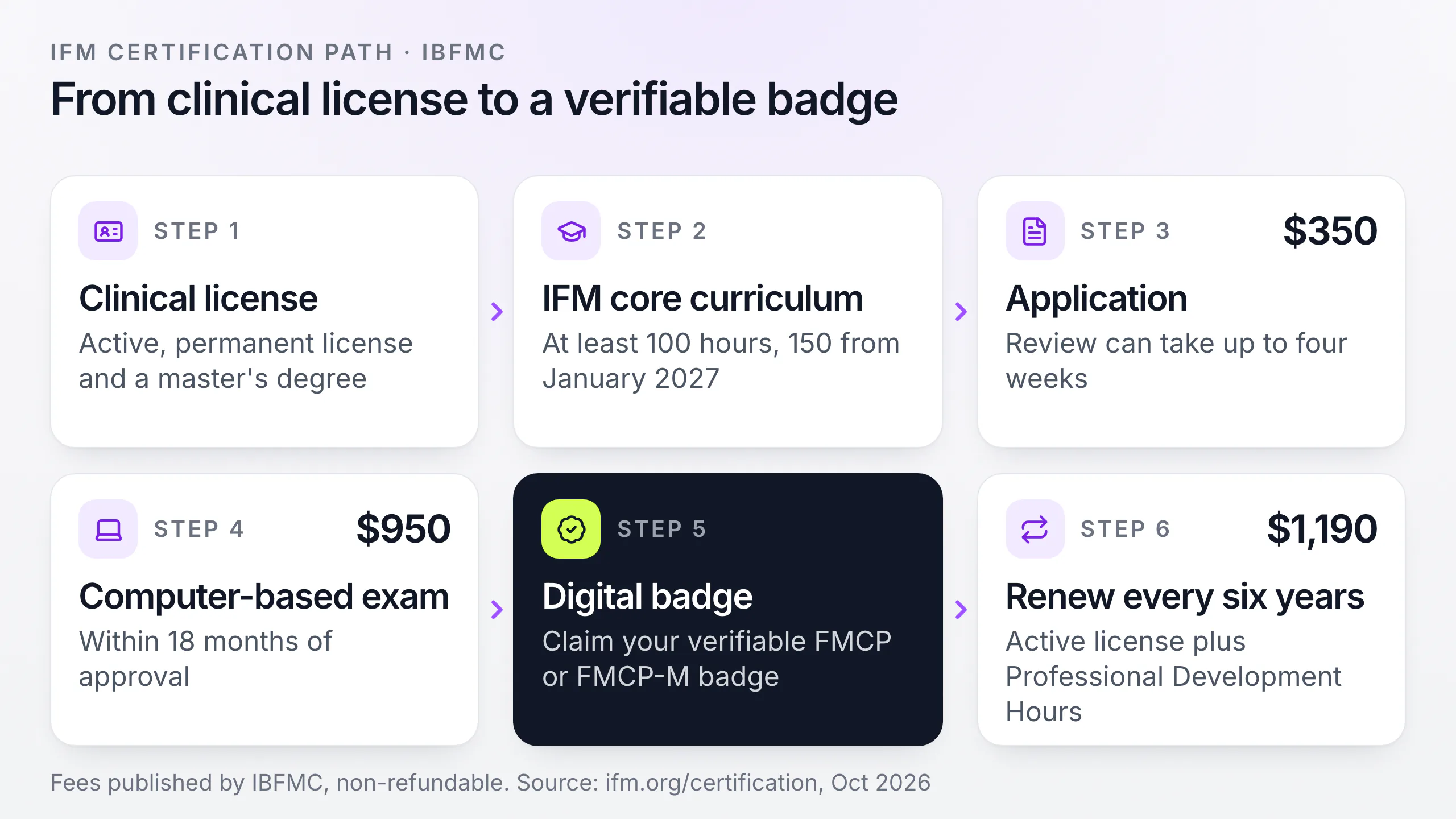
How to become a functional medicine doctor
Because functional medicine is an approach rather than a licensed specialty, the path has four parts:
- Hold a clinical license. For physicians, that means an MD or DO and an active license. NDs, NPs and PAs, and many other licensed clinicians, also train in functional medicine within their own scope.
- Complete functional medicine training. IFM's core curriculum is the route to IFM certification. Other programs teach the same approach in different formats.
- Earn a credential, if you want one. Certification is voluntary. It gives patients and peers a verifiable signal that you completed training and passed an exam.
- Keep learning. Most credentials require ongoing education to renew.
Then comes running the practice, which we come back to at the end.
IFM certification: the Functional Medicine Certification Program
IFM certification is now overseen by the International Board of Functional Medicine Certification (IBFMC), which runs the Functional Medicine Certification Program. If you hold the earlier IFM Certified Practitioner (IFMCP) credential, IFM says certified practitioners transition to the new credentials through its Certification Hub.
The two credentials
| Credential | Designed for |
|---|---|
| Functional Medicine Certified Professional, Medical (FMCP-M) | Licensed physicians (MD, DO, ND), nurse practitioners and physician associates or assistants with a broad scope of licensure |
| Functional Medicine Certified Professional (FMCP) | Other licensed clinicians, such as registered nurses, nutrition professionals, chiropractors, acupuncturists, dentists, pharmacists, physical and occupational therapists and mental health professionals |
Eligibility requirements
- Academic. At least a master's degree in an eligible healthcare discipline from an accredited university (non-US candidates: at least a bachelor's or equivalent). IBFMC makes allowances for fields whose entry-level degree changed.
- Licensure. An active, permanent healthcare license. Student, residency and temporary licenses are not eligible.
- Training. Accredited functional medicine training that covers all of the competencies for your credential, with a minimum of 100 hours of instruction. From January 2027 the minimum rises to 150 hours, and training completed before then counts under the 100-hour rule.
The training requirement is the one to read closely. IBFMC says that, at this time, IFM's core curriculum is the only education that meets all of its training requirements. That curriculum has seven programs: Applying Functional Medicine in Clinical Practice (AFMCP) and six Advanced Practice Modules in GI, cardiometabolic, immune, environmental health, bioenergetics and hormone health. IBFMC says other providers may be recognized in the future.
The steps and the exam
- Complete the academic, licensure and training requirements.
- Submit your application. Review can take up to four weeks, and once approved you have 18 months to take the exam.
- Register for an exam window and schedule your appointment.
- Pass a computer-based written exam built on the FMCP or FMCP-M competencies.
- Claim your verifiable digital badge.
- Renew every six years by keeping your license active and earning Professional Development Hours.
IFM certification fees
| Fee | Amount |
|---|---|
| Application | $350 |
| Exam | $950 |
| Exam retake | $475 |
| Exam deferral | $150 |
| Renewal application (every six years) | $1,190 |
Other functional medicine training paths
IFM is the only route to the IBFMC credentials today, but it is not the only way to learn functional medicine. These programs each lead to their own certificate or credential.
Kresser Institute: Adapt Practitioner Training
Kresser Institute's Adapt Practitioner Training, Fellowship and Certification program is cohort-based and virtual, built for licensed clinicians. It runs as a year-long mentored program with live patient cases and small-group learning. The institute also sells self-paced specialized courses, for example on functional blood testing and hormones.
School of Applied Functional Medicine (SAFM)
SAFM offers accredited continuing education to active licensed or certified medical and wellness practitioners. Students progress through four programs at their own pace, with an emphasis on clinical application, complex case practice and business training. SAFM has been teaching since 2011.
Integrative medicine board certification (ABOIM)
Physicians who want a board-style credential in a neighboring field can look at the American Board of Integrative Medicine, offered through the American Board of Physician Specialties (ABPS), which is separate from ABMS. Eligibility requires an MD or DO, an accredited residency, current or previous board certification, and an ABOIM-approved integrative medicine fellowship or one of three other training options. Candidates then pass a computer-based written exam, and certificates last eight years.
Functional medicine training paths compared
| Path | Format | Who it is for | Assessment |
|---|---|---|---|
| IFM core curriculum and IBFMC certification | AFMCP plus six Advanced Practice Modules | Licensed clinicians with an eligible degree | Computer-based written exam, renewal every six years |
| Kresser Institute Adapt | Year-long, cohort-based, virtual and mentored | Licensed clinicians | Program certification (see Kresser Institute) |
| School of Applied Functional Medicine | Four programs, self-paced, with case practice | Licensed or certified medical and wellness practitioners | See SAFM |
| ABOIM (integrative medicine) | Approved fellowship or accepted training option | Board-certified MD and DO physicians | Computer-based written exam, eight-year certificate |
A simple way to choose: if a verifiable credential matters to you, IBFMC is the route with an independent board, a published exam process and published fees. If you learn best from mentored case work, compare Adapt and SAFM on format and price. If you are a board-certified physician who wants a board credential, look at ABOIM.
Running a functional medicine practice after certification
Functional medicine is lab-heavy and plan-heavy. A single new patient can bring a long intake, several panels from different labs and a plan with many moving parts, and the work repeats every time new results arrive. Training teaches you how to read all of it. The practice still needs a system that holds it together.
LongevityEHR is a standalone EHR for cash-pay functional, longevity, concierge and hormone clinics. Patients complete your intake forms in a portal under your brand. Lab PDFs from any lab go through AI lab extraction and a provider review before release. Values are graded against ranges your clinic sets and grouped by health domain, and care plans built from your templates show patients the steps they have done and what comes next.
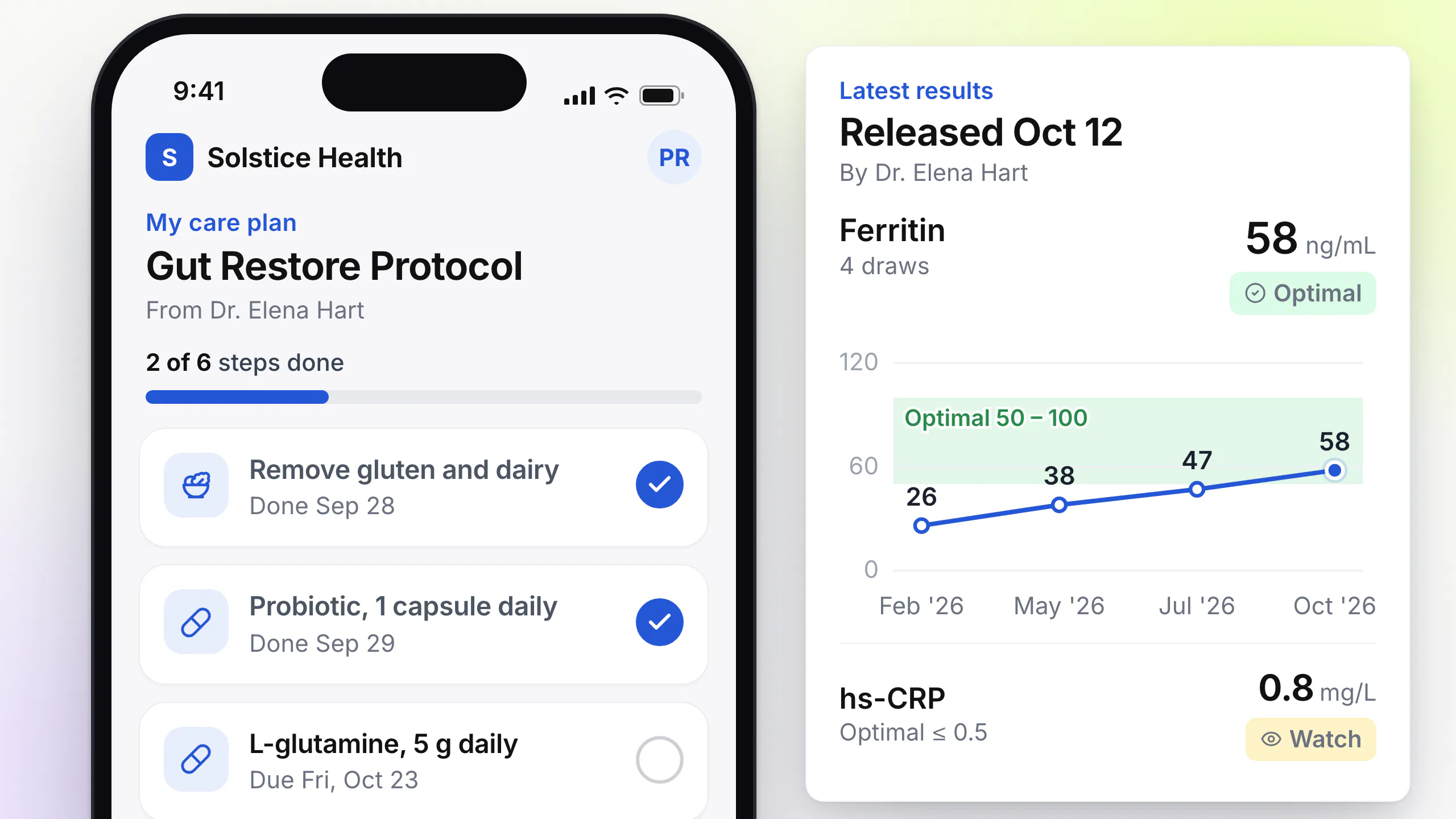
LongevityEHR does not interpret results for you. Range classification is deterministic, and your providers write every word of interpretation. See how it fits a functional practice on our functional medicine EHR page.

Run your longevity clinic on one system
- AI lab extraction with provider review
- Your ranges, every result as a trend
- Memberships through your own Stripe
15-day free trial. BAA on request.
Sources
- IBFMC, Functional Medicine Certification Program (accessed October 21, 2026)
- IBFMC, Eligibility Requirements (accessed October 21, 2026)
- IBFMC, How to Get Certified (accessed October 21, 2026)
- IBFMC, Certification Fees (accessed October 21, 2026)
- The Institute for Functional Medicine, What Is Functional Medicine? (accessed October 21, 2026)
- ABMS, Specialty and Subspecialty Certificates (accessed October 21, 2026)
- Kresser Institute (accessed October 21, 2026)
- School of Applied Functional Medicine (accessed October 21, 2026)
- American Board of Physician Specialties, Integrative Medicine (ABOIM) (accessed October 21, 2026)