
On this page
- What biomarker analysis means in practice
- The main categories of biomarkers
- Commonly discussed longevity biomarkers
- Biomarker tracking methods
- Where biomarker analysis breaks down in clinics
- What to look for in biomarker analysis software
- Our perspective: from isolated values to a clinical loop
- How LongevityEHR supports the workflow
- A practical starting checklist

Key takeaways
- A biomarker is an objective measure of a biological state. The FDA's BEST framework sorts biomarkers into seven types, and most longevity work relies on monitoring, risk and response markers.
- Tracking only works when the same person is measured consistently. Reliability (ICC) and the minimal detectable difference (MDD) tell you whether a change is real or noise.
- The right biomarker set depends on the patient and the clinical context, so ranges and panels should be set by the clinic, not by a lab's generic defaults.
- Biomarker software should turn lab reports into structured, trendable data, keep an audit trail, and protect patient data under HIPAA.
- LongevityEHR starts at $99 per provider a month, with a 15-day trial at $0.
Biomarker analysis is the process of measuring a biological indicator, interpreting the result against a defined reference, and using that interpretation to inform a clinical decision. In a longevity, functional medicine, concierge or hormone clinic, the work is less about a single lab value and more about a repeatable loop: collect, extract, interpret against clinic-defined ranges, act, and measure again. This guide covers the categories of biomarkers, the methods used to track them over time, the sources of variability that distort trends, and the criteria for choosing software that supports the work.
The content is general information for clinic owners and operators in the United States. It is not individual medical, legal or financial advice, and clinical protocols, compliance decisions and billing structures should be reviewed by a qualified professional.
What biomarker analysis means in practice
The term covers several activities that are often blurred together. Biomarker discovery is research: finding a measure that tracks a disease or process. Biomarker testing is the applied side. One academic review defines a biomarker test as the entire set of materials, assay and method used to measure a biomarker. Biomarker analysis sits between the two for a clinician: taking a validated test result and interpreting it for a specific patient at a specific time.
That distinction matters operationally. A clinic does not discover biomarkers. It selects tests, receives results from outside laboratories, and decides what a value means for a care plan. The quality of that decision depends on three things: whether the test is fit for the question, whether the result is comparable with earlier results, and whether the reference range suits the patient in front of you.
Biomarker assessments, the phrase some clinics use for a scheduled panel and review, are the recurring version of this. A baseline assessment establishes starting values. Follow-up assessments, often quarterly or semiannually depending on the protocol, show whether an intervention is moving the markers it was meant to move.
The main categories of biomarkers
The FDA and NIH BEST glossary groups biomarkers into seven types: susceptibility or risk, diagnostic, monitoring, prognostic, predictive, pharmacodynamic or response, and safety. The categories describe the purpose a marker serves, not the molecule being measured. The same analyte can play different roles depending on the question.
| Category | What it answers | Typical clinic use |
|---|---|---|
| Susceptibility or risk | Is this person more likely to develop a condition? | Baseline cardiovascular or metabolic risk review |
| Diagnostic | Is a condition present? | Confirming a suspected deficiency or disorder |
| Monitoring | How is status changing over time? | Serial panels during a care plan |
| Prognostic | What is the likely course? | Stratifying follow-up intensity |
| Predictive | Who is likely to respond to an exposure? | Choosing between intervention options |
| Pharmacodynamic or response | Did the intervention have a biological effect? | Checking a marker after a protocol change |
| Safety | Is harm occurring? | Liver, kidney or hematocrit checks during therapy |
Two of these categories carry most of the weight in cash-pay preventive care. Monitoring biomarkers assess status or intervention effects serially, and predictive biomarkers identify who is more likely to experience a favorable or unfavorable effect from an exposure. Safety markers matter wherever hormone therapy or other prescribed interventions are involved.
Aging biomarkers
Longevity practice adds a further family. A widely cited Cell paper describes how aging biomarkers span molecular, biological, functional, clinical and phenotypic measures and can be used to evaluate biological age and the effect of longevity interventions. Epigenetic clocks and multi-omic measures belong here, and different markers capture different aspects of aging across organ systems and individuals.
The same paper lists the characteristics an effective aging biomarker needs: it should be minimally invasive, reliable over time, responsive to interventions, and better than chronological age at forecasting functional decline. Those four criteria are a useful filter when a vendor offers a new panel. Ask whether there is evidence for each, not just whether the marker is measurable.
Commonly discussed longevity biomarkers
No single list fits every patient, and a defensible protocol says so. Commonly tracked groups in longevity clinics include:
- Cardiometabolic markers: lipids, ApoB, fasting glucose, HbA1c, fasting insulin and HOMA-IR.
- Inflammation markers: high-sensitivity CRP and related measures.
- Hormone panels: sex hormones, thyroid and adrenal markers, relevant to hormone and concierge practices.
- Organ function: liver enzymes, kidney function, complete blood count.
- Nutrient status: vitamin D, B12, ferritin, magnesium and others.
- Aging-specific measures: epigenetic clocks and functional assessments, where the clinic has chosen to offer them.
A clinic can browse a biomarker library for clinicians to see how individual markers are described, but the set a clinic actually orders should come from clinical leadership and the patient's history.
Why the right set varies by patient
The European Society of Medicine notes that reliability is population-specific: a change that is unremarkable in an elderly patient might be a clinical concern in a young adult. It also observes that candidate biomarkers often fail to track clinical status because of flawed initial identification, or because they merely correlate with a risk factor rather than the disease process. For a clinic, this is the argument for custom reference ranges and for treating a marker as one input among several, never as a verdict.
Biomarker tracking methods
Tracking means measuring the same person repeatedly and comparing results. The methods are mostly about reducing the noise that has nothing to do with biology.
- Fix the conditions. Use the same lab, the same assay and the same collection conditions where possible (fasting status, time of day, timing relative to supplements or medication).
- Record the context. Illness, travel, poor sleep, hard training and menstrual cycle phase can all move a result. A structured note beside the value makes later interpretation honest.
- Use consistent quality controls. Research protocols for longitudinal work rely on batch-bridging and consistent quality controls to limit temporal variability. A clinic cannot run its own batch-bridging, but it can avoid switching laboratories mid-protocol without flagging the change.
- Store values in structured form. A PDF cannot be trended. Each result needs a numeric value, unit, date and source so it can be plotted against earlier points.
- Compare against defined ranges. Standard laboratory ranges describe a population. Many longevity clinics also define narrower target ranges for their protocols, which makes the range itself a clinic decision that should be documented.
Is a change real? Reliability, ICC and MDD
A rising or falling number is not automatically progress. The research literature recommends assessing test-retest reliability, ideally with the intraclass correlation coefficient (ICC) for continuous data, rather than relying on simple linear correlation. Practical interpretation of a change then uses the minimal detectable difference (MDD) and the standard error of measurement (SEM). These tell you how large a change must be to exceed measurement noise. They are not equivalent to the minimal clinically important difference, which asks whether the change matters to the patient.
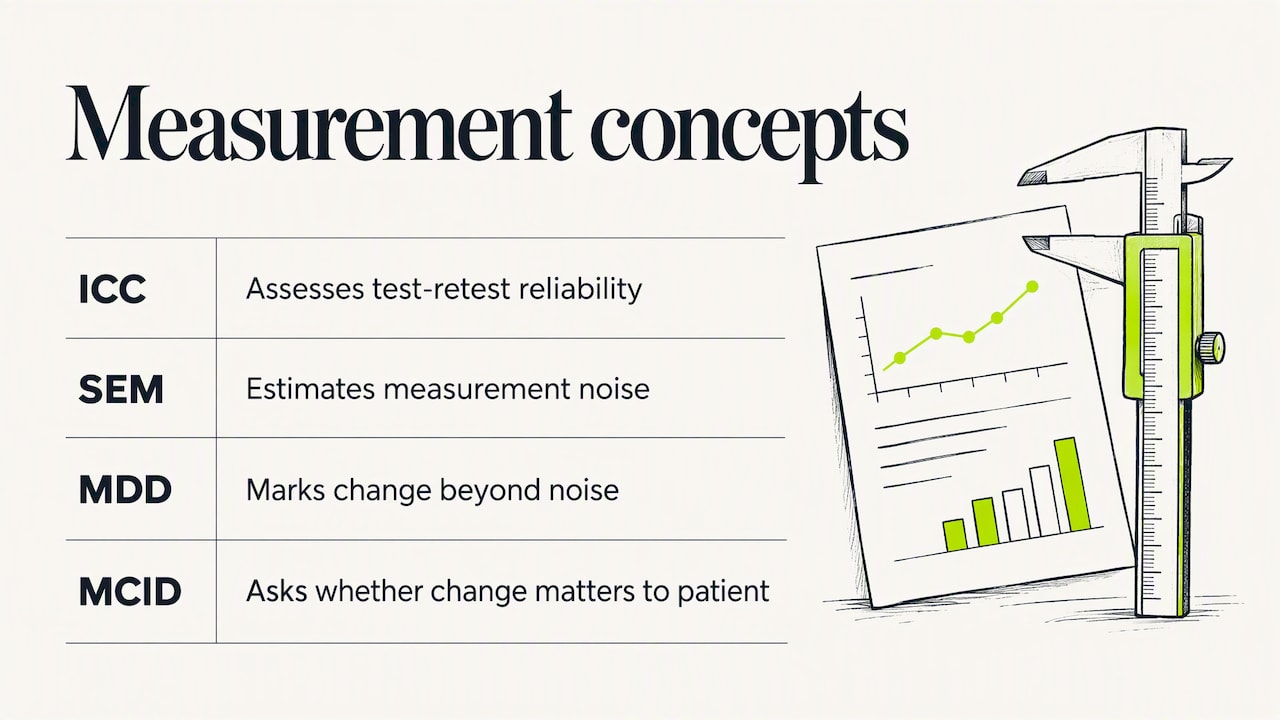
A fictional illustration: a hypothetical patient's fasting insulin moves from 8.0 to 7.4 µIU/mL between two panels drawn at different labs. If the assay's measurement error is larger than 0.6, the change may be noise. If the same value had moved from 14 to 7 on the same assay, the change would more plausibly reflect a real shift. The numbers here are invented to show the reasoning only, and thresholds for any real marker should come from the assay documentation and a qualified clinician.
Robert Califf's widely cited review adds a caution: the idea of clinical monitoring is intuitive, but defining the biomarker change that should trigger a change in care is complex and often less precise than is desirable. Clinic protocols should therefore state their action thresholds in advance and treat them as clinical judgment, not as certainty.
Where biomarker analysis breaks down in clinics
Most problems are operational, not scientific.
- Results arrive as PDFs and portal screenshots. Staff retype values, and each retyped value is an error opportunity.
- Ranges live in a spreadsheet. Different clinicians apply different targets to the same marker.
- Trends are invisible. A value is read in isolation at the visit, and the earlier panel is not pulled up beside it.
- Analysis and action are disconnected. The insight lives in a note, and the care plan is a separate document the patient never sees updated.
- Patients see raw numbers without context. Without explanation, a flagged value can cause alarm or be ignored.
Each of these is a workflow problem that software can reduce, which is where tool selection starts.
What to look for in biomarker analysis software
Software in this category ranges from lab portals to full clinical platforms. Judge it on criteria tied to the loop described above.
| Criterion | What to check |
|---|---|
| Data capture | Can lab reports be converted into structured values without manual retyping, with provider review before anything is saved? |
| Range control | Can the clinic define its own ranges per marker, rather than inheriting a lab's defaults? |
| Trending | Are serial results shown on one timeline, with units and dates consistent? |
| Connection to care | Do results feed care plans, notes and follow-up scheduling in the same system? |
| Patient view | Can patients see results and plans in a portal under the clinic's brand? |
| Privacy and compliance | Is the vendor HIPAA-compliant, will it sign a BAA, and does it offer role-based access and audit trails? |
| Cost structure | Is pricing per provider, and are patient counts capped? |
On privacy, the technical expectations are well established in laboratory interoperability programs: audit logging of result queries and secure transmission are standard features, not extras. In the US, the baseline is HIPAA, and a clinic that stores protected health information with a vendor should ask for a business associate agreement (BAA) and confirm access controls before importing any patient data. Your compliance counsel or a qualified privacy professional should review the arrangement.
Our perspective: from isolated values to a clinical loop
We build for clinics that charge directly for care, and our view is that the biomarker is rarely the weak link. The weak link tends to be the handoff between the lab report and the next clinical action.
Three convictions shape how we approach biomarker analysis.
Ranges belong to the clinic. A functional medicine practice and a hormone clinic often define optimal ranges differently from a reference laboratory, and both can be defensible. The platform should apply the clinic's ranges and make them visible, instead of hiding them in a spreadsheet. See how this works for a functional medicine EHR with custom lab ranges.
AI should draft, and clinicians should decide. Extracting values from a lab report is clerical work, and it is well suited to automation. Interpretation is clinical work. That is why AI lab extraction in our platform places extracted values into the clinic's own biomarker ranges and leaves provider review in the process.
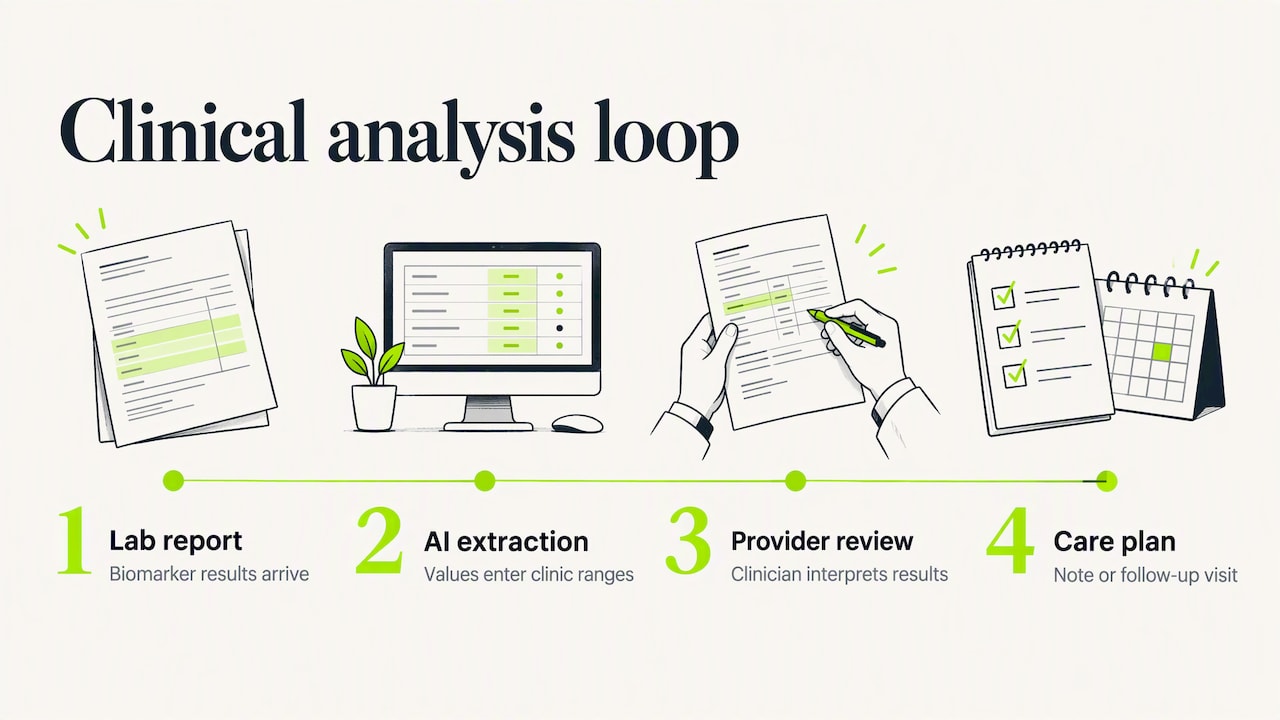
A result should lead somewhere. A value that never reaches a care plan, a note or a follow-up visit has not been analyzed, only stored. Connecting biomarker tracking to care plans built from clinic templates and to scheduling keeps the loop closed.
None of this replaces clinical judgment, and none of it makes a marker more predictive than the evidence supports. It removes the friction that stops clinicians from using the data they already pay to collect.
How LongevityEHR supports the workflow
LongevityEHR is white-label software for cash-pay longevity, functional medicine, concierge and hormone clinics. For biomarker work, the relevant pieces are AI lab extraction into your own biomarker ranges, care plans from your templates, clinical notes, intake forms, scheduling with video visits, memberships and payments through your own Stripe account, and a branded patient portal. Every plan includes unlimited patients. Compliance: HIPAA, with a BAA on request. Details are on the security page.
Pricing is per provider:
| Plan | Monthly | Billed annually |
|---|---|---|
| Trial | $0 for 15 days | Not applicable |
| Core | $99 per provider a month | $69.30 a month ($831.60 a year) |
| Scale | $199 per provider a month | $139.30 a month ($1,671.60 a year) |
| Enterprise | Custom pricing | Custom pricing |
Annual billing is 30% off. You can start on the 15-day trial and test the lab extraction and biomarker views with your own ranges before committing. See current plans and pricing.

For a broader comparison of what a clinic platform should include, the EHR for longevity clinics page walks through labs, plans and the portal together.
A practical starting checklist
Before you add a new marker or tool, run through these steps with your clinical lead:
- Name the question the marker answers and its category (risk, monitoring, response or safety).
- Confirm which laboratory and assay you will use, and commit to keeping it stable for a protocol period.
- Write down the target range and who approved it.
- Decide what change would trigger action, and note that this is a clinical judgment, not a measured certainty.
- Define the re-test interval and the conditions for each draw.
- Decide how the patient will see the result and the explanation.
- Confirm where the data is stored, who can access it, and that a BAA is in place with any vendor handling it.

Run your longevity clinic on one system
- AI lab extraction with provider review
- Your ranges, every result as a trend
- Memberships through your own Stripe
15-day free trial. BAA on request.
Sources
- Biomarkers in early-phase trials: fundamental issues (PMC)
- About Biomarkers and Qualification (FDA)
- Biomarker definitions and their applications (PMC)
- Biomarkers of aging for the identification and evaluation of longevity interventions (Cell)
- Alzheimer blood biomarkers: practical guidelines for study design (Molecular Neurodegeneration)
- Biomarkers in Clinical Practice: Challenges and Opportunities (European Society of Medicine)