
On this page
- What intrinsic capacity means
- The five domains
- What the evidence says
- The ICOPE pathway as a clinical workflow
- Choosing measurement tools
- Interventions that move intrinsic capacity
- Building an intrinsic capacity dashboard
- Perspective: keeping function and labs in one record
- Putting the loop into practice with LongevityEHR
- Limits and cautions
Key takeaways
- Intrinsic capacity (IC) combines five domains: cognition, mobility, psychological, sensory and vitality.
- A 2024 meta-analysis reported a mortality hazard ratio of 0.57 for people with higher IC.
- The WHO ICOPE pathway offers a four-step model: screen, evaluate, build a care plan, monitor.
- Measurement is the main obstacle. Validated domain-specific tools beat custom indices.
- Multicomponent interventions (exercise, nutrition, cognitive training) outperform single-modality ones.
Intrinsic capacity is the composite of all the physical and mental capacities a person can draw on, as defined by the World Health Organization (WHO). Clinicians assess it across five domains: cognition, mobility, psychological health, sensory function and vitality. It measures what a patient can do, not which diagnoses the patient carries, and that is why longevity medicine has adopted it. This guide covers the definition, the evidence, the validated tools and the workflow for tracking it in a clinic.
What intrinsic capacity means
The WHO introduced the concept as part of its healthy ageing framework. Intrinsic capacity describes the combined physical and mental reserves of an individual. It is distinct from functional ability, which also depends on the environment: housing, transport, social support and assistive technology. Two patients with the same IC can function very differently depending on those surroundings.
The framework represents a shift from disease-centered to function-oriented care. A conventional workup asks which conditions are present and whether their markers are controlled. An IC assessment asks whether the patient can walk, think, see, hear, regulate mood and sustain energy, and whether those abilities are holding steady, improving or declining.
Researchers in geriatric medicine describe IC as more than the sum of its parts. It behaves like an underlying functional reserve, and function-centered metrics can reveal pre-clinical decline that standard labs often miss. For a longevity clinic, that is the practical appeal: an early, measurable signal that arrives before a diagnosis or a disability.
The five domains
| Domain | What it covers | Examples of validated or commonly used measures |
|---|---|---|
| Cognition | Memory, orientation, executive function | MMSE, brief screening questions |
| Mobility (locomotion) | Gait, balance, strength | Short Physical Performance Battery (SPPB) |
| Psychological | Mood, depressive symptoms, sleep-related distress | Brief depression screening questionnaires |
| Sensory | Vision and hearing | Visual acuity checks, hearing screens |
| Vitality | Energy and metabolism, nutrition | Nutritional screening, weight change, appetite |
The domain list and the SPPB and MMSE examples come from the WHO-aligned literature reviewed here. Specific instruments vary by study and by clinic, and the choice should be documented so that repeat measurements stay comparable.
Why vitality is the domain clinics overlook
Vitality covers energy and metabolism, which overlaps most with what longevity clinics already track. Fatigue, appetite, weight trends and metabolic labs all inform it. Clinics that run biomarker panels hold much of the vitality data already. What is usually missing is a structured way to place it beside mobility, cognition, mood and sensory results for the same patient.
What the evidence says
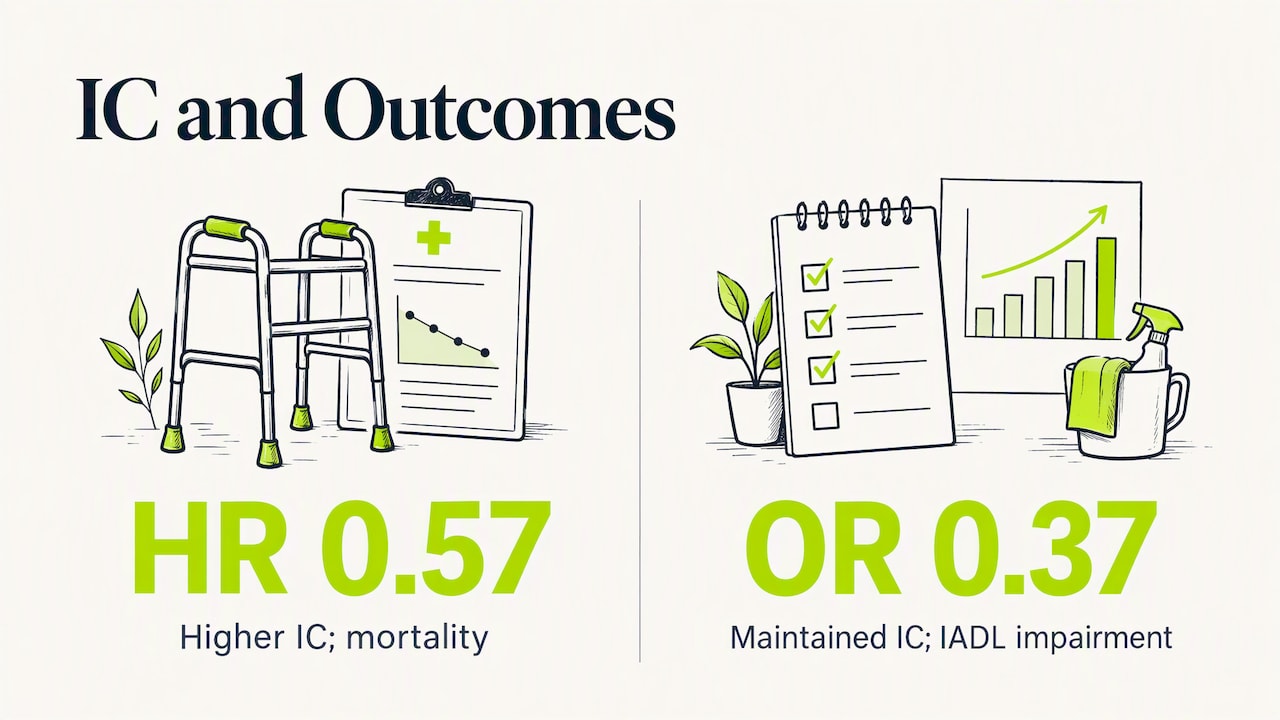
The case for measuring IC rests on its link to outcomes. A 2024 meta-analysis in The Lancet Healthy Longevity reported a hazard ratio for mortality of 0.57 (95% CI 0.51 to 0.63) for individuals with higher intrinsic capacity. It also linked a maintained IC trajectory to an odds ratio of 0.37 (95% CI 0.19 to 0.71) for impairment in instrumental activities of daily living (IADL).
These figures come from older adult cohorts. They show association, not that any single intervention produces the same effect in a given patient. A clinic serving middle-aged, cash-pay clients should treat them as a rationale for monitoring, not as a promise of results.
IC is also not static. A systematic review of IC transitions and trajectories in BMC Geriatrics examined how people move between IC states over time, which supports repeated measurement instead of a one-time score. Other work has explored contributing factors: one analysis of WHO ICOPE pilot data from Lianyungang, China examined the association between polypharmacy and IC. That makes medication review a reasonable part of any IC workup.
The ICOPE pathway as a clinical workflow
The WHO Integrated Care for Older People (ICOPE) approach turns the concept into a four-step pathway:
- Basic screening. A rapid assessment of 8 to 12 minutes that trained professionals or non-experts can deliver.
- In-depth evaluation. A clinical assessment for patients whose screening flagged a concern.
- Personalized care plan. A multidisciplinary plan addressing the identified declines.
- Ongoing monitoring. Repeat measurement to confirm whether capacity is stable or changing.
The pathway was designed for primary and community settings, with the aim of managing functional capacity before irreversible disability occurs. A longevity clinic can borrow the structure while adjusting for a younger and healthier population.
Use filter questions, not one monolithic test
The ICOPE literature describes a common pitfall: trying to assess every domain with a single long instrument. A more efficient design uses filter questions for domains such as cognition and hearing. A "yes" to a trigger question escalates the patient immediately to deeper evaluation. Step 1 is meant to trigger referral, not to diagnose.
A practical intake sequence might look like this:
- Collect screening answers on a pre-visit form so appointment time goes to flagged domains.
- Run a performance test for mobility during the visit.
- Route flagged cognitive, sensory or psychological items to the appropriate clinician or referral.
- Schedule the follow-up date before the patient leaves.
Choosing measurement tools
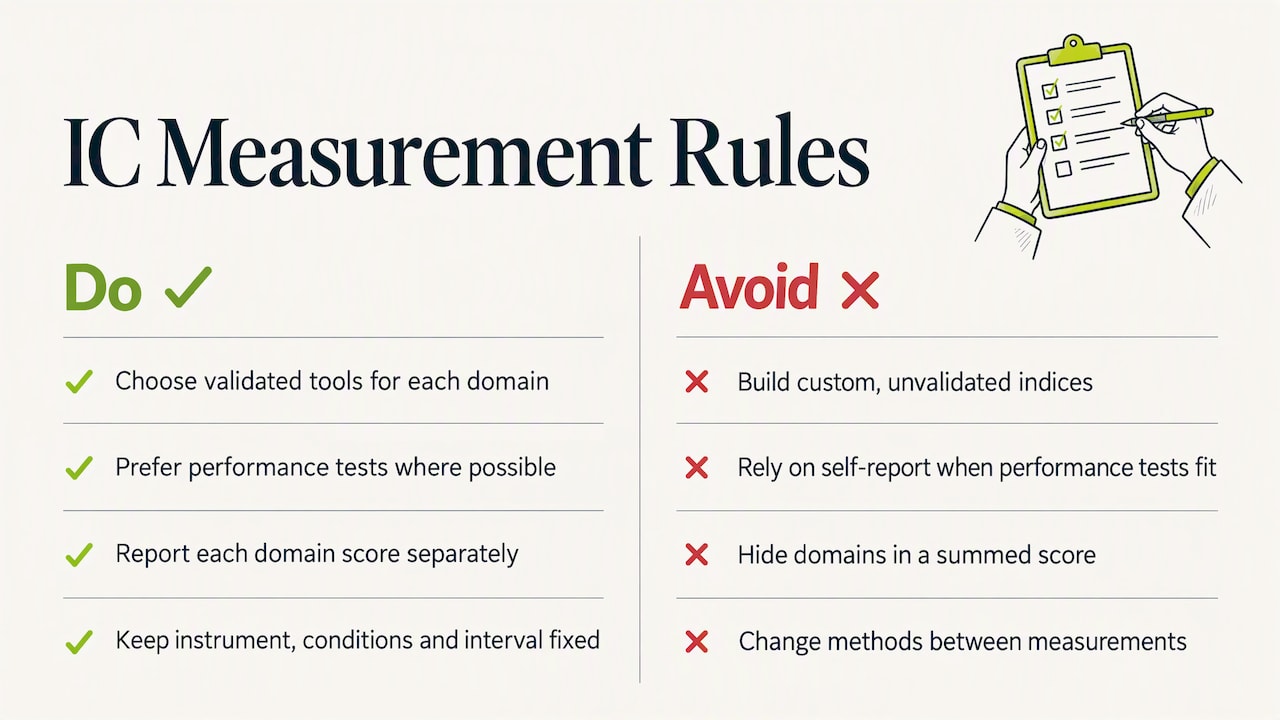
Standardized measurement is currently the biggest hurdle. Researchers have used a wide variety of scales, so cross-study comparison remains difficult. The guidance for clinicians is to select reliable, validated tools for each domain, for example SPPB for mobility and MMSE for cognition, instead of building custom, unvalidated indices. Unvalidated composites can produce unreliable data and weak care plans.
Three practical rules follow.
Prefer performance tests where possible. Self-reported psychological and sensory items carry social desirability and recall bias. These can lead to over- or under-reporting of decline compared with performance-based tests such as the SPPB.
Keep domain scores visible. The same literature notes that a bifactor structural model gives better conceptual clarity and fit than simply summing domain scores. For a clinic, the takeaway is to report each domain alongside any composite, because a single number hides which domain is moving.
Freeze the protocol. Use the same instrument, the same conditions and the same interval each time. A change in the score is only meaningful if the method did not change.
Interventions that move intrinsic capacity
The strongest current evidence favors multicomponent programs. Evidence reviewed in BMC Geriatrics indicates that combining cognitive training, physical exercise such as resistance training, and nutritional advice yields better results than single-modality interventions, which tend not to address the interconnected nature of functional decline.
The parameters reported in that body of work give a starting frame:
- Sessions of 20 to 90 minutes
- Two to three sessions per week
- Resistance training at 30% to 80% of one-repetition maximum (1RM)
These ranges were drawn from studies of older and often frail adults. A clinician must individualize them to the patient's baseline, comorbidities and contraindications. Geroscience experts also note that gerotherapeutics such as metformin and rapamycin are under investigation for aging mechanisms, while practitioners should prioritize multicomponent lifestyle interventions with the strongest evidence.
Building an intrinsic capacity dashboard
Clinics searching for a longevity health dashboard usually want one view of a patient's trajectory. For IC, that view needs a few elements:
- Domain-level scores over time, with dates and the instrument used
- Flags when a screening trigger is positive
- Linked biomarkers for vitality, including labs and wearable data where relevant
- The active care plan, with the interventions assigned to each declining domain
- Next assessment date
The obstacle in most practices is fragmentation. Lab PDFs sit in one place, intake forms in another, and exercise notes in a third. A dashboard that depends on manual re-entry tends to fall out of use within months.
Perspective: keeping function and labs in one record
We build software for longevity and cash-pay clinics. A common gap is that a clinic collects rich lab data, while function measures such as grip strength, gait speed, cognitive screens and hearing checks live in free-text notes or spreadsheets. When a clinician cannot chart those measures against labs for the same patient, the care plan drifts back toward managing numbers.
We do not claim that any platform computes a validated IC score on its own. The measurement science is unsettled, and the guidance to use validated domain tools applies to software as much as to clinicians. What a platform can do is hold the pieces together: custom clinic ranges for biomarkers, structured intake and follow-up forms for screening questions, care plans tied to the patient record, and outcomes reporting across visits. That is the repeatable loop of screen, evaluate, plan and monitor, with the data in one record.
Our view is that clinics should decide on their instruments first and configure software second. The tool should follow the protocol.
Putting the loop into practice with LongevityEHR
For clinics that want to run this loop in one system, LongevityEHR is a white-label platform built for longevity and cash-pay practices. It combines biomarker tracking with custom clinic ranges, custom intake and follow-up forms, care plans and wearable data integration in a branded patient portal. It is HIPAA compliant, with a BAA on request. Role-based access and tenant-isolated data are described on the security page.
Published pricing on the pricing page lists a Core plan at $99 per provider a month ($831.60 per provider a year with annual billing) and a Scale plan at $199 per provider a month ($1,671.60 per provider a year), with unlimited patients on every plan. A 15-day free trial is available, and Enterprise pricing is custom.
Limits and cautions
- Population fit. Most IC research studies older adults. Applying the framework to younger patients is an extrapolation, and thresholds from older cohorts may not transfer.
- Screening is not diagnosis. A positive trigger calls for clinical evaluation by a physician or the relevant specialist, such as an audiologist, ophthalmologist or neurologist.
- Association is not causation. The mortality and IADL figures describe cohorts, not guaranteed outcomes for an individual.
- Documentation and compliance. Any tool that stores screening results in the US handles protected health information and needs HIPAA safeguards. Other countries have their own rules.

Run your longevity clinic on one system
- AI lab extraction with provider review
- Your ranges, every result as a trend
- Memberships through your own Stripe
15-day free trial. BAA on request.
Sources
- Intrinsic capacity and aging: advances in research and clinical practice (PMC)
- Lancet Healthy Longevity meta-analysis on intrinsic capacity and outcomes
- ICOPE implementation framework, 2nd edition (European Geriatric Medicine)
- Intrinsic Capacity in Older Adults: Recent Advances (PMC)
- Transitions and trajectories in intrinsic capacity states over time (BMC Geriatrics)
- Polypharmacy and intrinsic capacity, WHO ICOPE pilot data from Lianyungang (Frontiers in Medicine)
- ICOPE framework measurement guidance (Springer Nature Link)