
On this page

Key takeaways
- A longitudinal health record combines data from many encounters and sources into one view of a person over time. A single visit note, however detailed, is not one.
- Inside one clinic, the record is longitudinal when labs, notes, care plans and intake answers are stored in structured form and can be compared across dates.
- Across organizations, building the record depends on health information exchange, patient matching and data quality controls, and these remain the hard part.
- Longevity clinics can capture most of the value in-house by extracting labs into consistent biomarker ranges and keeping plans, notes and visits in one system.
- This article is general information, not clinical, legal or billing advice. Have a qualified professional review any decision about records and compliance.
A longitudinal health record is a patient's health information gathered over time, across encounters and, in the broadest sense, across providers and care settings. For a cash-pay longevity, functional medicine, concierge or hormone clinic, it is the difference between a stack of isolated lab PDFs and a continuous view of how a patient's biomarkers, plans and symptoms change from one visit to the next. This guide defines the term, lists what such a record contains, explains where it comes from, and describes how a clinic can build one inside its own practice.
What a longitudinal health record means
The word "longitudinal" comes from research. A longitudinal study uses continuous or repeated measures to follow particular individuals over prolonged periods, often years or decades. A longitudinal health record applies the same idea to care: the same person, observed repeatedly, with every observation kept in context.
The academic literature describes it as a person-centered record assembled across time and, in an electronic health record (EHR) environment, across healthcare networks. Readers also search for "longitudinal patient data" and "longitudinal health data." These are the raw material: the individual measurements, diagnoses, prescriptions and notes. The longitudinal record is what results when that material is organized so that a clinician can read it as a timeline.
Three properties define it:
- Continuity. Data points are tied to one person and ordered in time.
- Breadth. The record draws on more than one encounter and ideally more than one source.
- Usability. Entries are structured enough to compare, chart and act on, not only to archive.
How it differs from a conventional EHR
The terms overlap, which causes confusion. The AHIMA explainer distinguishes an electronic medical record, which generally represents care delivered by one provider or enterprise, from the broader EHR concept in which longitudinal care spans multiple providers and settings over a lifetime. The scope is the key distinction. An organization's record can be longitudinal for that provider, while an interoperable EHR follows the person across providers.
The U.S. Office of the National Coordinator for Health IT (ONC) describes an EHR as a digital version of a patient's chart, with information collected and maintained by providers over time, including diagnoses, laboratory results, medications and notes. In practice, an EHR becomes longitudinal only if its data is structured and retained across visits, and only if it is fed by the other places a patient receives care.
| Feature | Single-visit documentation | Practice-level longitudinal record | Cross-organization longitudinal record |
|---|---|---|---|
| Scope | One encounter | All encounters at one clinic | Encounters at many providers |
| Typical data | Note, orders | Notes, labs, plans, forms, visits | Plus pharmacy, hospital and other-clinic data |
| Main challenge | Retrieval | Structuring data consistently | Interoperability and patient matching |
| Who controls it | The clinician | The clinic | A network or exchange |
Most cash-pay clinics operate in the middle column, and that is where a well-designed system can do the most good.
What a longitudinal health record contains
The published descriptions agree on the main categories. A shared longitudinal record can include clinical observations, care summaries, allergies, medications, lab reports, immunizations, medical histories, mental-health and nutritional assessments, action plans, quality-of-life indicators, images and narrative text. The Michigan Health Information Network lists typical elements such as admissions, discharges and transfers, allergies, diagnoses, medications, procedures, lab and imaging results, care plans, referrals and social determinants, standardized, matched and stored across participating organizations.
For a longevity or functional medicine practice, the useful subset looks different from a hospital's. It tends to center on:
- Biomarker history: lipids, glycemic markers, hormones, inflammatory markers and nutrient levels, each with the date and the reference range the clinician used.
- Intake and follow-up questionnaires: symptoms, sleep, stress, diet and goals, repeated at set intervals.
- Clinical notes: assessments and plans written at each visit.
- Care plans: the protocols, supplements, prescriptions and lifestyle targets in force at a given time, along with their revisions.
- Visit and membership history: when the patient was seen and what program they are enrolled in.
Scheduling periodic checkups helps build the record, because repeated reviews are exactly what turns single measurements into a trend a clinician can interpret.
A fictional example
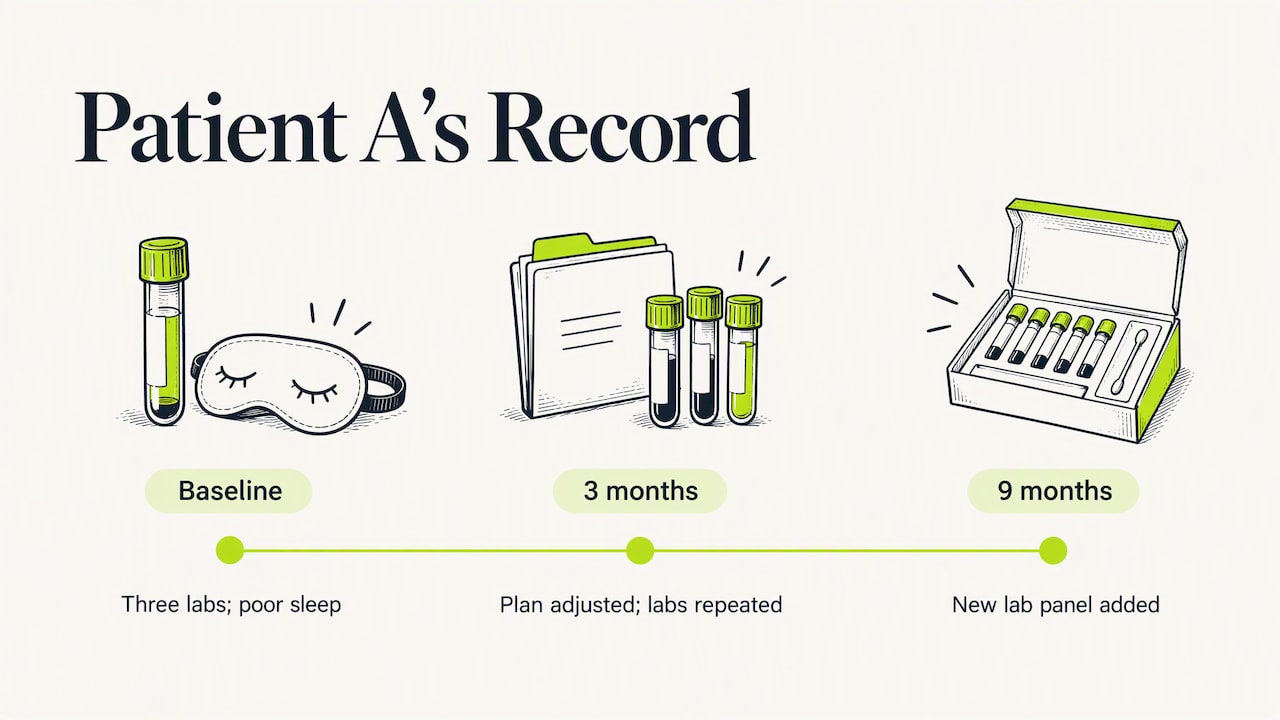
Consider a fictional patient, "Patient A," who joins a clinic at age 48. At baseline, her fasting glucose, fasting insulin and triglycerides are recorded and her intake form notes poor sleep. At three months, the care plan is adjusted and labs are repeated. At nine months, a new lab panel is added. Read alone, each visit shows a snapshot. Read together, they show whether the plan is moving her markers in the direction the clinician intended, and which change in the plan coincided with the shift. That comparison is the entire point of the record.
Where the data comes from
Assembling a complete longitudinal record generally requires combining electronic data from many providers and pharmacies through secure health data sharing. HL7's guidance for personal health records adds that a longitudinal record can combine an organization's EHR data with information from laboratory and radiology systems, personal health records, apps and patient devices, while the EHR remains the authoritative source at the organization. Patients can view, contribute to and manage their own information in that model.
A systematic review of personal health records similarly describes them as potentially integrating provider EHR information with data from wearables and sensors, giving patients and providers a more unified health history.
For an independent clinic, the realistic sources are:
- The clinic's own encounters, notes and plans.
- Outside lab reports, often delivered as PDFs.
- Patient-reported information through intake and follow-up forms.
- Records the patient brings from previous providers.
The second source is where most clinics lose longitudinal value. A PDF lab report is readable but not comparable. If the values are never entered into structured fields, nobody can chart ApoB or HbA1c across four years without retyping.
How clinicians use it
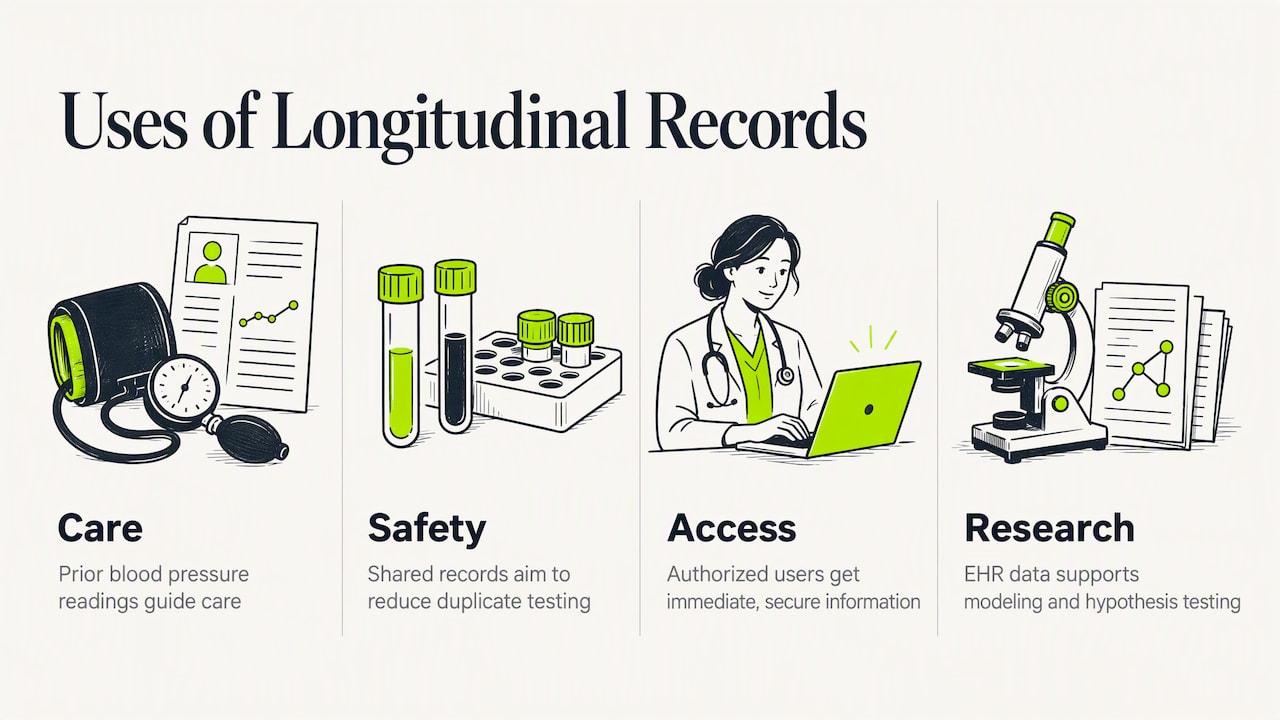
The published literature describes the clinical payoff in plain terms. Providers can retrieve a longitudinal history, or selected information such as prior blood pressure readings, to assess trends and guide care. Shared records are also intended to reduce medical errors and duplicate testing. ONC describes EHRs as real-time, patient-centered records that make information available immediately and securely to authorized users.
A concrete public example of the idea at scale is NHS England's CVD Pathways work, which links primary care blood pressure data with hospital admissions, outpatient appointments, mortality records and dispensed prescriptions to create a longitudinal view of patient health. That is a national data project and not a model for a small clinic, but it shows what the term means once many sources are joined.
Beyond individual care, longitudinal EHR data can support research. A 2024 Nature Medicine review says longitudinal real-world EHR data support understanding health and disease, hypothesis generation and testing, predictive modeling and translation into clinical applications. Clinics should treat this as context, not as a promise about any single practice's data.
Challenges to plan for
The same sources are candid about the difficulties.
- Disparate systems and formats. A review of modern EHRs notes that healthcare data are often distributed across multiple systems and formats instead of sitting in one unified record.
- Terminology and identity. Shared records require harmonizing clinical information and terminologies, identifying patients across systems and assuring data quality.
- Relevance over volume. The same source advises that a shared record should include information relevant for sharing, not a complete data dump.
- Bias and missing data. The Nature Medicine authors caution that EHR analyses are affected by bias and missing information, which can lead to misleading conclusions if ignored.
- Consistency of updates. HL7's draft guide presents synchronization and controlled merging of updates among systems as a safeguard for consistency and integrity. Version history on updates is another safeguard the shared-record literature describes.
For a clinic handling protected health information, privacy and security sit on top of all this. HIPAA obligations, business associate agreements and state privacy laws are matters for your compliance counsel, not for a software feature list.
Building the record inside a cash-pay clinic
The following sequence works for most independent practices. It is general operational guidance and should be adapted with your clinical leadership and legal advisers.
- Define the biomarker set and ranges. Decide which markers you track and which ranges your clinicians use. Longevity and functional practices often use ranges tighter than a lab's standard reference interval, so consistency matters more than any single number.
- Structure lab data at entry. Convert every outside report into discrete values tied to dates. Manual entry is slow and error-prone, which is why many clinics adopt extraction tools with clinician review.
- Standardize intake and follow-up forms. Ask the same questions at set intervals so answers can be compared.
- Write care plans from templates. Template-based plans make it possible to see what changed between versions.
- Keep notes in the same system. A note that lives in a separate document cannot be read next to the biomarker it discusses.
- Review the timeline at every visit. A record that nobody reads is storage. Build the review into the visit workflow.
- Close the loop with the patient. Share results and plans through a branded portal so patients see the same timeline.
The clinical program becomes a repeatable loop: measure, interpret, plan, follow up, measure again. A longitudinal record is the memory of that loop.
Our perspective
We built LongevityEHR for practices that run this loop on a cash-pay basis, and our view is simple: a clinic rarely has a data shortage. It has a structure shortage. Lab reports arrive as PDFs, intake answers sit in a form tool, plans live in documents and notes in another system, so no one can see the whole patient on one screen.
For that reason we focus on the in-practice longitudinal record rather than promising a universal one. Inside the platform, AI extracts values from lab reports into the clinic's own biomarker ranges, and a provider reviews the result before it is relied on. Care plans are created from the clinic's own templates, clinical notes and intake forms sit beside them, scheduling includes video visits, and memberships and payments run through the clinic's own Stripe account. Patients see it all in a white-label portal carrying the clinic's brand.
We would also caution against treating any software as a substitute for clinical judgment. A timeline shows what changed. Deciding what the change means, and what to do, remains the clinician's work. Questions about HIPAA, BAAs and state rules belong with qualified counsel. LongevityEHR is HIPAA compliant, with a BAA on request.
How LongevityEHR supports a longitudinal record
Clinics that want to build the record described above can start with a 15-day trial at $0 and see how labs, plans, notes and visits sit together. The EHR for longevity clinics page explains the platform, AI lab extraction covers how reports become structured values, and biomarker tracking shows how those values are charted over time.
Pricing is per provider, and every plan includes unlimited patients. Annual billing is 30% off.
| Plan | Monthly | Billed annually | Notes |
|---|---|---|---|
| Trial | $0 for 15 days | Not applicable | Try the platform before subscribing |
| Core | $99 per provider a month | $69.30 a month ($831.60 a year) | Unlimited patients |
| Scale | $199 per provider a month | $139.30 a month ($1,671.60 a year) | Unlimited patients |
| Enterprise | Custom pricing | Custom pricing | Contact us |
The platform also includes capabilities such as AI care plan drafting and e-prescribing. Plan details are on the pricing page.

Run your longevity clinic on one system
- AI lab extraction with provider review
- Your ranges, every result as a trend
- Memberships through your own Stripe
15-day free trial. BAA on request.
Sources
- Shared Longitudinal Health Records for Clinical and Population Health
- Benefits of EHRs, ONC
- Defining the Differences Between the CPR, EMR, and EHR, AHIMA
- Longitudinal Records, HL7 Personal Health Records
- Longitudinal Record Use Case Summary, MiHIN
- Longitudinal studies, PMC
- Personal Health Records: A Systematic Literature Review
- CVD Pathways, NHS England Data Science
- Harnessing EHR data for health research, Nature Medicine
- Streams, rivers and data lakes: an introduction to modern EHRs