
On this page
- What subscription billing means for a clinic
- Step 1: Design the membership catalog first
- Step 2: Choose a payment architecture that protects card data
- Step 3: Separate payments from PHI, and get a BAA where needed
- Step 4: Automate renewals and failed-payment recovery
- Step 5: Build a cancellation path that holds up
- Step 6: Connect billing to the rest of the patient record
- Comparing the main ways clinics bill memberships
- Our perspective on membership billing
- Running memberships on LongevityEHR
- A launch checklist for recurring billing
- Metrics worth tracking monthly

Key takeaways
- Define membership tiers, billing cycle and included services before choosing any tool. Billing logic follows the catalog, not the reverse.
- Store cards through tokenization so the clinic never holds raw card numbers, and confirm any vendor touching patient-linked payments will sign a business associate agreement (BAA).
- Automate renewal reminders, card-expiry notices and scheduled retries. Manual collection is where recurring revenue leaks.
- Make cancellation as simple as sign-up. The federal rule was vacated in 2025, but the FTC still pursues deceptive subscription practices.
- Billing works best when it lives in the same system as scheduling, intake and care plans, so a lapsed payment is visible where staff already work.
Managing subscription billing in a clinic means four things: a clear membership catalog, card-on-file payments that renew without staff intervention, a defined process for failed charges, and a cancellation path that is as easy as enrollment. For a cash-pay longevity, concierge or hormone practice, it also means keeping payment data and protected health information (PHI) apart. This guide covers each piece in the order a practice operator would set it up.
Generic subscription guides assume a software company selling seats. A clinic sells access to clinical care, and that changes the compliance picture, the retry rules and the way billing connects to scheduling and patient records.
What subscription billing means for a clinic
A subscription in a clinic is a membership: a patient pays a fixed amount monthly, quarterly or annually in exchange for defined access. That might be a set number of visits, quarterly lab panels, messaging with a clinician, telehealth, or a care plan with follow-ups. Concierge and direct primary care practices have used this structure for years, and longevity clinics have adopted it because ongoing biomarker tracking and plan adjustments fit a recurring model better than one-off visits.
The billing tasks that follow are the same as in any subscription business:
- Enrollment and first charge
- Recurring charges on a schedule
- Upgrades, downgrades and pauses
- Failed payment recovery
- Cancellation and refunds
- Reporting on revenue and retention
What differs is that every one of these events is tied to a patient who is also in a clinical record. That tie is the source of most clinic-specific risk.
Step 1: Design the membership catalog first
Before configuring software, write down what each tier includes. Practices that skip this end up with billing rules that no one can explain to patients.
A workable catalog answers these questions for every tier:
- What is the price and billing period (monthly, annual, or both)?
- What is included, and what is billed separately (labs, supplements, e-prescribing, IV therapies)?
- Are there enrollment fees, and are they refundable?
- What happens to unused visits at the end of a cycle?
- Can a member pause, and for how long?
- What is the cancellation notice, if any, and how is a mid-cycle cancellation prorated?
Offering an annual option at a discount is common because it improves cash flow and reduces the number of renewal events where a patient can lapse. It also raises the stakes for your refund policy, so write that policy before the first annual member signs up.
Keep plan names neutral at the payment layer
The name of a clinical program can itself reveal health information. A plan called "Menopause Hormone Optimization" appearing on a card statement or inside a payment processor's dashboard links a named individual to a condition. Decide early on neutral descriptors for what the payment system sees, and keep the clinical detail inside the record system.
Step 2: Choose a payment architecture that protects card data
The industry method for recurring charges is tokenization. The processor replaces the card number with a proxy token, and your systems store only that token. According to PCI-aligned guidance from a payments developer hub, this reduces a merchant's PCI scope, though merchants are never entirely out of scope. Solutions that let sensitive data touch your own servers keep you fully within scope and require full PCI compliance on your side.
Practical takeaways for a clinic:
- Never collect card numbers in free-text fields, intake forms or email.
- Use a hosted payment form or processor-provided fields so card data goes straight to the processor.
- Ask how long a stored token remains valid and how card updates are handled, because that determines how often you must re-collect payment details.
Step 3: Separate payments from PHI, and get a BAA where needed
The most common mistake in clinic billing is treating a payment tool as if it were only a financial tool. The moment a charge is linked to a patient record, plan name or visit type, the payment flow may involve PHI.

Two safeguards matter:
A signed business associate agreement. A POS buyer's guide for medical clinics warns that many point-of-sale tools advertise recurring billing but that clinics need vendors able to sign a BAA when transactions tie to clinical records. Ask for the BAA in writing before onboarding and confirm it covers every product you will use, not only card processing. Your compliance counsel or privacy officer should review it.
Data minimization in billing events. One healthcare billing vendor describes an architecture in which PHI never reaches the payment processor. Whichever tool you use, the principle is sound: the processor should receive an amount and a token, not a diagnosis, a clinic program or clinical notes.
A quick audit you can run this week:
| Question | Good answer |
|---|---|
| What does the processor see in the charge description? | A neutral label, not a clinical program name |
| Can staff view full card numbers? | No, only the last four digits |
| Who can see billing data? | Role-based access, limited to staff who need it |
| Is patient data isolated from other customers of the software? | Yes, with tenant-level separation |
| Is there a signed BAA? | Yes, covering all services in use |
Our security and HIPAA overview describes how role-based access and tenant-isolated data work on our platform.
Step 4: Automate renewals and failed-payment recovery
Manual invoicing does not scale past a few dozen members. Staff forget, patients feel awkward being chased, and revenue slips. Automation should cover three events.
Pre-renewal communication
Send a reminder before each renewal, especially annual ones. Membership software vendors describe proactive reminders and card-expiry notices as a significant retention lever compared with reactive collections. The vendor makes that claim about its own category, so treat it as direction rather than a guaranteed figure, and measure your own results.
A sensible cadence:
- 30 days before an annual renewal: a plain notice with date, amount and how to update the card or cancel
- 7 days before: a short reminder
- On the day: a receipt after the charge succeeds
- When a card is within a month of expiring: a prompt to update it
Retry schedules
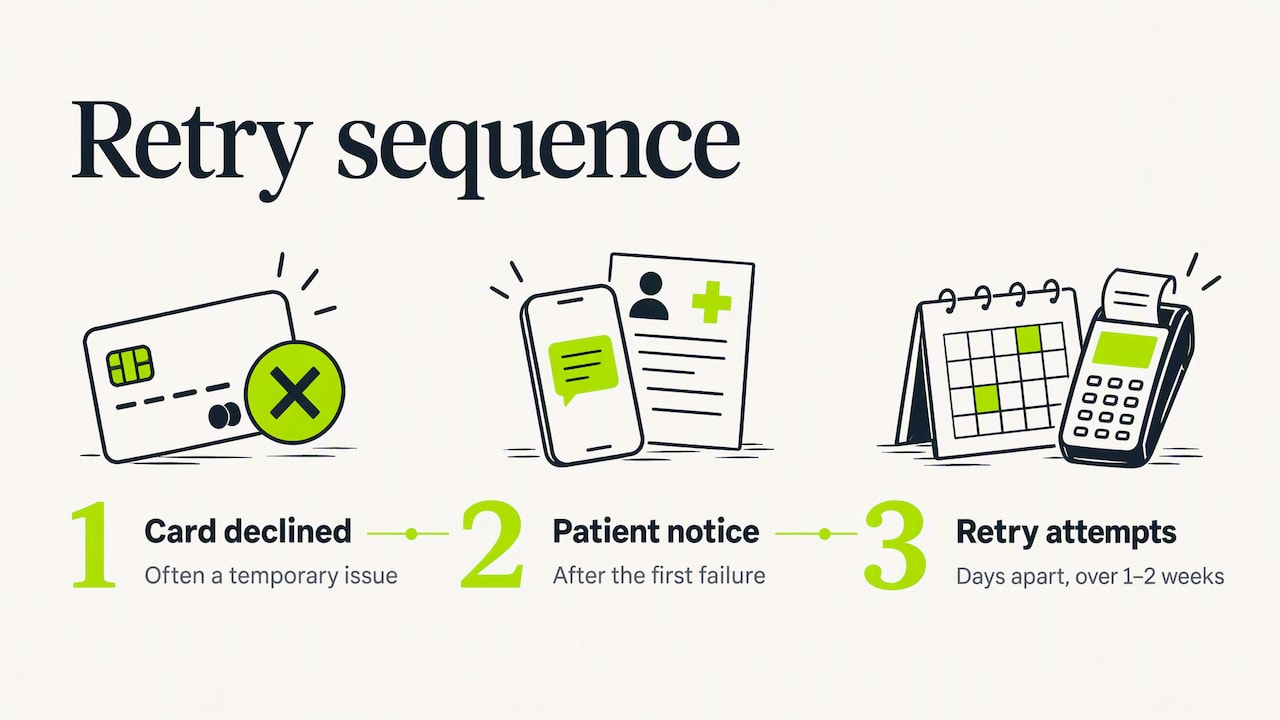
A declined card is often a temporary issue: an expired card, a limit, or a bank flag. A retry schedule spaced over several days recovers many of these without a phone call. Typical designs retry a few times over one to two weeks, with a patient notice after the first failure. Check your processor's documentation for its supported retry options and any card-network rules.
A clear grace period
Decide in advance what happens when payment fails: do members keep access for seven days, or are bookings paused immediately? Clinical continuity matters. A patient on an active care plan should not be abruptly cut off from a message thread because of an expired card. Many clinics keep clinical access during a short grace period and pause only elective services.
Step 5: Build a cancellation path that holds up
This is where billing meets regulation, and the legal situation needs precision.
The FTC announced it had finalized a "click to cancel" rule in January 2025 requiring that cancelling be as easy as signing up. On July 8, 2025, the Eighth Circuit vacated that rule on procedural grounds, and the FTC has since moved toward revisiting it. So there is no current federal click-to-cancel rule in force as of this writing, but that does not make hard-to-cancel memberships safe.
The FTC continues to enforce the Restore Online Shoppers' Confidence Act (ROSCA) and Section 5 of the FTC Act. Its amended complaint against Uber, joined by state attorneys general, challenges a subscription program's enrollment and cancellation practices. A stipulated order in a separate FTC case cites the same statutes. Many states also have their own automatic renewal laws, so a clinic should have counsel review its terms for each state where it enrolls patients.
A defensible design for a clinic, whatever the current rule status:
- Disclose price, billing frequency, renewal terms and cancellation method clearly before the patient pays.
- Obtain express consent to recurring charges.
- Let patients cancel through the same channel they used to enroll. If sign-up is online, cancellation should not require a phone call.
- Confirm cancellation in writing and state the effective date.
- Keep consent records and cancellation logs.
This is a legal question as much as an operational one. Have a healthcare attorney in your state review the membership agreement before launch.
Step 6: Connect billing to the rest of the patient record
Billing that sits in a separate tool creates blind spots. A front-desk coordinator booking a follow-up cannot see that the membership lapsed. A clinician cannot tell whether a patient is still enrolled in a care plan. Reports on retention require exporting from two systems and reconciling by hand.
When memberships, scheduling, intake and care plans share one platform, several things become simple:
- Booking rules can reflect membership status.
- Intake forms are completed during enrollment, not chased afterward.
- Care plan renewals line up with membership renewals.
- Outcomes and retention can be reported by cohort.
We cover these connections on our pages for scheduling and telehealth, care plans and intake forms.
Comparing the main ways clinics bill memberships
| Approach | Strengths | Weaknesses |
|---|---|---|
| General point-of-sale subscriptions | Quick to start, familiar | May lack a BAA, no link to the patient record, manual reconciliation |
| Standalone healthcare billing tool | Built for PHI separation | Separate system from scheduling and clinical data |
| Manual invoicing and spreadsheets | No software cost | Error-prone, does not scale, high missed-renewal risk |
| Membership billing built into the clinical platform | One record, branded portal, status visible to staff | Requires choosing a platform that fits your specialty |
The right choice depends on volume and complexity. A solo practice with twenty members can tolerate more manual work than a multi-location clinic with several tiers and annual plans.
Our perspective on membership billing
We build software for longevity and cash-pay clinics. A common risk is launching with a sound clinical program and a patchwork billing setup, where the patchwork becomes the part that limits growth.
The reasoning behind our approach is simple. A longevity patient relationship is a loop of labs, review, plan adjustment and follow-up. The membership is what funds that loop and keeps the patient engaged in it. If billing is a separate world, the loop has a gap at exactly the point where retention is decided. That is why memberships and payments sit alongside labs, biomarkers, care plans and scheduling in one portal, and why payments run through the clinic's own Stripe account with the patient portal in the clinic's brand.
We also think clinics should be skeptical of any billing setup they cannot explain to a patient in two sentences. If cancellation is hard, the patient notices, and the trust you built clinically erodes. Make joining and leaving equally clear, and let outcomes drive renewal.
Running memberships on LongevityEHR
Our membership and payments features let a clinic sell monthly or yearly memberships, bundles and single services, collect payments through its own Stripe account and present everything in a branded patient portal. Billing sits in the same platform as the clinical record, with role-based access and tenant-isolated data.
Pricing is published and billed per provider seat, with unlimited patients on every plan and 30% off with annual billing:
| Plan | Monthly | Annual |
|---|---|---|
| Core | $99 per seat | $831.60 per seat a year |
| Scale | $199 per seat | $1,671.60 per seat a year |
| Trial | $0 for 15 days | Not applicable |
| Enterprise | Custom | Custom |
See the pricing page for what each plan includes, or review the full feature list before you decide. Concierge and direct primary care practices can also look at our concierge medicine software page.
A launch checklist for recurring billing
Use this list before enrolling your first member:
- Membership tiers, prices and inclusions are written down.
- Terms of service state renewal frequency, price and cancellation steps in plain language.
- Consent to recurring charges is captured and stored.
- The payment vendor has signed a BAA where charges tie to patient records.
- Card data is tokenized and never stored by clinic staff.
- Charge descriptions are neutral.
- Renewal reminders and card-expiry notices are scheduled.
- A retry schedule and grace period are defined.
- Cancellation works through the enrollment channel and sends written confirmation.
- A healthcare attorney has reviewed the agreement for each state where you enroll patients.
- Staff know who handles refund requests and disputes.
- A monthly report covers new members, cancellations, failed payments and recovered revenue.
Metrics worth tracking monthly
Billing data is also your earliest warning system. Track a short list consistently:
- Monthly recurring revenue by tier, so you see which memberships actually drive income.
- Involuntary churn: members lost to failed payments rather than a decision to leave. This is the number automation should shrink.
- Voluntary churn: members who cancel, with reasons recorded at cancellation.
- Recovery rate: the share of failed charges collected after retries.
- Annual-to-monthly mix, which affects cash flow and the volume of renewal events.
Review these alongside clinical outcomes. A tier with high cancellations after the first lab review may signal that expectations were set poorly at enrollment, not that the price is wrong.

Run your longevity clinic on one system
- AI lab extraction with provider review
- Your ranges, every result as a trend
- Memberships through your own Stripe
15-day free trial. BAA on request.
Sources
- Security | North Developer
- Best Medical & Healthcare POS Systems 2026 | POSadvice.com
- Echobind: Meet CopperTab
- Membee: Renewal features
- FTC Releases Summary of Key Accomplishments
- Crowell: FTC Moves to Revive Click-to-Cancel Rule
- FTC et al. v. Uber et al., First Amended Complaint
- Stipulated Order for Permanent Injunction, FloatMe