
On this page
- What a follow-up form is for
- What a patient follow-up form should collect
- A sample layout
- How to write questions patients will actually answer
- Build the workflow, not just the form
- Connecting forms to labs and results
- Privacy and security when forms go digital
- Perspective
- Running follow-up inside LongevityEHR
- Pricing and getting started

Key takeaways
- Follow-up means contacting a patient at a later, specified date to check progress since the last visit. A form is the structured way to do it between appointments.
- A strong form has five parts: symptoms and function, adherence and side effects, measured values, goals from the care plan, and a clear instruction on when to call.
- Forms only improve care when someone owns the review, a schedule exists, and the results are audited.
- Collect follow-up data in a HIPAA-covered system with a BAA in place, not through unsecured email.
- LongevityEHR includes custom intake and follow-up forms, clinical notes, care plans from clinic templates and a white-label portal. Plans start with a 15-day trial at $0.
A patient follow-up form works when it is short, tied to the patient's care plan, and reviewed by a named person within a set time. For a cash-pay longevity, functional medicine, concierge or hormone clinic, that means the form lives inside the same system as labs, notes, scheduling and the patient portal, so answers land in the chart instead of an inbox. This guide covers what to collect, how to word it, and how to turn forms into a repeatable loop.
The content below is general information for clinic owners and operators. Clinical content, consent language and billing treatment should be reviewed by a qualified clinician, healthcare attorney or compliance professional before you adopt them.
What a follow-up form is for
The U.S. Agency for Healthcare Research and Quality (AHRQ) defines follow-up as contacting a patient or caregiver at a later, specified date to check progress since the last appointment. Its stated purposes include monitoring health, reinforcing action plans, confirming medicine regimens, scheduling appointments, verifying that referrals were completed, and sharing lab results.
AHRQ also notes that follow-up can surface misunderstandings, answer questions and build a trusting relationship. In a cash-pay model, that last point carries weight. Members pay for ongoing attention, and a well-timed check-in is the most visible proof that the attention continues between visits.
A follow-up form differs from an intake form in one way. Intake builds the baseline. Follow-up measures change against that baseline. If the two are built separately, with different wording and different storage, comparing them becomes manual work. That is the first design decision to get right.
What a patient follow-up form should collect
Many free templates for this topic are generic: a name line, a checklist of symptoms, a few open boxes. A longevity or functional medicine practice needs more structure, because the care plan is built on protocols, supplements, hormone therapy, lifestyle targets and repeat labs. A practical form has five blocks.
1. Symptoms and function since the last visit
Ask what has changed, not only what is wrong. Use a short scale for energy, sleep, mood, digestion, pain and cognition, then one open question: "What is the main thing you want us to address next?" Keep the scale identical every time so trends are comparable.
Some programs use validated instruments for this block. Cleveland Clinic's Center for Functional Medicine, for example, uses the NIH-validated PROMIS Global Health questionnaire, 10 questions that take about 5 minutes, sent electronically 7 days before appointments to track physical, mental and social well-being over the course of care. A clinic can adopt a validated tool like this or build its own scale, as long as it stays consistent.
2. Adherence and side effects
List the items in the patient's current plan (medications, supplements, hormone protocols, dietary changes) and ask for each one: taken as directed, partly, or not at all, and any side effects. AHRQ lists confirming medicine regimens as a core purpose of follow-up. Pre-populating this list from the care plan saves the patient from retyping and keeps the answers aligned to what you actually prescribed.
3. Self-measured values
AHRQ advises asking patients to track key clinical values between visits using simple forms, portals, automated calling, apps, or devices that report results automatically. For a longevity clinic this might be home blood pressure, morning weight, fasting glucose readings or sleep hours. Ask for the value, the date and the conditions (fasting, after exercise, and so on).
4. Progress against care-plan goals
The CMS Innovation Center's ACCESS model Care Update template offers a useful pattern. It structures tracking around each clinical measure with a baseline value, most recent value and target value, followed by a clinician assessment of progress, a plan, and a secure contact for questions. Its examples include blood pressure, HbA1c and LDL cholesterol.
That three-column logic (where the patient started, where they are, where they are headed) fits longevity work directly. Apply it to ApoB, fasting insulin, testosterone, vitamin D or whatever markers your protocols target.
5. Questions, concerns and a contact instruction
End with an open box for questions and one explicit instruction on when to call rather than wait. AHRQ gives examples such as blood pressure above 140/90 or a weight gain of more than 2 to 3 pounds in a day for heart failure patients, and advises that patients using paper forms be told to call when values are of concern. Your thresholds should come from your clinicians and be specific to the patient's condition.
A sample layout
The table below shows one way to structure a monthly follow-up for a fictional patient on a hormone and metabolic health protocol. It is an illustration, not clinical guidance.
| Block | Example item | Response type |
|---|---|---|
| Symptoms | Energy, sleep quality, mood (1 to 10) | Scale |
| Adherence | Each protocol item, taken as directed? | Yes, partly, no |
| Side effects | Any new symptoms since the last visit | Checklist plus text |
| Measured values | Morning weight, home blood pressure | Number plus date |
| Goals | Progress on the two goals set at the last visit | Scale plus text |
| Contact | Preferred contact method, questions for the provider | Choice plus text |
How to write questions patients will actually answer
Completion rates fall when forms read like a clinical chart. AHRQ recommends using easy-to-understand language without medical terminology in messages, asking patients how they prefer to be contacted, and giving clear instructions on when to reach the practice. Practical rules that follow:
- Ask one thing per question. "How is your sleep and energy?" is two questions.
- Use the same scale and the same direction (higher is better) throughout.
- Keep the routine form under 10 minutes. Reserve long questionnaires for quarterly reviews.
- Show the patient their own goal in the form. "Your target is fasting glucose under 100" is more motivating than a blank field.
- Tell patients what happens next: who reads it and how soon they will hear back.
Physicians sometimes worry that adding forms adds work. The opposite holds when forms replace unstructured portal messages and phone tag, because the answers arrive in a consistent shape that a clinician can scan quickly.
Build the workflow, not just the form
A form with no owner is a liability. AHRQ's follow-up guidance lays out a sequence that translates well to a cash-pay practice. Each step below includes where it tends to go wrong.
- Decide who gets follow-up and why. AHRQ points to patients on high-risk medicines, those managing chronic conditions, those who missed appointments and those recently discharged. In a longevity clinic, add patients who just started a new protocol or who have repeat labs pending. Going wrong: sending the same form to everyone, which trains patients to ignore it.
- Assign responsibility. Name who sends, who reads, who responds and who escalates to the clinician. Going wrong: "the team" owns it, so no one does.
- Set the schedule. Tie timing to the plan: two weeks after a new protocol, monthly during titration, quarterly once stable. Going wrong: ad hoc timing that depends on who remembers.
- Track it in the record. AHRQ recommends tracking through the EHR or a computer-based calendar and assigning staff to keep it current. Going wrong: tracking in a separate spreadsheet that falls out of date.
- Audit. Sample records to count follow-up actions completed within the target time frame and what they achieved, such as medicine changes, referrals or clarified regimens. Going wrong: measuring forms sent instead of outcomes produced.
In LongevityEHR, scheduling, video visits, clinical notes, care plans and forms sit in one platform, so step four happens in the same record the clinician already opens. A follow-up response can sit beside the visit note and the care plan it relates to, instead of in a separate tool.
Connecting forms to labs and results
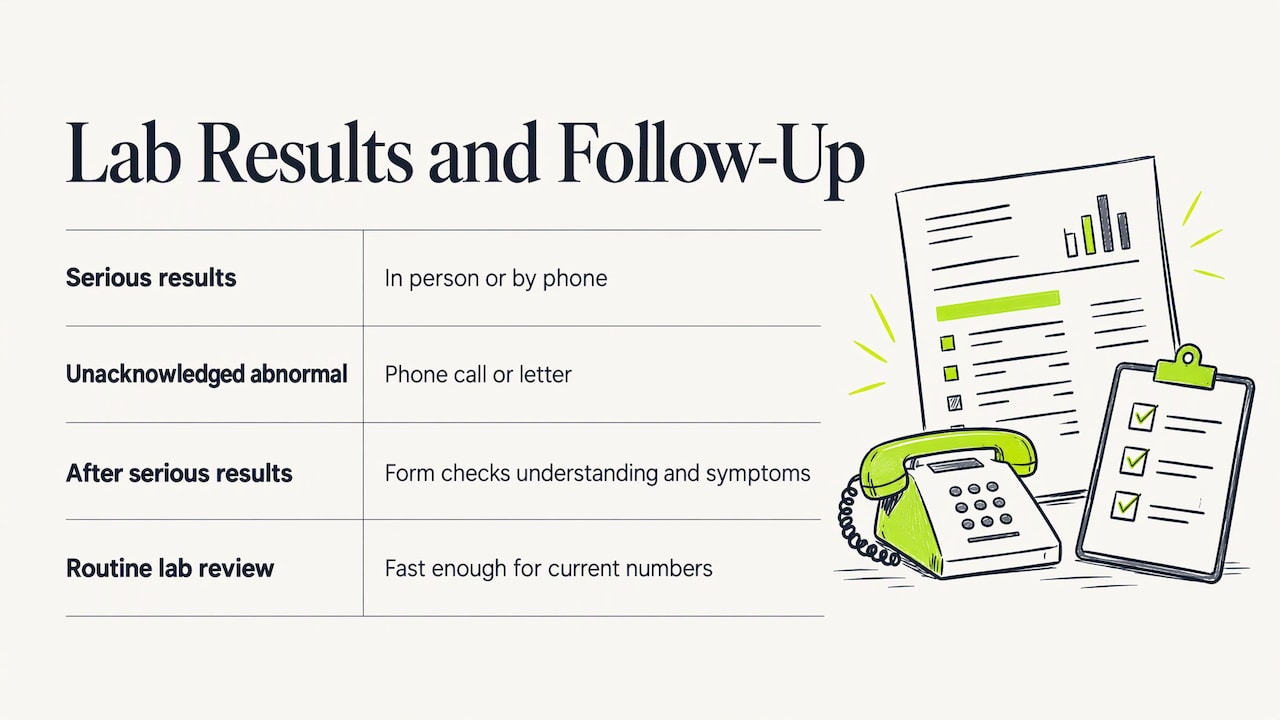
Follow-up forms and lab results belong together. The ONC SAFER Guide on test results states that failure to follow up on diagnostic test results can lead to misdiagnosis, patient harm and liability, and recommends monitoring clinician review of results and follow-up on abnormal ones as a quality activity. The same guide recommends that time-sensitive or unambiguous results, such as a cancer diagnosis, be communicated in person or by telephone rather than asynchronously, and that when a patient cannot be confirmed to have acknowledged an abnormal result, a phone call or letter be used instead.
Two practical conclusions for a clinic. First, a follow-up form is not the channel for delivering serious results. Use a call or visit, and use the form to check understanding and symptoms afterward. Second, routine lab review should be fast enough that the follow-up form can reference current numbers.
LongevityEHR's AI lab extraction reads lab reports into the clinic's own biomarker ranges, with provider review, so the values a follow-up refers to are already in the chart. Care plans are built from clinic templates through the care plan tools, which keeps goals and follow-up questions tied to the same protocol.
Privacy and security when forms go digital
Follow-up forms collect protected health information, so the delivery channel matters. AHRQ says sensitive health and personal information should not be sent through unsecured email. A secure patient portal is the usual answer.
For HIPAA purposes, a software vendor that stores or handles ePHI on your behalf is a business associate. HHS states that a covered entity may use a cloud service to store or process ePHI provided it enters into a HIPAA-compliant business associate agreement (BAA) with the provider and otherwise complies with the HIPAA Rules. Before you adopt any form tool, confirm that a BAA is available. LongevityEHR is HIPAA, with a BAA on request, and offers role-based access and tenant-isolated data. More detail is on the security page, and a practical guide to HIPAA-compliant messaging covers the communication side.
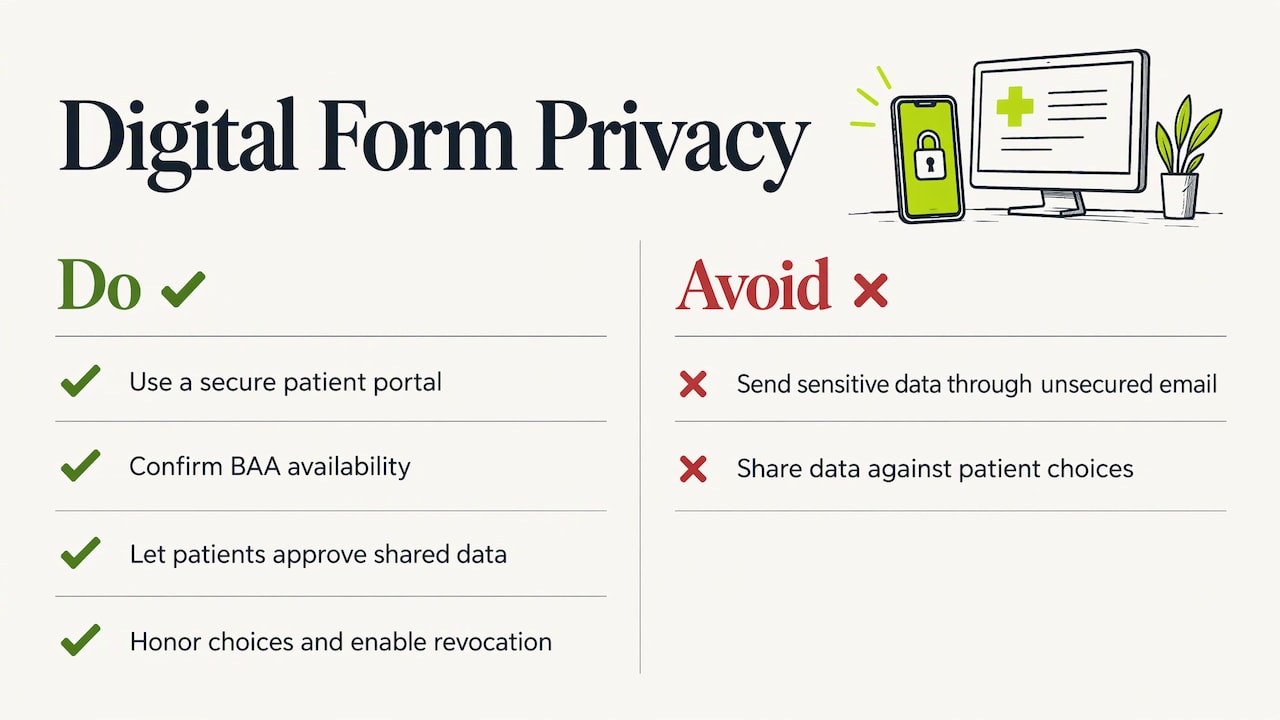
ONC's guidance on patient-directed data sharing adds two habits worth copying. Give patients the opportunity to approve how their health information is transmitted, respect their choices about which data types are shared, and make revoking permission clear and easy. Your privacy officer or healthcare attorney should confirm the consent language that applies to your state and services.
Perspective
We built follow-up into LongevityEHR because the care loop in a longevity clinic does not end when the visit does. Labs, protocols and goals change over weeks, and the patient's own report is the missing data between appointments.
The mistake to avoid is treating the follow-up form as a separate document. When it shares a record with the intake, the clinical notes, the biomarkers and the care plan, a provider can read progress in one place and decide the next step. When it lives in a different tool, it becomes one more inbox.
Our approach is to keep the clinic in control: the clinic's own forms, the clinic's own biomarker ranges, care plans from the clinic's own templates, and a patient portal under the clinic's brand. Providers stay the reviewers of every result.
Running follow-up inside LongevityEHR
LongevityEHR is a white-label EHR for cash-pay longevity, functional medicine, concierge and hormone clinics. For follow-up, the relevant pieces are:
- Intake and follow-up forms that the clinic customizes.
- Clinical notes kept in the same record.
- Scheduling with video visits, so a flagged response can become a visit.
- A white-label patient portal in the clinic's branding.
- Memberships and payments through the clinic's own Stripe account.
Clinics can launch under their own brand in days, without custom development.
Pricing and getting started
Every plan includes unlimited patients, and annual billing is 30% off. Licensing is per provider.
| Plan | Monthly | Billed annually |
|---|---|---|
| Trial | $0 for 15 days | Not applicable |
| Core | $99 per provider a month | $69.30 a month ($831.60 a year) |
| Scale | $199 per provider a month | $139.30 a month ($1,671.60 a year) |
| Enterprise | Custom pricing | Custom pricing |
The fastest way to judge fit is to build one real follow-up form in the 15-day trial, covering the five blocks above, and send it to a fictional test patient. See the plans and trial for details.

Run your longevity clinic on one system
- AI lab extraction with provider review
- Your ranges, every result as a trend
- Memberships through your own Stripe
15-day free trial. BAA on request.
Sources
- AHRQ Health Literacy Universal Precautions Toolkit, Tool 6
- AHRQ: Follow Up with Patients, Tool 6
- CMS ACCESS model Care Update template
- Cleveland Clinic Center for Functional Medicine new patient packet
- ONC SAFER Guide: Test Results Reporting and Follow-up
- ONC: Key Privacy and Security Considerations for Healthcare APIs
- HHS: Business Associates FAQ