
On this page

Key takeaways
- Self-scheduling is real-time booking by the patient on the web or a phone app, limited by provider-defined rules such as visit type, length and lead time.
- A case study of nearly 2 million appointments found lower no-show rates for self-scheduled visits (2.7% vs 4.6%) but higher cancellation rates (37.6% vs 27.0%), so plan for open slots to be released and refilled.
- Start with established-patient follow-ups and video visits, and keep phone or in-person booking for patients who prefer it.
- Require rules, reminders, intake and payment links, and clean data in the clinical record, not just a booking page.
- LongevityEHR includes scheduling with video visits, intake forms, memberships and a white-label portal, with in-app scheduling on the Core, Scale and Enterprise plans.
Patient self-scheduling lets a patient book, reschedule or cancel an appointment online without calling the front desk, within rules the clinic defines. For cash-pay longevity, functional medicine, concierge and hormone clinics, the useful question is not whether to offer it, but which visits to open, which to keep staff-controlled, and how to keep the booking tied to intake, payment and the clinical record. This guide covers the definition, the evidence, the features to require and a six-step rollout. It is general information, not legal or financial advice, and your compliance counsel should review the final setup.
What patient self-scheduling means
A scoping review of the literature describes patient self-scheduling as synchronous, real-time appointment booking that patients complete on the web or through a smartphone app. The key word is synchronous. The patient sees live availability, picks a slot and receives confirmation immediately, with no callback or email thread.
That separates it from a simple request form, where the patient submits a preferred time and staff confirm later. A request form still creates work for staff. True self-scheduling moves the transaction to the patient and leaves staff to design the rules and handle exceptions.
The same capability goes by several names: online patient appointment scheduling, direct scheduling, online booking. The mechanics are consistent:
- The clinic defines appointment types, durations, providers, locations and who may book each.
- The system exposes open slots that satisfy those rules.
- The patient chooses a slot, confirms and can later change or cancel within the clinic's limits.
- The booking lands on the provider's calendar and in the patient's record.
The quality of a system is determined mostly by step 1. A calendar that shows every slot to every patient produces mismatched visits. A calendar that applies rules produces bookings staff do not need to fix.
What the research shows about benefits
The evidence is encouraging but uneven, and it comes mostly from large health systems rather than small private practices. Read it as direction, not as a forecast for your clinic.
| Finding | Source context |
|---|---|
| Possible labor savings, information transparency, cost reduction, cycle-time gains, satisfaction, loyalty and attendance | 2022 scoping review |
| No-shows 2.7% for self-scheduled vs 4.6% otherwise; cancellations 37.6% vs 27.0% | Case study of nearly 2 million U.S. appointments, January 2019 to June 2021 |
| Patients seen through accepted rescheduling offers were seen a median of 14 days sooner | 2024 study of an EHR-based self-rescheduling tool |
| 93.5% of exclusively self-scheduled screening mammograms needed a single step, vs 74.5% staff-scheduled | 2021 mammogram scheduling study |
| Decreased staff labor and waiting time in studies of web-based scheduling | 2022 scoping review |
Two details matter for operators. First, the lower no-show rate comes with a higher cancellation rate. Patients who book themselves also cancel more easily, which is better for you than a silent no-show only if the freed slot can be refilled. A waitlist, or a clear cancellation window, turns the pattern into an advantage.
Second, the 2024 rescheduling study reported an estimated $3 million in professional fees over nine months at a large academic system. That figure reflects a health system with high volume and insured visits. A cash-pay clinic should translate the logic, not the number: every earlier recovered slot is a visit that would otherwise sit empty or be delayed.
The evidence also has limits. A 2011 systematic review of advanced access scheduling found reductions of 1.1 to 32 days in third-next-available wait times across primary care studies, but noted that data on clinical outcomes and loss to follow-up were limited. Faster access is documented. Better health outcomes from scheduling alone are not.
Who uses it and who does not
Adoption is not even. In the nearly 2 million appointment case study, self-scheduling users skewed younger and commercially insured, and Medicaid patients used it less. The same paper points to access to technology and technology literacy as barriers, and to intuitive design, willingness and patient training as supports.
A 2024 retrospective study found that patients aged 65 or older and patients who primarily spoke Chinese or another language were less likely to accept rescheduling offers than comparison groups.
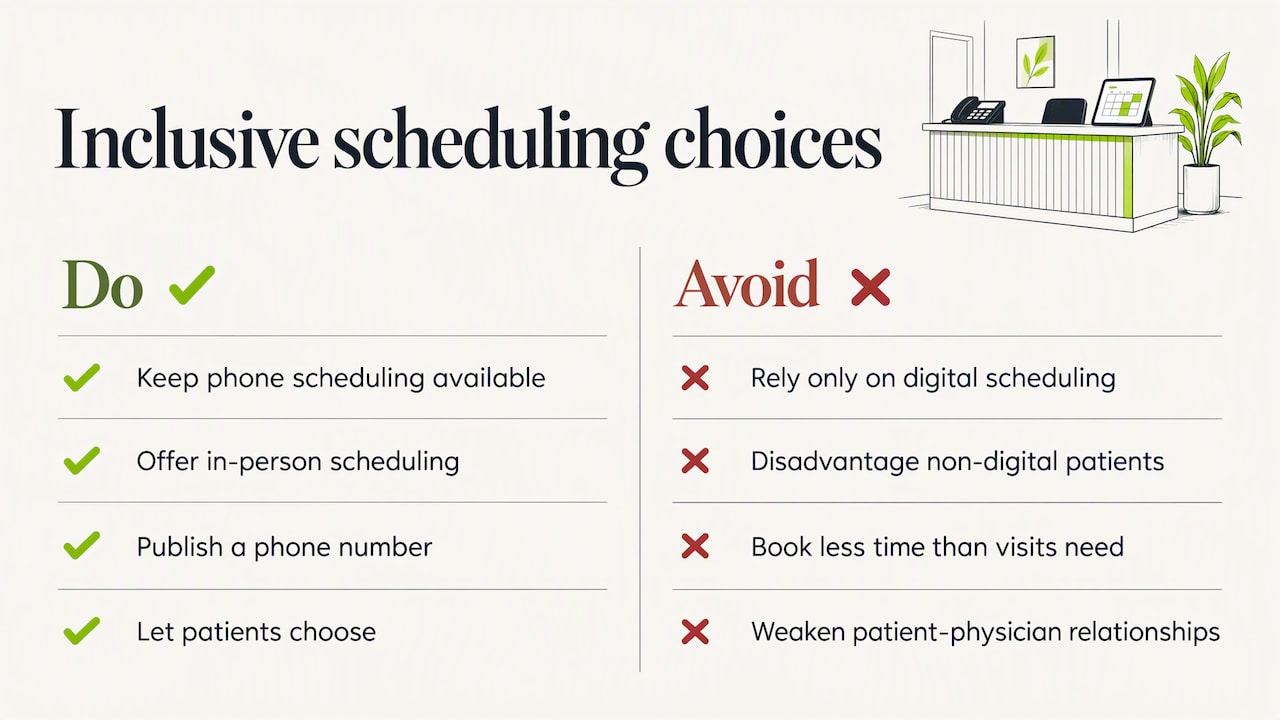
For a cash-pay clinic, the payer mix concern is less relevant, but the age and language findings still apply, especially to a clinic whose patients are in their 60s and beyond. An ethical analysis of direct scheduling recommends that providers keep phone or in-person scheduling available alongside self-scheduling so patients who prefer or depend on non-digital methods are not disadvantaged. The same analysis flags a trade-off: more efficiency and autonomy for patients, against the risk that a booking tool allots less time than a visit needs and weakens the patient-physician relationship.
The practical response is simple. Offer both channels, publish a phone number on the booking page, and let patients choose.
Features to require in self-scheduling software
A booking page alone is not enough. Check each of the following before choosing a tool.
Appointment rules
- Separate appointment types with their own length, buffer time, provider and location.
- Limits on who may book: new patients, established patients, active members only.
- Minimum notice for booking and for changes, and a maximum horizon.
- Visit-type restrictions, so a complex initial consult is not booked into a 15-minute follow-up slot.
A 2024 study of seven self-scheduling processes recorded 733,651 successfully self-scheduled completed visits in 2023, with ticket offers (patients invited to book a specific need) accounting for 46.6%. The lesson is that invitation-based booking, where the clinic sends the right visit type to the right patient, can carry nearly half the volume. Rules plus targeted invitations beat an open calendar.
Rescheduling, cancellation and reminders
Patients should be able to move or cancel from the same confirmation message, within the policy you set. Reminders by text or email reduce avoidable gaps, and the cancellation policy should appear at booking, not after.
Intake and consent before the visit
A booking that does not trigger paperwork creates a front-desk task the day before. Look for intake forms assigned automatically at booking, so history and consent are done before the patient arrives.
Payment and membership logic
In cash-pay care, scheduling and payment are one decision. A member should see member-covered visits, and a non-member should see a price and a payment step. Clinics that run memberships and payments in the same system avoid reconciling a booking tool against a separate billing tool.
Video visits
Many longevity follow-ups, lab reviews and hormone check-ins are suited to video. The booking tool should generate the video link and place it in the confirmation, so patients do not hunt for a separate invitation.
Record accuracy
Wrong-patient matching and wrong-visit-type bookings are the safety risks of self-scheduling. Require identity verification at account creation and a booking flow that writes into the patient's chart, not a parallel list.
Integration and real-time data
If a booking tool sits beside your EHR rather than inside it, availability can drift and staff end up double-entering. Standards exist to reduce this. The Argonaut Scheduling specification is vendor-agnostic and defines FHIR RESTful APIs and guidance for patient and practitioner access to and booking of appointments, based on FHIR 3.0.1. Most small clinics will never implement it directly, but it is a useful question for a vendor: how does the calendar stay synchronized with the chart?
The simplest answer for a small practice is one system where scheduling, notes, forms and the portal share a record. Then the data you want is already together:
- Booking source (patient or staff) by visit type.
- No-show and cancellation rates by provider and day.
- Time from request to visit for new patients.
- Share of bookings that were refilled after a cancellation.
Review those four figures monthly. They tell you whether the rules are too loose or too tight.
Privacy and security review
Online booking collects identifiers and often a reason for visit, which can be protected health information. In the United States, HIPAA governs this for covered entities, and the safeguards you need depend on your own setup, so have a privacy or compliance professional review it. A BAA with each vendor that handles PHI is standard practice. LongevityEHR is HIPAA compliant, with a BAA on request.
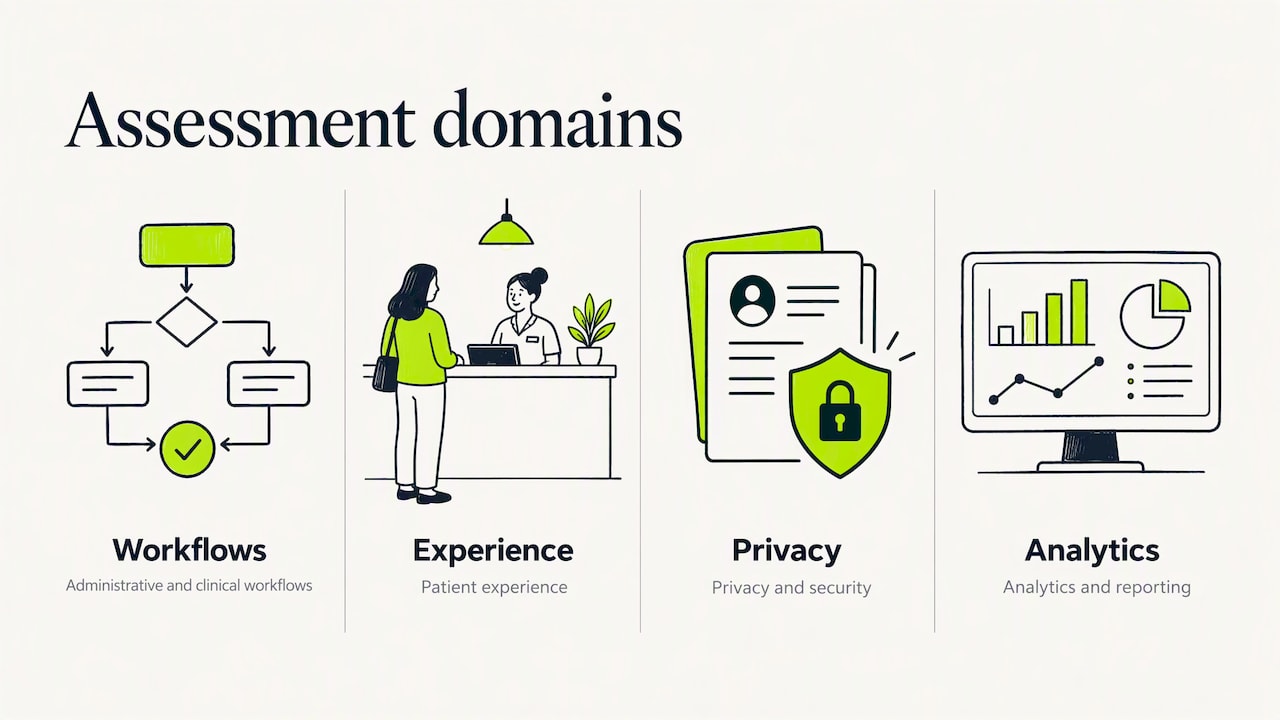
For a structured way to think about assessment, the Ontario Health portal implementation guide (a Canadian document, not a U.S. requirement) recommends that organizations assess administrative and clinical workflows, patient experience, privacy and security, and analytics and reporting. It also recommends a Privacy Impact Assessment, a Threat Risk Assessment and secure patient identity verification at registration. U.S. clinics can borrow the checklist logic while following HIPAA and applicable state law.
Barriers on the provider side are also real. A 2017 systematic review found that cost, flexibility, safety and data integrity were the main reasons some providers hesitated to move to web-based scheduling. Each of those is addressed by the choices above: transparent pricing, flexible rules, identity verification and a single record.
Six steps to roll it out
- Map visit types. List every appointment you offer, its length, the provider and whether it needs a prerequisite such as labs or a signed consent.
- Sort into three groups. Open to self-booking (follow-ups, video visits, lab reviews), staff-booked (complex initial consults, procedures) and invitation-only (renewal or re-test visits sent to specific patients).
- Set the policies. Cancellation window, late-change fee if you charge one, new-patient rules and membership entitlements. Put them in plain language at the booking step.
- Attach forms and payment. Each visit type triggers its intake form and payment or membership check.
- Pilot with a subset. Start with one provider or one visit type for a few weeks. Watch for wrong-type bookings and confusion, then adjust.
- Keep a human channel. Keep the phone line, and tell patients on the booking page that staff will book for them on request.
A fictional example: a hormone clinic with two providers opens 30-minute video follow-ups to established patients up to 48 hours ahead, keeps initial consultations staff-booked and sends a booking invitation for a repeat lab review once results are due. The clinic reviews cancellations monthly and shortens the cancellation window if refills are not keeping pace. This is an illustration, not a benchmark.
Our perspective
We build software for cash-pay longevity, functional medicine, concierge and hormone clinics. Scheduling is easy to treat as a front-desk convenience, but it is the front door of the whole patient loop. A booking that does not connect to intake, payment, the chart and the follow-up creates work somewhere else.
For that reason we think the right question is not which booking widget to add, but whether scheduling lives in the same place as the rest of the care loop. When a visit is booked, the intake form, the video link, the membership check and the clinical note should all follow without staff retyping anything.
We also think clinics should be cautious about automating the first visit. Established-patient follow-ups are the safest place to start, and a person should stay reachable for everyone else. Self-scheduling should add choice, not remove it.
How LongevityEHR fits
LongevityEHR is a white-label EHR for cash-pay longevity clinics. For this topic the relevant pieces are scheduling with video visits, intake forms, clinical notes, memberships and payments through your own Stripe account, and a white-label patient portal under your branding. Confirm with our team exactly how booking is configured for your visit types and patient groups. LongevityEHR is HIPAA compliant, with a BAA on request.
Plans on the pricing page are billed per provider, and every plan includes unlimited patients:
| Plan | Monthly | Billed annually |
|---|---|---|
| Trial | $0 for 15 days | Not applicable |
| Core | $99 per provider a month | $69.30 a month ($831.60 a year) |
| Scale | $199 per provider a month | $139.30 a month ($1,671.60 a year) |
| Enterprise | Custom pricing | Custom pricing |
Annual billing is 30% off. The platform also includes capabilities such as AI care plan drafting and e-prescribing. In-app scheduling is included on Core, Scale and Enterprise; the 15-day trial at $0 covers every other Core feature except bulk patient import, so you can test the rest of the workflow before committing.

Run your longevity clinic on one system
- AI lab extraction with provider review
- Your ranges, every result as a trend
- Memberships through your own Stripe
15-day free trial. BAA on request.
Sources
- Barriers to and Facilitators of Automated Patient Self-Scheduling (scoping review, 2022)
- Automated patient self-scheduling: case study
- An Electronic Health Record-based self-rescheduling tool, Journal of Medical Internet Research, 2024
- The Effect of Automated Mammogram Orders Paired With Self-Scheduling
- Advanced access scheduling outcomes: A systematic review
- Patient Opportunities to Self-Schedule in a Large Health System
- Argonaut Scheduling implementation guide
- Patient Portal Provincial Implementation Guide v2.2, Ontario Health
- Web-Based Medical Appointment Systems: A Systematic Review
- Ethical considerations for direct scheduling of patients