
On this page
- What proactive healthcare means
- Proactive, reactive, and preventive care compared
- What a proactive care plan includes
- Where the evidence is strong and where it is thin
- Building the proactive loop in a clinic
- Memberships: the business model that fits proactive care
- Measuring whether it works
- Perspective
- Running proactive care on LongevityEHR
- Common mistakes when starting
Key takeaways
- Proactive healthcare identifies risk and acts before disease is established, using shared planning and continuous follow-up rather than visits driven only by symptoms.
- It goes beyond standard preventive care (screenings, vaccines, check-ups) by adding individual risk estimation, patient participation, and ongoing adjustment.
- A workable proactive care plan has clear goals, prioritized actions, named responsibilities, and a scheduled follow-up.
- Clinics need lab data, biomarker tracking, care plans, scheduling, and memberships working in one place, or the loop breaks down.
- Evidence is strongest for screening and risk-factor control, and more limited for fully personalized prevention, so measure your own outcomes.
Proactive healthcare is care that acts before avoidable decline begins: it identifies risk early, supports prevention, and builds a personalized plan with the patient, then follows up on a schedule. For a clinic, it means replacing a model that waits for symptoms with a repeatable loop of assessment, planning, tracking, and adjustment. This guide explains the definition, how it differs from reactive and preventive care, what a proactive care plan contains, and how cash-pay practices can run it. It is general information for clinic owners and operators, not medical, legal, or financial advice.
What proactive healthcare means
Proactive healthcare is a health-centered, life-course approach. Rather than waiting for deterioration, it looks for risk, supports prevention, and engages people in personalized plans. A 2022 review in the public health literature describes proactive health as activity centered on health, controlling risks at their source, and creating health value along the way.
Duke's Center for Personalized Health Care offers a framework many clinicians find practical. It describes personalized health care as a proactive framework that uses predictive technologies to establish individual risk and gives people a personal health plan intended to maximize health and minimize disease. The common shorthand is four Ps: predictive, preventive, personalized, and participatory.
Four ideas recur in every credible definition:
- Early identification. Risk is estimated before symptoms appear.
- Individualization. Plans reflect the person's biology, history, goals, and preferences.
- Participation. The patient helps set goals and carries out the plan.
- Continuity. Progress is tracked and the plan is revised, rather than closed at the end of a visit.
Proactive, reactive, and preventive care compared
These terms overlap, and clinics often use them loosely. The distinction matters because it decides what you build, staff, and price.
Reactive medicine, as a 2019 peer-reviewed review puts it, intervenes after disease is established, to interrupt progression or relieve symptoms. Prevention acts before disease is established. CMS describes preventive care as screenings, vaccines, check-ups, counseling, and risk-factor assessments intended to prevent or delay illness, support early detection, and limit the effects of chronic disease.
Proactive care builds on prevention. The 2022 review cited above separates the two this way: preventive care reduces the occurrence of disease or its complications, while proactive care emphasizes initiative by individuals, industries, and society. Duke's framework adds the practice-level difference: shared planning, risk assessment, coaching, and continuity replace a dialogue dominated by the physician.
| Dimension | Reactive care | Preventive care | Proactive care |
|---|---|---|---|
| Trigger | Symptoms or diagnosis | Guideline schedule | Individual risk and goals |
| Typical activity | Treat the problem | Screen, vaccinate, counsel | Assess risk, plan, track, adjust |
| Patient role | Recipient | Participant in screening | Co-author of the plan |
| Contact pattern | Episodic | Periodic | Continuous, with scheduled follow-up |
| Data use | Diagnosis support | Screening thresholds | Longitudinal trends against personal targets |
In practice most clinics blend all three. The point is to be deliberate about which parts of your service are proactive, and to give those parts a structure.
What a proactive care plan includes
People also ask what a proactive care plan is. NHS England's guidance on proactive care, written for people living with frailty at home, gives a usable template. It states that a proactive care plan sets out health and wellbeing goals and interventions, is co-produced with the person and relevant professionals, prioritizes feasible actions by impact and preference, and includes a clear follow-up plan.
The same guide names five core components, which translate well to outpatient and cash-pay settings:
- Identify a target cohort.
- Perform a holistic assessment.
- Develop a personalized care and support plan.
- Coordinate interventions across professionals.
- Provide continuity with scheduled follow-up.
Duke's five-step planning process starts earlier than most clinics do. It begins with a patient self-assessment of needs, preferences, and goals, followed by a clinician assessment of health status and risk using conventional, genomic, and other precision diagnostics. That sequence is worth copying: intake collects the patient's goals before the lab review begins, so the plan reflects what the patient wants as well as what the data shows.
A plan that works in a clinic usually carries these elements:
- Goals written in the patient's words and tied to measurable markers.
- Baseline data such as lab results, history, and intake responses.
- Prioritized actions, limited to what the patient can realistically do in the next period.
- Owners, so it is clear who does what (clinician, coach, patient).
- Review dates for follow-up visits and repeat testing.
Where the evidence is strong and where it is thin
Proactive care is not a single intervention, so the evidence varies by program type. Honest planning means knowing which claims are well supported.
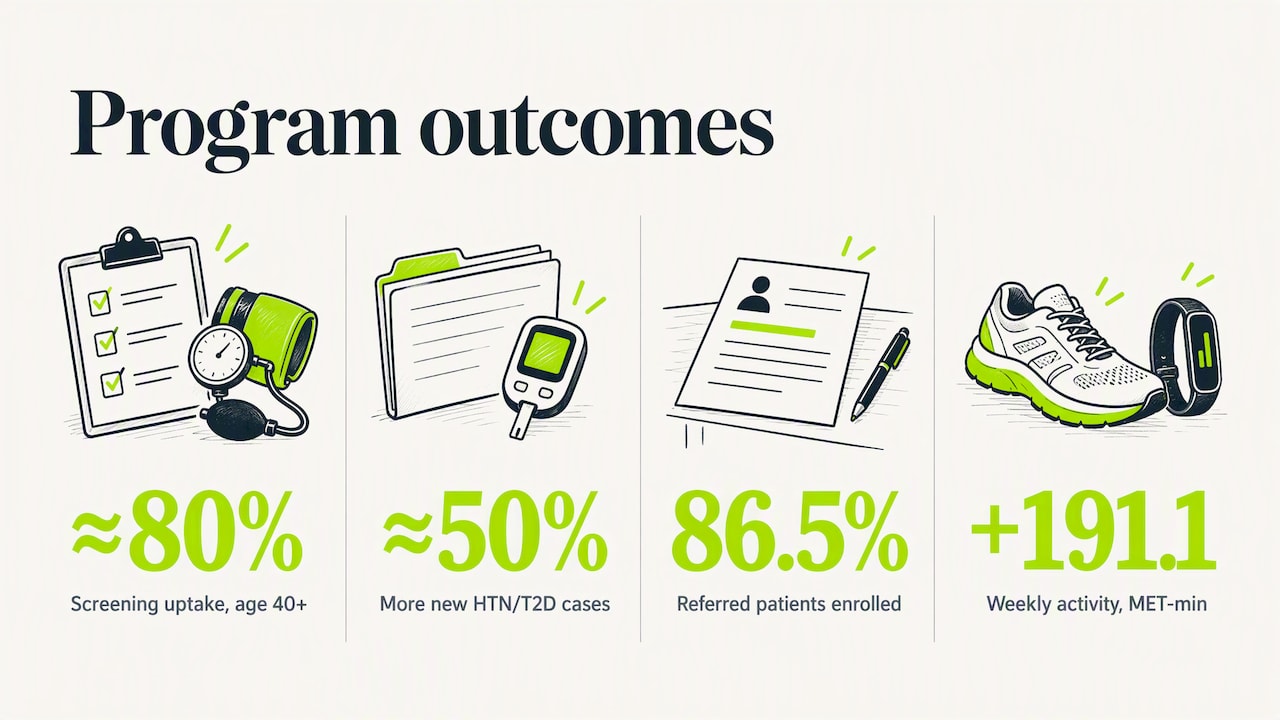
Screening and risk-factor control. WHO reported that after one year, eight pilot facilities in Uzbekistan reached nearly 80% uptake of cardiometabolic risk screening among people over 40, with approximately 50% more newly detected hypertension and type 2 diabetes cases. A Tajikistan evaluation found blood-pressure control improved in intervention clinics but not in control clinics after 12 months. In Poland, the POZ Plus coordinated-care pilot produced 13,361 new diagnoses from 10,956 preventive checks in its first 14 months.
Data-driven feedback loops. An Ontario implementation study used dynamic monitoring so patients and providers could change goals and care delivery as engagement and risk-factor data came in. It enrolled 378 of 437 referred patients (86.5%) into a six-month program, and weekly activity rose by an average of 191.1 MET-minutes.
Personalized prevention. This area is growing quickly but still maturing. A 2025 global scoping review of reviews names limited clinical-efficacy evidence, ethical and legal issues, and uneven knowledge among professionals and patients as major barriers. A 2023 review in Frontiers in Public Health defines personalized prevention as combining sociodemographic, clinical, anthropometric, behavioral, biomarker, omics, and gene-environment information to estimate individual risk and tailor preventive care. It also indicates that data become useful clinically only when risk information is linked to an action.
The practical lesson: collect data only where you know what you will do with it. A biomarker that does not change a plan adds cost and noise.
Building the proactive loop in a clinic
The Ontario study illustrates the model most clinics need: collect longitudinal data, compare progress with goals, and revise care in real time rather than waiting for the next acute episode. Here is how that translates into a clinic workflow.
Step 1: Define who you serve
A target cohort can be broad (adults seeking healthspan optimization) or narrow (perimenopausal patients, patients with metabolic risk). A defined cohort lets you standardize intake questions, lab panels, and plan templates.
Step 2: Capture goals and history at intake
Custom intake and follow-up forms let you collect patient goals, symptoms, and history before the first visit. Structured responses are easier to compare over time than free-text notes. LongevityEHR supports intake forms built for this purpose.
Step 3: Turn lab results into usable data
Lab reports often arrive as PDFs from different sources, and retyping values is slow and error-prone. Our platform uses AI lab extraction to pull results into the clinic's own biomarker ranges, with the provider reviewing what is extracted. Clinics that work from narrower optimal ranges rather than generic reference intervals can keep those ranges consistent across patients. Reference pages such as the biomarker library and HOMA-IR cutoffs help clinicians define the ranges they use. Interpretation remains a clinical judgment, and ranges should be reviewed by your medical director.
Step 4: Write the plan from templates
Plans built from clinic templates keep quality consistent while leaving room to individualize. A good template covers goals, actions, monitoring schedule, and who is responsible. See how care plan software fits into the workflow.
Step 5: Schedule follow-up before the patient leaves
Continuity is the feature that separates proactive care from a one-time workup. Scheduling with video visits makes mid-cycle check-ins practical, particularly for patients who travel or live far from the clinic.
Step 6: Track and adjust
Repeat labs, compare trends with each patient's targets, and revise the plan. Biomarker tracking over time is what makes the loop visible to both clinician and patient.
Memberships: the business model that fits proactive care
Insurance-based visits are paid per encounter and per problem, which rewards reactive work. Proactive care is paid for continuity: regular touchpoints, testing, and plan revisions. That is why cash-pay longevity, functional medicine, concierge, and hormone clinics commonly use membership structures, where patients pay a recurring fee for a defined set of services.
A membership model works only when the operations behind it are tidy. Patients need to understand what is included, billing must run on schedule, and renewals should not depend on front-desk effort. Running memberships and payments through the clinic's own Stripe account keeps billing under the clinic's control.
Billing, licensure, corporate practice rules, and advertising requirements differ by state and by service. Have a qualified healthcare attorney and your compliance advisor review your membership terms, consent forms, and marketing claims before launch.
Measuring whether it works
Proactive care needs its own scorecard. Visit volume tells you little. Consider tracking:
- Enrollment and retention, such as the share of referred or interested patients who start a program and the share still active after six and twelve months. The Ontario study reported 86.5% enrollment and 15.6% dropout at one year, which gives a sense of what a structured program can look like.
- Biomarker movement toward each patient's targets across repeat testing.
- Plan adherence, meaning how many planned actions were completed between visits.
- Follow-up completion, the share of scheduled reviews that actually occur.
- Patient-reported outcomes gathered through follow-up forms.
The Tajikistan evaluation suggests that routine records, adapted clinical algorithms, training, supervision, and decision support can turn prevention into measurable improvement even where resources are limited. The lesson for a private clinic is that consistent records matter more than elaborate technology. Outcomes reporting only works when data is entered the same way every time.
One caution on interpretation: a meta-analysis of goal-oriented care found no firm benefit because the underlying trials were low quality. Treat your own outcome data as a way to learn and refine, and avoid promising specific results to patients.
Perspective
We built LongevityEHR on a simple premise: a clinic that wants to practice proactive care usually knows what it wants to do. The friction is operational. Lab PDFs arrive in different formats, biomarker ranges live in spreadsheets, care plans are rewritten from scratch, and follow-up depends on someone remembering to book it.
Our view is that proactive care is a loop, and a loop needs one place where its parts connect. Labs feed the biomarker record, the record informs the plan, the plan sets the follow-up schedule, and the schedule brings the patient back with new data. When those pieces sit in separate tools, the loop leaks, and the first thing to leak is continuity.
That is why we designed the platform around the clinic's own ranges, the clinic's own plan templates, and the clinic's own brand and billing. Clinicians stay in control of interpretation: AI extraction proposes, and the provider reviews. We think that is the right division of labor for cash-pay practices that sell trust as much as testing.
Running proactive care on LongevityEHR
LongevityEHR is white-label software for cash-pay longevity, functional medicine, concierge, and hormone clinics. It brings AI lab extraction into your own biomarker ranges, care plans from your templates, clinical notes, intake forms, scheduling with video visits, memberships and payments through your Stripe account, and a branded patient portal into one system. Every plan includes unlimited patients. Compliance: HIPAA, with a BAA on request.
Pricing is per provider:
| Plan | Monthly | Billed annually |
|---|---|---|
| Trial | $0 for 15 days | Not applicable |
| Core | $99 per provider a month | $69.30 a month ($831.60 a year) |
| Scale | $199 per provider a month | $139.30 a month ($1,671.60 a year) |
| Enterprise | Custom pricing | Custom pricing |
Annual billing is 30% off. You can review each plan and start the 15-day trial on the pricing page, or see the full feature list first. Details on how we handle privacy are on our HIPAA page.
Common mistakes when starting
- Testing everything. Broad panels without a plan to act on the results raise cost and anxiety. Link each marker to a possible action.
- Plans with no follow-up date. A plan without a scheduled review is a handout.
- Inconsistent ranges. If each clinician uses different targets for the same marker, trend data loses meaning. Agree on ranges as a clinical team.
- Overpromising. Prevention evidence is uneven, and patients should hear what a program is designed to do, not guaranteed results.
- Skipping legal review. State rules on telehealth, lab ordering, and corporate structure vary. Get qualified review.

Run your longevity clinic on one system
- AI lab extraction with provider review
- Your ranges, every result as a trend
- Memberships through your own Stripe
15-day free trial. BAA on request.
Sources
- Proactive Health: An Imperative to Achieve the Goal of Healthy China (PMC, 2022)
- What Is Personalized Health Care? (Duke Center for Personalized Health Care)
- Preventive Care (CMS)
- Healthcare Evolves From Reactive to Proactive (PMC)
- Proactive care: providing care and support for people living at home with frailty (NHS England)
- Intervention package improves men's health in Uzbekistan (WHO)
- Evaluation and pilot implementation of essential interventions in Tajikistan (BMC Health Services Research)
- A Polish Pilot Programme of Coordinated Care (PMC)
- Mapping the barriers for personalized prevention (PMC, 2025)
- Components, prospects and challenges of personalized prevention (Frontiers in Public Health, 2023)
- Implementation of a value-based learning health system in Ontario (PMC)
- Effects of goal-oriented care for adults with multimorbidity (Journal of Evaluation in Clinical Practice)