
On this page
- Dictation, transcription and ambient AI: three different jobs
- How speech becomes a structured note
- How accurate is medical speech recognition?
- What to review before you sign
- Using voice documentation inside a visit
- HIPAA and privacy considerations for US clinics
- Questions to answer before adopting medical dictation software
- Perspective
- Keeping notes, labs and plans in one record
Key takeaways
- Dictation means the clinician speaks the note. Transcription turns recorded speech into text. Ambient AI listens to the whole visit and drafts the note. In every route, the clinician reviews and signs.
- Published error rates vary widely, from under 1% in controlled dictation to more than 50% in conversational, multi-speaker settings. Review before signing is not optional.
- Omissions, wrong terms and misattributed statements are the errors to look for first.
- Any vendor that handles audio or text containing PHI on your behalf generally needs a BAA before you use it.
- Measure your current note quality first, then pilot with a few providers before a clinic-wide rollout.
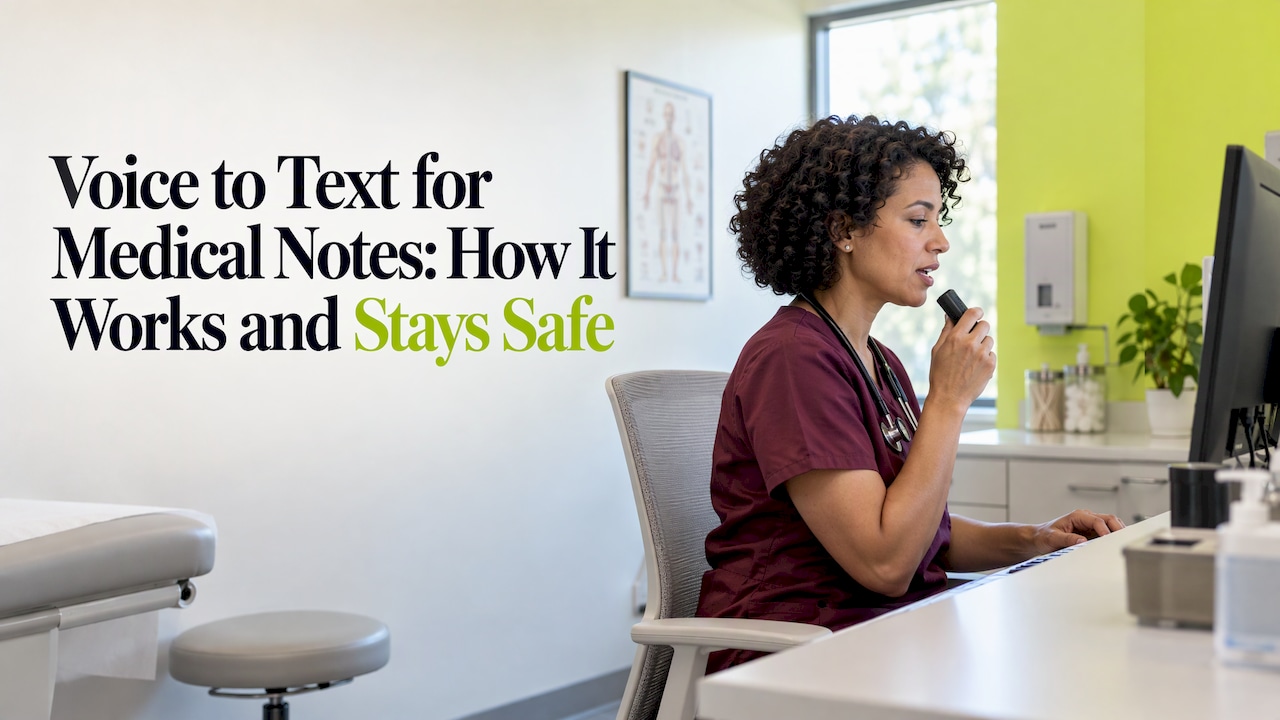
Voice-to-text for medical notes converts a clinician's speech into written clinical text, which the clinician then reviews, edits and signs in the patient record. The category covers three different jobs: dictation, transcription and ambient AI scribing. Each has a different accuracy profile, workflow and compliance footprint, so a clinic should decide which job it needs before it compares tools. This guide is general information for owners and operators of cash-pay longevity, functional medicine, concierge and hormone clinics in the United States. It is not clinical, legal or financial advice, and any compliance decision should be reviewed by a qualified professional.
Dictation, transcription and ambient AI: three different jobs
The phrase "voice to text" is used loosely, and vendors blur the lines. According to one comparison of the three approaches, dictation is the clinician speaking the note, transcription is turning recorded speech into text by a person or by software, and an ambient scribe records the whole visit and drafts the note itself. In each case the clinician reviews and signs the final note.
A peer-reviewed comparative review of EHR interfaces describes the same split from the technical side. Simple speech recognition inside an EHR gives immediate voice-to-text entry into the record, which allows immediate proofreading. More advanced versions use natural language processing and voice-enabled ambient capture.
| Approach | Who speaks | What the software produces | Typical use |
|---|---|---|---|
| Dictation | The clinician, directly to the record | Text in the words the clinician chose | Brief notes, addenda, assessment and plan |
| Transcription | The clinician, recorded for later | Finished text from a person or software | Backlogged notes, long consult letters |
| Ambient AI scribe | Clinician and patient in conversation | A drafted note from the conversation | Full visit notes where capture during the visit is acceptable |
The distinction matters for cost and risk. Dictation keeps the clinician in control of the wording. Ambient drafting saves more keystrokes but depends on the system correctly deciding what in a conversation belongs in the chart.
How speech becomes a structured note
Most voice documentation tools follow the same chain, even when the marketing differs. One engineering overview describes it this way: speech is captured during or right after the encounter, converted to text with medical speech recognition, organized into a standard format such as a SOAP or progress note, and then reviewed, edited and approved by the provider before it is written to the record.
A more detailed pipeline description adds steps worth knowing about:
- Capture of the clinician's speech.
- Speech recognition tuned for medical terminology.
- Intent recognition, which separates dictating a note from requesting an action or amending existing content.
- Entity extraction, which pulls out medications, conditions and measurements.
- Placement into the right note section.
- Clinician review and amendment.
- Delivery to the EHR, commonly through a FHIR-based integration.
Every stage is a place where an error can enter. A misheard drug name at step 2 becomes a wrong entity at step 4 and a wrong line in the plan at step 5. That is why the review step carries most of the safety weight.
How accurate is medical speech recognition?
Accuracy depends heavily on the setting. A clinician dictating clearly in a quiet room is a very different input from two people talking over each other.
A 2025 systematic review in BMC Medical Informatics and Decision Making found word error rates for AI-based speech recognition in clinical documentation ranging from 0.087 in controlled dictation settings to over 50% in conversational or multi-speaker scenarios. The same review noted that some studies reported shorter documentation time and more complete notes, while others found heavier editing burdens and persistent errors with specialized terminology and accented speech.
Older studies show what review changes:
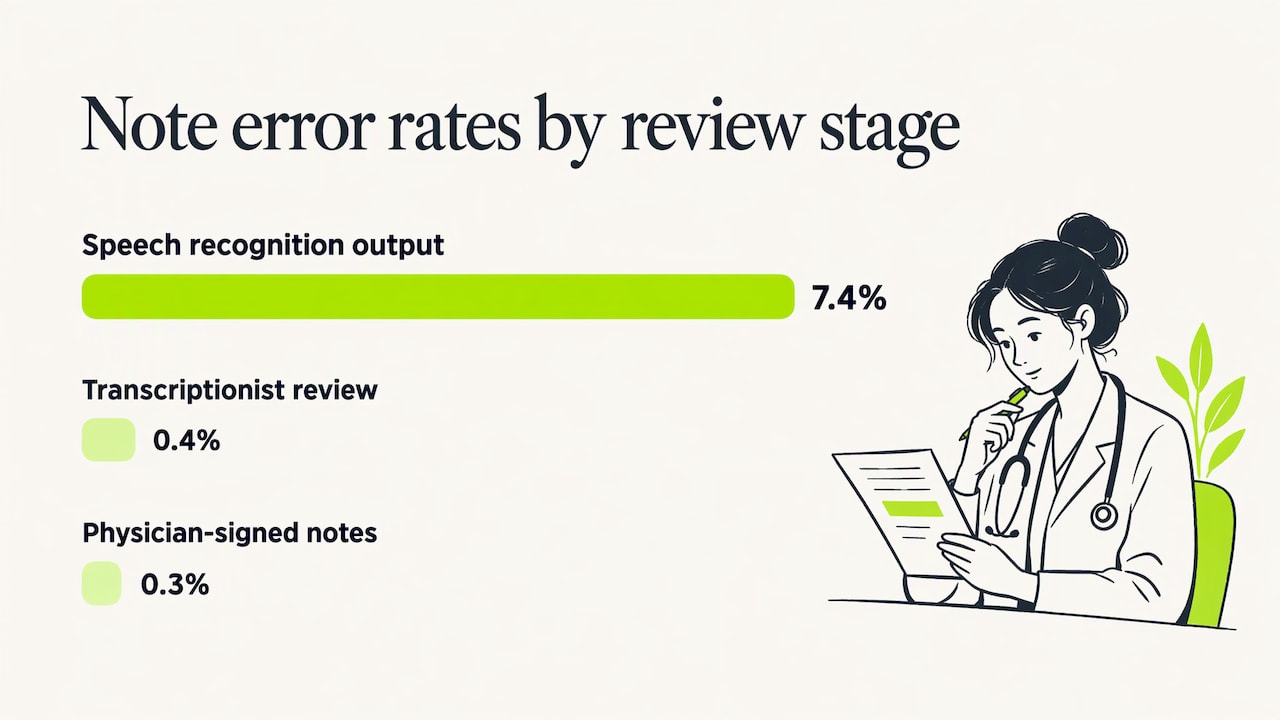
- In an analysis of 217 notes, error rates were 7.4% in speech-recognition output, 0.4% after transcriptionist review and 0.3% in physician-signed notes. About 5.7% of the speech-recognition-stage errors were clinically significant.
- A 2016 emergency department study found 1.3 errors per note, with 71% of notes containing at least one error and 15% containing a critical one.
- A 2015 systematic review reported recognition accuracy between 88.90% and 96.00%, with turnaround time improving by 16.41% to 82.34% compared with dictation plus transcription.
Ambient tools bring their own pattern. A 2025 evaluation of ambient digital scribe platforms found an average of 13.9 errors per transcript, with 19.5% of transcript errors carried into the clinical note, and an average of 3.0 errors per case with potential for moderate-to-severe harm. A comparative analysis of four commercial AI scribe tools found that omissions made up 71% of errors, additions 19.4% and incorrect facts 6.5%.
The practical reading: the numbers differ by tool, specialty and study design, so no single figure applies to your clinic. What the studies agree on is that the signing clinician is the final safeguard, and that omissions are the most common failure.
What to review before you sign
A short, repeatable review habit catches most of the errors the studies describe. For any note drafted by voice, check:
- Medications and doses. Confirm drug names, strengths, routes and frequencies. Similar-sounding names are a classic recognition failure.
- Laterality, numbers and units. Left versus right, decimal points, mg versus mcg.
- Negations. "No chest pain" must not become "chest pain."
- Omissions. Compare the draft against what you remember of the visit, especially allergies, symptoms the patient raised and agreed follow-up.
- Attribution. Make sure the patient's statements and your own assessments are not swapped.
- Added content. Remove anything that was never said or examined.
- Lab and biomarker values. Verify any value quoted in the note against the source report.
The Joint Commission's Quick Safety alert on speech recognition warns that poorly managed speech-recognition documentation can produce poor written communication and more errors. It recommends routine assessment of 1% of speech-recognition documents by a healthcare documentation specialist. A clinic can adopt a similar spot-check, for example by having a second clinician or qualified documentation reviewer sample a small share of notes each month.
Using voice documentation inside a visit
The workflow question is usually where voice documentation succeeds or fails. Three patterns are common in cash-pay practices:
- Dictate after the visit. The clinician speaks the assessment and plan while the encounter is fresh, then edits. This keeps the patient conversation free of any device.
- Dictate during telehealth. On video visits, the clinician can summarize findings aloud as the visit closes, which doubles as a verbal recap for the patient.
- Ambient capture. The tool listens throughout. This requires patient notice and, where applicable law requires it, consent.
The Australian Digital Health Agency's implementation guidance reports that some practitioners changed how they speak when using a scribe, going slower, articulating more clearly and restating what the patient said so the tool captures it. That is a real behavior change to plan for in training. It is guidance from Australia, but the workflow point applies anywhere.
A fictional example shows the pattern. A clinician at an imaginary hormone clinic finishes a follow-up visit and dictates: the patient reports improved sleep, current dose unchanged, repeat labs in twelve weeks. She reads the draft, corrects one dose that was misheard, adds a missed symptom, and signs. The time saved is in typing, while the clinical judgment stays with her.
HIPAA and privacy considerations for US clinics
Audio and transcripts of patient encounters are PHI. This is general information, and your compliance counsel or a qualified HIPAA professional should review your specific setup.
Points that come up repeatedly in the compliance literature:
- A BAA is generally required before you disclose PHI to a vendor that creates, receives, maintains or transmits it on your behalf, according to this HIPAA and voice technology overview. The same source notes that the Security Rule calls for a risk analysis of voice systems and administrative, physical and technical safeguards.
- AI scribe vendors are almost always business associates. A legal analysis of AI scribes says contracts should define what data is accessed, how it may be used (including for model training) and whether it is de-identified or retained afterward.
- Each hop needs coverage. One HIPAA build guide cautions that a BAA with one vendor covers only that vendor. If transcribed PHI is sent on to a language model without a BAA for that use, the clinic has an uncovered step.
- Local-only tools differ. According to one compliance guide, a tool that never sends audio or text to any server is not a business associate. Confirm how a given tool actually works before relying on that.
The common thread is that compliance applies to the whole chain: the microphone app, the speech service, any AI model, storage and access controls. Clinics that want to see how privacy, billing and documentation safeguards fit together can read about HIPAA compliance across documentation workflows. For how we describe our own approach, see our HIPAA compliance page. In short, LongevityEHR is HIPAA, with a BAA on request.
Questions to answer before adopting medical dictation software
The Australian Digital Health Agency's guidance lists five preparation steps before implementing a scribe: assess your needs, establish a baseline for the quality of your clinical notes, investigate the tools, check that your technical infrastructure is compatible with your EHR, and map how the tool fits your clinical workflow. A mixed-methods pilot study adds selection factors such as institutional priorities, internal champions, financial value, clinical value, implementation resources and who will own the tool long term.
For a small cash-pay practice, that translates into a short checklist:
- Define the problem. Is the bottleneck after-hours charting, long initial consults, or note consistency across providers?
- Baseline. Time a sample of notes and review a few for completeness before changing anything.
- Decide the job. Dictation, transcription or ambient capture, as defined above.
- Confirm where the note lands. The best tool is the one whose output arrives in the chart in the right section, not one that needs copy and paste.
- Get the BAA and the data terms in writing. Include retention, training use and subprocessors.
- Pilot with two or three providers for a few weeks and compare against the baseline.
- Set a review standard and a periodic spot-check.
Perspective
We build software for cash-pay longevity, functional medicine, concierge and hormone clinics, and our view is that the note is only one link in a longer care loop. A visit produces labs, a plan, follow-up, a membership and a payment, and documentation that sits apart from those pieces creates rework no matter how fast it was captured.
That is why we design the platform around the whole loop. Clinical notes, intake forms, care plans built from the clinic's own templates, scheduling with video visits and a white-label patient portal live in one place, and AI lab extraction places results into the clinic's own biomarker ranges with provider review. Our view is that speed in any one step matters less than whether the record stays connected and reviewable by the clinician who signs it.
Whatever voice tool a clinic evaluates, we would ask the same questions: who reviews the output, where does the note land, and is there a BAA in place. Answering those first makes the rest of the choice easier.
Keeping notes, labs and plans in one record
Voice capture solves typing. It does not by itself connect a note to the labs that prompted it or the plan that follows. LongevityEHR is white-label EHR software for cash-pay clinics, and it brings clinical notes, intake forms, care plans, scheduling with video visits and memberships and payments in one portal. Payments run through the clinic's own Stripe account, and the patient portal carries the clinic's branding.
Every plan includes unlimited patients, and pricing is per provider:
| Plan | Monthly | Billed annually |
|---|---|---|
| Trial | $0 for 15 days | Not applicable |
| Core | $99 per provider a month | $69.30 a month ($831.60 a year) |
| Scale | $199 per provider a month | $139.30 a month ($1,671.60 a year) |
| Enterprise | Custom pricing | Custom pricing |
Annual billing is 30% off. You can start on the 15-day trial and see the plans on the pricing page.

Clinics that want to see the whole patient loop before choosing documentation tools can review the EHR built for longevity clinics.

Run your longevity clinic on one system
- AI lab extraction with provider review
- Your ranges, every result as a trend
- Memberships through your own Stripe
15-day free trial. BAA on request.
Sources
- Interfacing With the Electronic Health Record (EHR): A comparative review
- Medical Dictations: What They Are and How They Work
- Build EHR Voice-to-Text Features for Clinical Documentation
- AI Voice Documentation for Healthcare
- Evaluating the performance of artificial intelligence-based speech recognition for clinical documentation
- Analysis of Errors in Dictated Clinical Documents
- Incidence of speech recognition errors in the emergency department
- Risks and benefits of speech recognition for clinical documentation
- Evaluating the Quality and Safety of Ambient Digital Scribe Platforms
- Documenting Care with AI: A Comparative Analysis
- Speech recognition technology translates to patient risk (The Joint Commission)
- Implementation of AI scribes in healthcare workflows (Australian Digital Health Agency)
- HIPAA and Voice Technology: Compliance Requirements
- HIPAA Compliance Risks With AI Scribes In Health Care
- AI Clinical Scribe in Telemedicine: HIPAA-Safe Build Guide
- Dictation for Doctors: HIPAA-Compatible Voice to Text
- Selection and Implementation of Virtual Scribe Solutions