
On this page
Key takeaways
- The hs-CRP test measures C-reactive protein at the low concentrations relevant to cardiovascular risk, not the higher levels seen in acute illness.
- The 2003 AHA/CDC statement groups average hs-CRP levels as low risk (below 1.0 mg/L), average (1.0 to 3.0 mg/L) and high (above 3.0 mg/L).
- The 2019 ACC/AHA guideline lists hs-CRP of 2.0 mg/L or more as a risk-enhancing factor, so guidelines and labs do not use one single cutoff.
- A result above 10 mg/L points to infection or inflammation. The statement says to set it aside and repeat the test in about two weeks.
- What it measures
- C-reactive protein at low concentrations, using a high-sensitivity assay.
- Sample
- Blood draw. Fasting or nonfasting, in a metabolically stable patient.
- Common units
- mg/L. The AHA/CDC statement recommends reporting hs-CRP in mg/L only.
- Main guideline reference
- AHA/CDC scientific statement on markers of inflammation (2003) and the 2019 ACC/AHA primary prevention guideline.
What the hs-CRP test measures
C-reactive protein (CRP) is an acute-phase reactant: its concentration rises with infection, injury and inflammation. The hs-CRP test uses a high-sensitivity assay that measures CRP accurately at low concentrations. The AHA/CDC statement notes that it is in these lower ranges, once considered normal, that hs-CRP levels appear to predict cardiovascular events.
In 2003, a joint scientific statement from the Centers for Disease Control and Prevention and the American Heart Association reviewed the inflammatory markers available at the time. It concluded that hs-CRP had the analyte and assay characteristics most suited to clinical use, and it set out how to measure and categorize it. Its risk categories are the ones this page uses below.
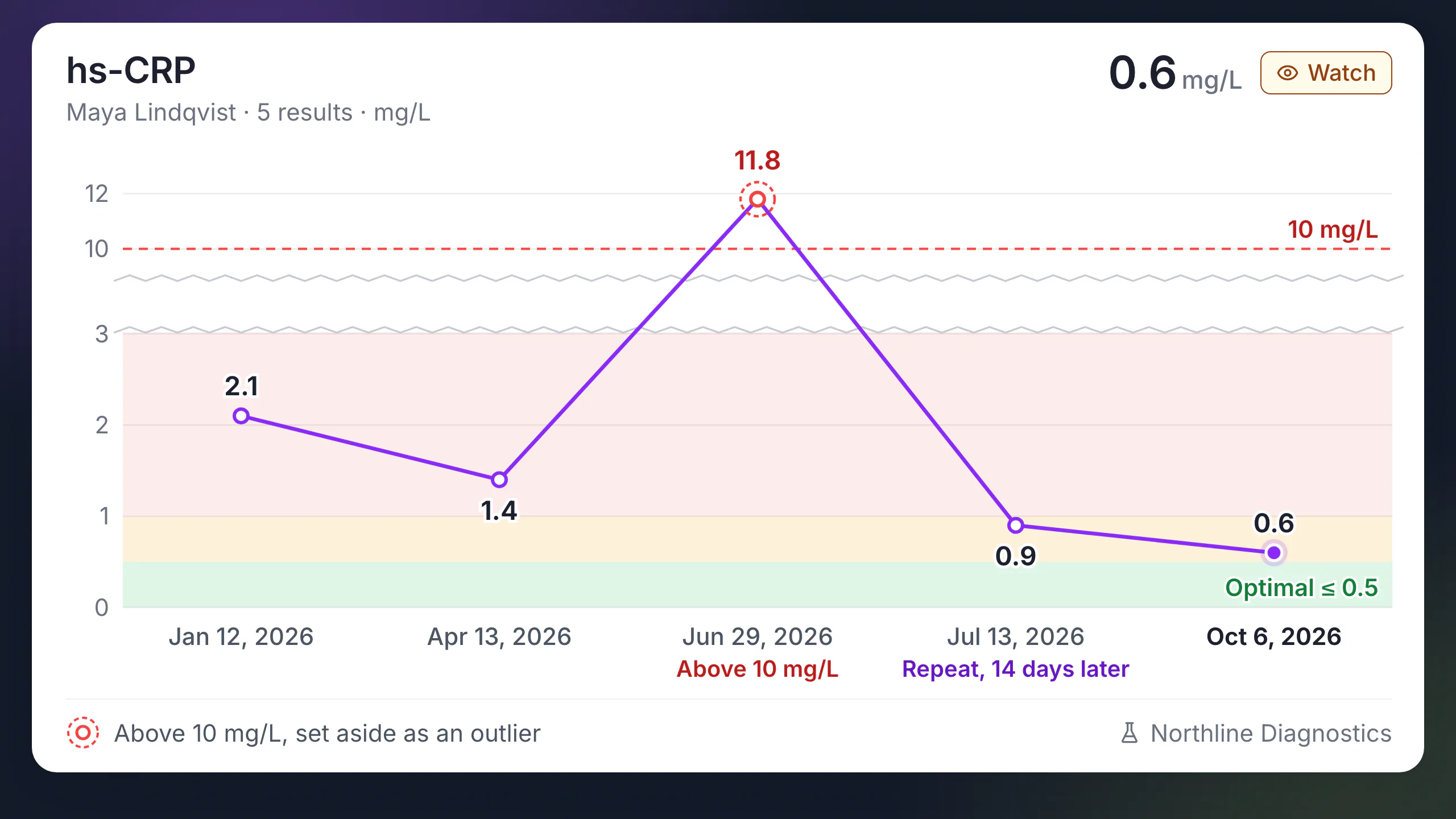
AHA/CDC risk categories for hs-CRP levels
The AHA/CDC statement groups the average of two hs-CRP measurements into three relative risk categories. The cutpoints correspond to approximate tertiles of hs-CRP in the adult population, drawn from more than 15 populations and more than 40,000 people. The statement reports that the high-risk tertile carries roughly a twofold relative risk compared with the low-risk tertile.
| Relative risk category | Average hs-CRP level |
|---|---|
| Low | Below 1.0 mg/L |
| Average | 1.0 to 3.0 mg/L |
| High | Above 3.0 mg/L |
A later guideline uses a different line. The 2019 ACC/AHA Guideline on the Primary Prevention of Cardiovascular Disease lists an hs-CRP of 2.0 mg/L or higher, if measured, among its risk-enhancing factors. For adults at borderline or intermediate 10-year risk, the guideline uses these factors to help guide decisions about preventive interventions. The two documents serve different purposes, and laboratories and guidelines differ in which thresholds they print and use.
Acute inflammation and other caveats
Because CRP rises with any inflammation, a single hs-CRP result can reflect a cold, a recent injury or an inflammatory flare rather than baseline risk. The AHA/CDC statement builds its measurement advice around that problem.
- Test a metabolically stable patient without obvious infection or inflammation.
- Measure twice, fasting or nonfasting, optimally two weeks apart, and use the average.
- If a result is above 10 mg/L, look for a source of infection or inflammation, set that result aside and repeat the test in about two weeks.
- Report results in mg/L only.
Chronic conditions matter too. The 2019 ACC/AHA guideline lists chronic inflammatory conditions such as psoriasis, rheumatoid arthritis, lupus and HIV as separate risk-enhancing factors, which is a reminder that an hs-CRP value needs the patient's history beside it.
Who the guidelines suggest testing
The 2003 statement did not support screening the whole adult population with hs-CRP for cardiovascular risk. It said measurement may help, at the physician's discretion, in people judged to be at intermediate risk by global risk assessment (10% to 20% risk of coronary heart disease over 10 years), and that the benefit of acting on it remained uncertain.
In its discussion of patients with established disease, the same statement says serial hs-CRP testing should not be used to monitor the effects of treatment. Clinics that repeat the hs-CRP test routinely should be clear with themselves, and with patients, about what a repeat value is being used for.
Defining an hs-CRP range for your clinic
Longevity clinics often read markers against bands of their own rather than the lab's reference interval. For hs-CRP, a clinic might align its bands with the AHA/CDC categories, with the 2019 risk-enhancing threshold or with a documented choice of its own. Whatever the choice, write down which source it follows and why.
- Name the guideline each band comes from.
- Decide how the clinic handles a single value above 10 mg/L, so nobody grades an acute spike as baseline risk.
- Note whether a band applies to a single value or to an average of two.
- Set a date to review the range.
Our guide to optimal vs reference ranges covers how to set and document clinic ranges in more detail. hs-CRP is often read next to lipid markers such as ApoB.
Tracking hs-CRP over time in LongevityEHR
In LongevityEHR, your clinic sets its own range for hs-CRP, per sex if you choose, and every released value is graded against it. Each value keeps a snapshot of the range that applied when it was recorded, so a later range change does not regrade history. The trend chart shows every draw, which makes a one-off spike above 10 mg/L easy to see next to the repeat test. See biomarker tracking for how ranges and trends work.
Results come in through AI lab extraction: upload the lab PDF or an image, and values are matched to your biomarkers. If a report states CRP in a unit that doesn't match the biomarker's configured unit, the value is flagged for review and never silently converted. A provider reviews every result before release to the patient's portal.
Range classification is deterministic. LongevityEHR does not interpret hs-CRP or any other result. Your providers write the interpretation and decide what, if anything, changes in the patient's care plan.

Run your longevity clinic on one system
- AI lab extraction with provider review
- Your ranges, every result as a trend
- Memberships through your own Stripe
15-day free trial. BAA on request.
Sources
- Pearson TA, et al. Markers of inflammation and cardiovascular disease: application to clinical and public health practice. A statement for healthcare professionals from the CDC and the AHA. Circulation. 2003, 107(3):499-511. (accessed October 21, 2026)
- Arnett DK, Blumenthal RS, et al. 2019 ACC/AHA Guideline on the Primary Prevention of Cardiovascular Disease. Circulation. 2019, 140(11):e596-e646. (accessed October 21, 2026)
This page is educational content for clinicians and clinic operators. It is not medical advice and does not replace clinical judgment. Ranges and thresholds vary by laboratory, method and guideline.