
On this page
- What branded patient portal design actually covers
- Branding decisions worth making deliberately
- Design principles that make a portal usable
- What a longevity clinic portal needs to show
- Core portal capabilities to check against
- Privacy and security checks before launch
- Build, buy or white-label
- Pricing for a branded portal
- A short launch plan
- Measuring whether the portal works
- Our perspective

Key takeaways
- A white-label portal is pre-built software that you rebrand with your logo and colors, which takes far less effort than a custom build.
- Real branding goes beyond a logo: sign-in, domain, theme, consent text and notification templates should all read as your clinic.
- Design for clarity first: perceivable, operable and understandable pages, with labs and care plans presented in language patients can act on.
- HIPAA requires a documented risk assessment and a Business Associate Agreement (BAA) with any vendor handling ePHI. LongevityEHR offers a BAA on request.
- Measure the portal by adoption and the behaviors it supports, such as completed forms, booked visits and lab review, not by appearance alone.
A branded patient portal should look like your clinic at every touchpoint (logo, colors, sign-in, emails) while handling the clinical loop behind it: labs, biomarkers, care plans, scheduling, memberships and payments. For a cash-pay longevity, functional medicine, concierge or hormone clinic, the practical route is a white-label portal that is already built and HIPAA-aware, so design effort goes into the patient experience instead of infrastructure. LongevityEHR's white-label patient portal is built for that purpose, and clinics launch it in days without custom development.
This guide covers what "branded" should mean in practice, which design and accessibility principles matter, what a longevity clinic's portal needs to show, the privacy checks to run, and how to judge whether the portal is working. It is general information for clinic owners and operators, not legal, clinical or financial advice. Have your counsel and compliance advisor review decisions that touch HIPAA, billing or clinical workflows.
What branded patient portal design actually covers
A white-label patient portal is a pre-built software product that a practice buys and rebrands with its own logo and colors. It is almost always delivered as software as a service, and it takes less effort than extensive development, according to a 2026 patient portal development guide. Design, in this model, means configuring a proven structure so that it fits your brand and your care model.
A thorough definition of "fully white-labeled" is longer than a logo upload. A 2026 vendor due diligence checklist lists these elements:
- Removal of vendor logos, links and footers.
- A custom domain with managed SSL.
- Branded sign-in and mobile experience.
- Theme controls for colors, typography and icons.
- Editable onboarding screens, consent text, and email and SMS templates.
Use that list as a brief for your own portal. The patient's first impression is usually an email invitation and a sign-in page, so those two surfaces deserve the same care as your website homepage.
What LongevityEHR provides in this area is a white-label patient portal that clinics brand as their own, with the clinic's payments and memberships running through the clinic's own Stripe account. That means the patient sees your name on the portal and on the payment flow, not a third party's.
Branding decisions worth making deliberately
Branding choices are small individually and large together. Settle these before launch so the portal feels like one product.
Identity and tone
Use your logo, a limited color palette and one typeface family. Keep contrast high between text and background, because a pale brand color that looks refined on your website can make buttons and labels hard to read in a portal. Write interface copy in the same voice as your clinic communications: plain, specific and calm.
Naming the sections
Patients in a longevity clinic are not looking for "documents." They are looking for results, their plan, their next visit and their membership. Label navigation with those words. A short, consistent set of destinations (Results, My Plan, Visits, Forms, Billing and Membership) reduces the time spent hunting for things.
Consent and onboarding text
Onboarding screens and consent language are part of the brand, and they are also legal text. Draft them with your counsel, then keep the tone consistent with the rest of the portal. Avoid burying patients in a wall of legalese on first login.
Design principles that make a portal usable
Branding gets attention, but usability decides whether patients return. The Web Content Accessibility Guidelines (WCAG) rest on four principles: content should be perceivable, users should be able to navigate and operate the interface, content and operation should be understandable, and the site should work across a range of browsers, devices and assistive technologies, as summarized in a peer-reviewed review of accessibility considerations. Those four principles translate into concrete portal decisions.
| Principle | What it means in a clinic portal |
|---|---|
| Perceivable | Sufficient color contrast, text alternatives for images and charts, readable font sizes |
| Operable | Full keyboard navigation, large tap targets, no time limits that lock patients out mid-form |
| Understandable | Plain labels, clear error messages, consistent layout from page to page |
| Works across technologies | Responsive on phones, tested on major browsers and with screen readers |
Accessibility is also a matter of who your patients are. A 2022 AHRQ final report on portal usability found that portal use grew during the pandemic, but gaps persisted among patients with low self-efficacy, less comfort with technology and some minority racial and ethnic groups. The report called for more outreach, education and accessibility. For a clinic, that suggests short onboarding walkthroughs, a visible way to reach staff, and wording that does not assume clinical vocabulary.
Usability can be measured. In a 2023 survey of 4,719 users of a national patient portal in Finland, the portal's usability scored a mean of 74.3 on the System Usability Scale, rated good. The same study found that information, and the lack of it, drove the most common positive and negative experiences. The lesson transfers directly: patients judge a portal by whether it tells them what they came to find out.
What a longevity clinic portal needs to show
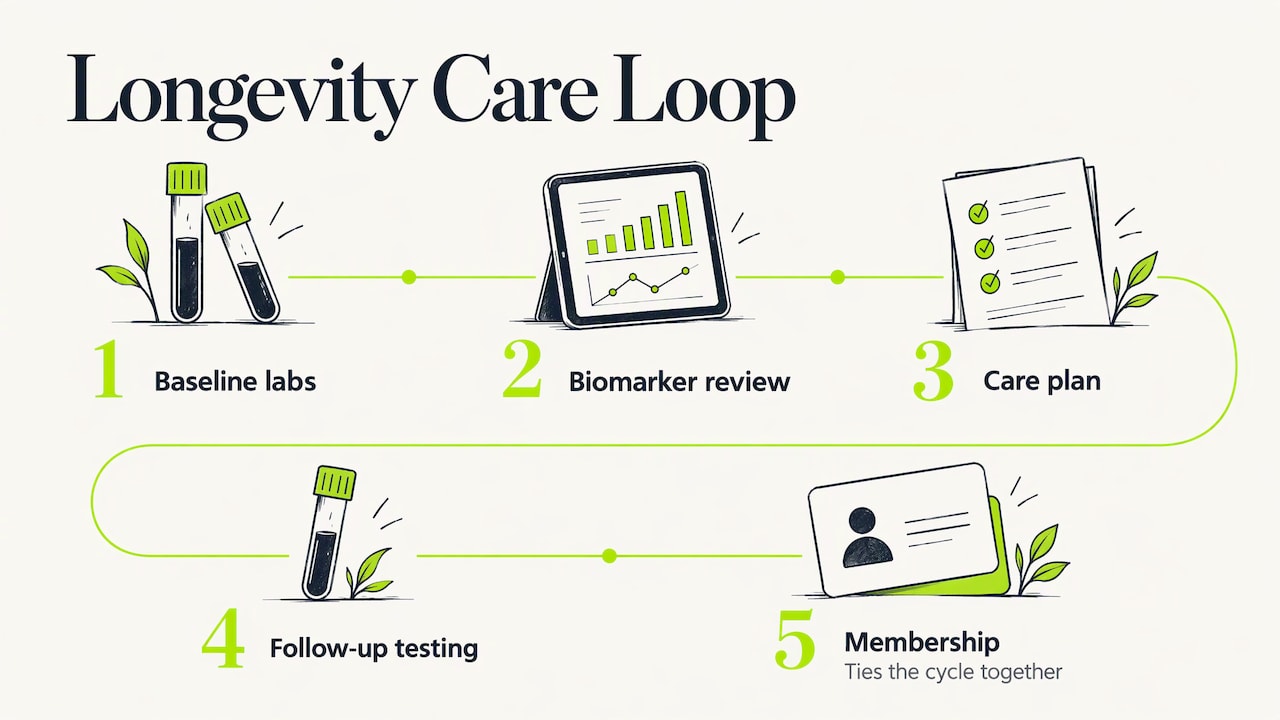
Generic portal templates assume a primary care model: visit summaries, medication lists, refill requests. A longevity or functional medicine practice runs a different loop: baseline labs, a biomarker review, a care plan, follow-up testing, and a membership that ties it together. The portal design should mirror that loop.
Results that make sense
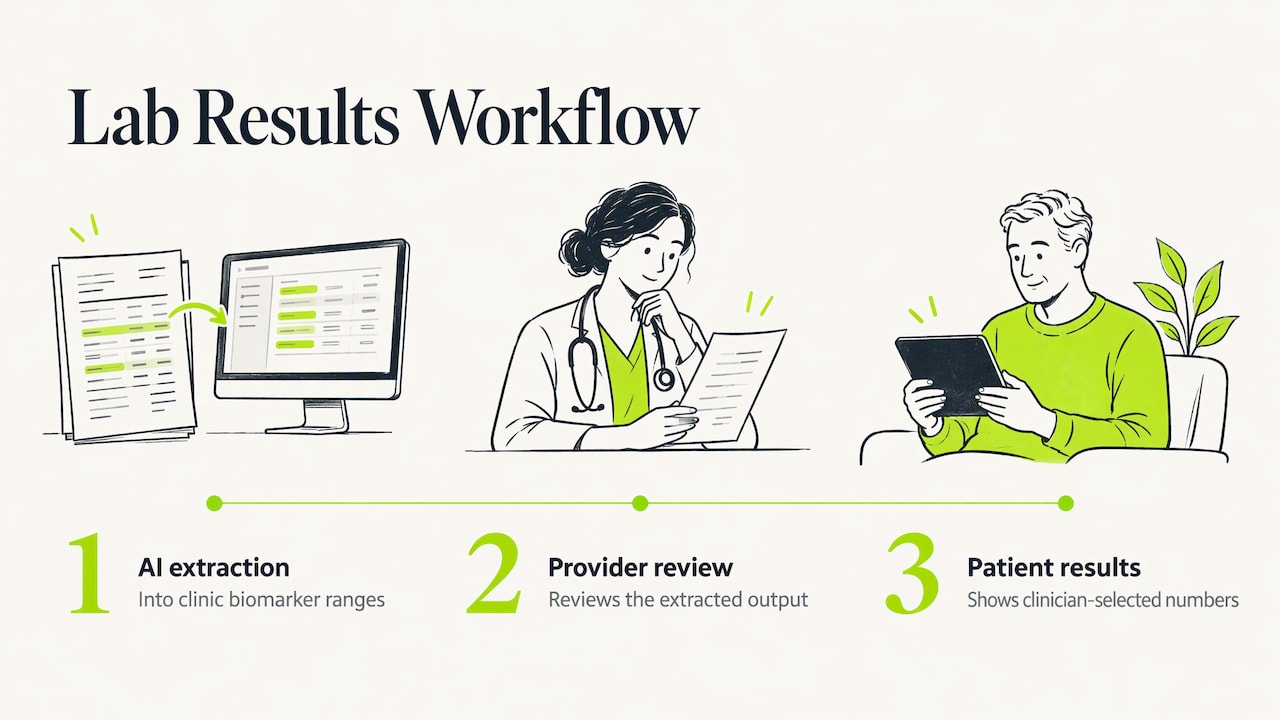
Lab results rank among the most-used portal features in published research: in a 2019 study of an inpatient portal, laboratory test results, care team information and the medication list were the most used features. In a longevity clinic, the numbers sit at the center of the care model. Presenting them against your clinic's own target ranges, not only a lab's generic reference interval, matches how you actually practice.
LongevityEHR extracts lab data with AI into the clinic's own biomarker ranges, and the provider reviews the output. Learn more on the AI lab extraction page. The result is that the numbers a patient sees in the portal are the ones your clinicians chose to track.
A care plan patients can follow
A care plan in a portal should read as a short list of what to do next, not as a clinical document. LongevityEHR builds care plans from the clinic's own templates, so the structure stays consistent between patients while the content reflects each plan. See the care plan software page for details.
Forms, scheduling and visits
Intake and follow-up forms completed before a visit save time in the room. LongevityEHR supports custom intake forms and clinical notes, and scheduling includes video visits, described on the scheduling and telehealth page. For the design of self-booking flows, the patient self-scheduling guide walks through setup.
Memberships and payments
Cash-pay clinics live on recurring revenue, so billing is part of the experience. Memberships and payments run through the clinic's own Stripe account, which means patients see a payment flow under your brand. Details are on the memberships and payments page.
Core portal capabilities to check against
One 2026 portal guide describes the core capabilities in terms that apply to most clinics: records access with clear source and status labels, secure messaging with response expectations, service requests such as appointments and forms, and trust controls such as identity verification, audit logs and accessibility. Use that as a gap-analysis list, then decide which of these your clinic needs at launch and which can follow. A launch with a smaller, well-designed set of features usually serves patients better than a crowded first release.
Privacy and security checks before launch
Branding does not change your obligations under HIPAA. A few checks belong in every portal decision. Your compliance advisor or counsel should confirm how they apply to your clinic.
- Risk assessment. HIPAA requires covered entities to assess risks to the confidentiality, integrity and availability of electronic PHI under 45 CFR 164.308(a)(1)(ii)(A). For a portal, the analysis should document patient enrollment and verification, authentication, secure message storage, staff access and the vendor's Business Associate Agreement.
- Technical safeguards. Under 45 CFR 164.312, HIPAA technical safeguards include unique user IDs, automatic logoff, audit controls and transmission security, with TLS 1.2 cited as the accepted minimum.
- Documentation retention. Policies, procedures and audit logs must be retained for at least six years under 45 CFR 164.316(b)(2).
- Business Associate Agreement. Any vendor that handles ePHI for you should sign one. LongevityEHR is HIPAA, with a BAA on request, and uses role-based access and tenant-isolated data. See the security page.
Ask your vendor which of these controls it supplies and which remain your clinic's responsibility, such as staff training, access policies and your own risk assessment.
Build, buy or white-label
There are three broad routes to a branded portal.
| Route | What it involves | Fit for a cash-pay clinic |
|---|---|---|
| Custom build | Hiring developers to design, build, integrate and secure a portal from scratch | Long timelines and a dedicated technical team, with HIPAA architecture to build and maintain |
| Template or no-code app | Assembling a portal from generic building blocks | Generic structure, with clinic-specific workflows left to you |
| White-label clinic platform | Configuring a purpose-built portal with your branding | Launch in days, with labs, plans, scheduling and payments already connected |
For a longevity clinic, the white-label platform is the practical choice. The clinic spends its time on what patients see and what clinicians write, not on infrastructure. LongevityEHR is purpose-built for cash-pay longevity, functional medicine, concierge and hormone clinics, and the portal is one part of a single platform that also holds labs, notes, plans, scheduling and memberships. That single record matters for design: the portal shows what the clinic already tracks, so there is nothing to synchronize.
Pricing for a branded portal
The white-label portal is part of the platform subscription, billed per provider, and every plan includes unlimited patients. Current published plans on the pricing page:
| Plan | Monthly | Billed annually |
|---|---|---|
| Trial | $0 for 15 days | Not applicable |
| Core | $99 per provider a month | $69.30 a month ($831.60 a year) |
| Scale | $199 per provider a month | $139.30 a month ($1,671.60 a year) |
| Enterprise | Custom pricing | Custom pricing |
Annual billing is 30% off the monthly rate. Paid upgrades add features such as AI care plan drafting and e-prescribing.
A short launch plan
A branded portal does not need months of work. This sequence suits a clinic starting from scratch.
- Define the brand kit. Logo files, two or three colors checked for contrast, a typeface, and a short voice guide for patient-facing text.
- List the patient journey. Write the five things a new patient does in the first 30 days: complete forms, upload or review labs, read the plan, book a follow-up, start a membership.
- Configure your biomarker ranges and care plan templates. Decide which markers you track and how you want ranges displayed.
- Set up forms and scheduling. Build the intake and follow-up forms, then define visit types, including video.
- Connect your Stripe account for memberships and payments.
- Draft consent and onboarding text and have counsel review it.
- Test with staff, then a few real patients. Watch where they hesitate. Fix labels and order before a wider rollout.
- Document the HIPAA basics: risk assessment, access policies and your BAA.
To see the portal with your own branding applied, you can start the 15-day trial, which costs $0.
Measuring whether the portal works
Portal design is not finished at launch. Track a small set of measures and adjust.
- Activation: the share of new patients who log in within a week of invitation.
- Task completion: forms finished before the first visit, visits booked through the portal, results viewed.
- Support load: questions to staff that the portal should have answered.
- Retention signals: membership renewals and follow-up testing completed.
The research supports looking at behavior. A 2019 systematic review found portal interventions improved health knowledge, self-efficacy, decision making, medication adherence and use of preventive services. In an inpatient study, portal use was associated with improved patient activation on neurology and medicine services. A 2021 study of 176,231 participants found that a simple self-order button in a portal raised the odds of completing a colorectal cancer screening kit to 3.8 times. Small design choices that make an action one tap away can change what patients do. For a longevity clinic, the same logic applies to a "book my follow-up labs" button.
Our perspective
Clinics often treat the portal as a skin placed over the real system. We see it the other way around: the portal is where the care loop becomes visible to the patient, so it should be designed from the loop outward.
That is why LongevityEHR keeps labs, biomarker ranges, care plans, notes, scheduling, memberships and payments in one platform, with a white-label portal on top. Your ranges are the ones patients see. Your plan templates are the plans patients follow. Your Stripe account is where memberships are paid.
Our approach is to remove the build phase so a clinic can launch under its own brand in days and spend its effort on what patients read and do. We designed the platform for cash-pay longevity, functional medicine, concierge and hormone clinics, and the portal reflects how those practices actually work.

Run your longevity clinic on one system
- AI lab extraction with provider review
- Your ranges, every result as a trend
- Memberships through your own Stripe
15-day free trial. BAA on request.
Sources
- Patient Portal Software Development guide, 2026
- Vendor due diligence checklist for a white-label patient portal
- Legal, Practical, and Ethical Considerations for Making Online Education Accessible (PMC)
- AHRQ final report: Designing for Demographics, 2022
- Patients' Experiences of a National Patient Portal, 2023 (PMC)
- Patient Portal Software Guide: Features and Security
- HIPAA Compliant Patient Portals: Security Requirements
- HIPAA Patient Portal Security Requirements 2026
- Using Patient Portals to Improve Patient Outcomes, 2019 (PMC)
- Acute Care Patient Portal study, JMIR 2019
- A Patient Portal-Based Commitment Device, 2021 (PMC)