
On this page
- What a healthcare membership model is
- The main membership models compared
- What members can expect, and what to disclose
- How to structure tiers, fees and add-ons
- Managing recurring payments
- Billing rules and privacy you cannot skip
- Metrics worth tracking
- Perspective: why membership operations belong in the clinical record
- One system for memberships, records and payments
- Pricing and starting a trial

Key takeaways
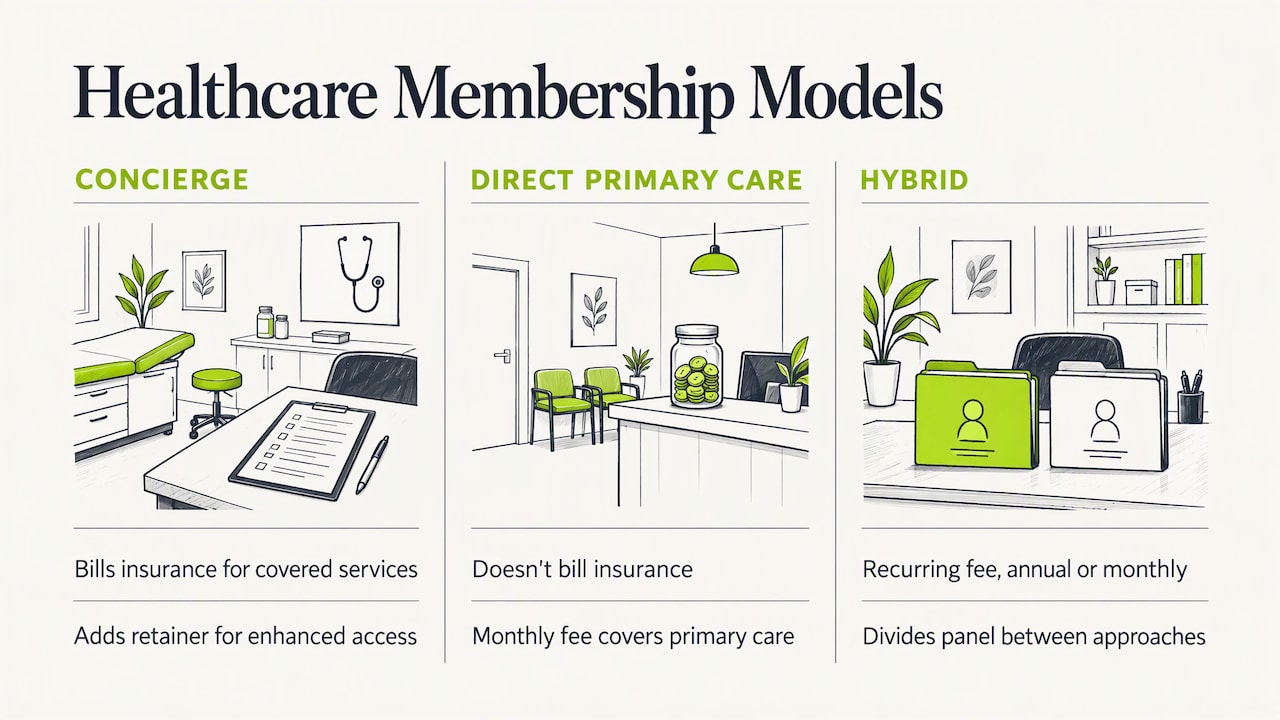
- Membership medicine charges a recurring fee directly to the patient. DPC does not bill insurance, concierge practices keep billing insurance for covered services and add a retainer, and hybrids split the panel between the two.
- Smaller panels are the trade: roughly 300 to 600 patients for concierge and 600 to 1,000 for DPC, against 2,000 to 3,500 in traditional practices.
- Price tiers around the access promise and the clinical value you deliver, then protect that promise by sizing the panel to your physician headcount.
- Recurring billing needs clear disclosure before the first charge, an easy way to cancel, a plan for failed payments, and payment records that carry no diagnosis information.
- Memberships, payments and records work best in one system, so staff are not reconciling three tools.
A healthcare membership model replaces per-visit payment with a recurring fee, paid monthly or annually, in exchange for a defined set of access and services. The main variants are direct primary care (DPC), concierge medicine, hybrid practices and cash-pay longevity programs. They differ in whether the practice still bills insurance, how large the panel is, and what the fee covers. Getting the model right matters, but so does the operational layer underneath it: tiers, renewals, failed payments, cancellations and privacy. This guide covers both, for owners and operators of cash-pay clinics in the United States.
The content below is general information, not legal, financial or clinical advice. Have your attorney, accountant and compliance advisor review any model before you launch it.
What a healthcare membership model is
In membership-based medicine, the patient pays the practice a recurring fee, annual or monthly, rather than a third party paying per encounter. The Membership Medicine Model from PPA describes the core distinction: concierge practices continue to bill insurance for covered services and add a retainer for enhanced access, DPC practices do not bill insurance and use a monthly fee for primary care, and hybrid practices divide the panel between the two approaches.
A membership is not insurance. As one explainer on healthcare memberships puts it, memberships do not pool risk or guarantee payment of medical bills, while insurance exists for unpredictable, high-cost events such as surgery or hospital stays. Your marketing and your enrollment terms should say this plainly. Patients who understand what the fee does and does not cover are less likely to be surprised later.
The main membership models compared
| Model | Insurance billing | What the fee typically buys | Typical panel size |
|---|---|---|---|
| Direct primary care | None for the membership | Primary care access under a flat monthly fee | 600 to 1,000 |
| Concierge medicine | Yes, for covered services | Retainer for enhanced access and responsiveness | 300 to 600 |
| Hybrid | Split by patient | Some patients on DPC terms, others on concierge terms | Varies by mix |
| Cash-pay longevity or functional medicine | Usually none | Testing, biomarker review, care plans and ongoing follow-up | Set by clinic capacity |
| Traditional insurance practice (for reference) | Yes | Per-visit fee-for-service | 2,000 to 3,500 |
The panel figures for the first, second and last rows come from the PPA overview. Those smaller panels are what allow 30 to 60 minute visits and same-day or next-day access. The longevity row is our own description of how cash-pay programs are commonly built, and your panel ceiling should come from your own capacity rather than a benchmark.
Direct primary care
DPC is the simplest model to explain. The patient pays one flat fee, the practice does not bill insurance for it, and the fee covers primary care access. Operationally, DPC is a recurring-billing business with a clinical front end, so renewal handling and payment failures affect revenue directly.
Concierge medicine
Concierge practices keep insurance billing for covered services and charge a retainer on top. That adds a compliance question: what exactly does the retainer pay for, and is the practice billing twice for anything? Work this through with a healthcare attorney before you publish your fee schedule. Concierge practices may also promise 24/7 responsiveness, which makes staffing, not software, the real constraint.
Hybrid practices
Hybrids run both models in one practice. They give a transition path for physicians leaving insurance-driven volume, but they require clean separation in scheduling, billing and records so that a member is never charged or billed under the wrong arrangement.
Longevity and functional medicine memberships
Longevity, functional medicine and hormone clinics usually run fully cash-pay. Their memberships often bundle lab panels, biomarker review, a written care plan and scheduled follow-ups. The value anchor is the ongoing loop: test, review, adjust, retest. A membership suits that loop because the patient is paying for continuity rather than for a single visit. If you run this kind of clinic, our page on longevity clinic membership software shows how we handle the billing side.
What members can expect, and what to disclose
Membership practices may offer longer visits, same-day or next-day access, direct physician communication, secure messaging, telemedicine and care coordination, according to PPA. Each of those is a promise. Write them into your membership agreement in terms you can staff.
The same source notes that the model can be a harder fit where patients cannot afford the fee, and that practices must account for panel attrition and local market saturation. Plan for both when you set your price and your enrollment targets.
One caution applies to anything resembling a membership product. A JAMA study of urgent care found that those membership fees do not count toward insurance deductibles and cannot be paid with HSAs or FSAs, and that about four visits a year would be needed to offset the average annual fee. Your patients may ask whether your fee is HSA or FSA eligible. Do not answer that yourself. Refer them to their plan administrator or tax advisor, and have your own advisor review how you describe the fee.
How to structure tiers, fees and add-ons
PPA's practice playbook tells practices to weigh market dynamics, value anchors, pricing power and the operational impact of the fee when setting annual or monthly prices. In practice, that becomes a short list of decisions.
- Define the access promise first. Response times, visit length and who the patient reaches are what the patient is buying. Price follows from what you can deliver to a full panel.
- Pick two or three tiers, not six. A base tier covering the core relationship, and one or two higher tiers that add testing, extra visits or longer review time, are easier to explain and easier to bill.
- Decide what is included versus itemized. Lab fees, supplements, procedures and imaging are common add-ons. List them in the agreement so that no member is surprised by a charge.
- Offer monthly and annual options. Annual billing improves cash flow and retention, and a discount for it is a familiar lever. Whatever you offer, state the total cost and renewal terms in plain language.
- Size the panel against headcount. The playbook advises considering panel size in light of retention, the access promise and physician headcount. A tier that promises quick access fails the moment the panel outgrows the calendar.
A fictional example
Consider an invented clinic, Harbor Point Wellness, with one physician and a ceiling of 350 members. It offers a Foundation tier (quarterly visits, secure messaging, one annual lab panel) and a Comprehensive tier (monthly visits, two lab panels, a written care plan updated each quarter). Because it caps the panel at 350, it can promise next-day messaging responses and keep to it. The clinic's first-year question is not how many members it can sign but how many it can serve at that promise. This is an illustration only, not a pricing recommendation.
Managing recurring payments
Recurring billing is where membership models either run quietly or consume the front desk. Four areas deserve a written process.
Enrollment and billing schedule
Choose whether every member renews on the same date or on their own enrollment anniversary. Anniversary billing spreads renewals, support calls and failed payments across the month, which one platform development guide recommends for just that reason. Same-date billing is simpler to reconcile. Either works if it is stated in the agreement.
Failed payments
Cards expire, get replaced and get declined. Decide in advance how many retries you will run, over what interval, when the member is notified, and at which point access is paused. The same guide points to retry schedules, account updater services and pre-expiry notifications as ways to recover payments. Write the member-facing wording once so that every pause or reminder reads the same way.
Cancellations and refunds
Set a rule for each case: cancellation mid-term, cancellation after a failed payment, partial-period refunds and refunds for services not delivered. Record the reason for every refund, and check that a refund does not accidentally trigger a new charge for the same period. Your billing tool should tie each refund to the original charge.
Test before patients pay
Stripe advises testing the full payment cycle in a staging environment before live use, covering declined cards, partial payments, refunds, plan enrollments and successful transactions. Do the same with your own configuration before the first member is charged.
For a longer walkthrough of this workflow, see our guide on managing subscription billing in a cash-pay clinic.
Billing rules and privacy you cannot skip
Clear terms and easy cancellation
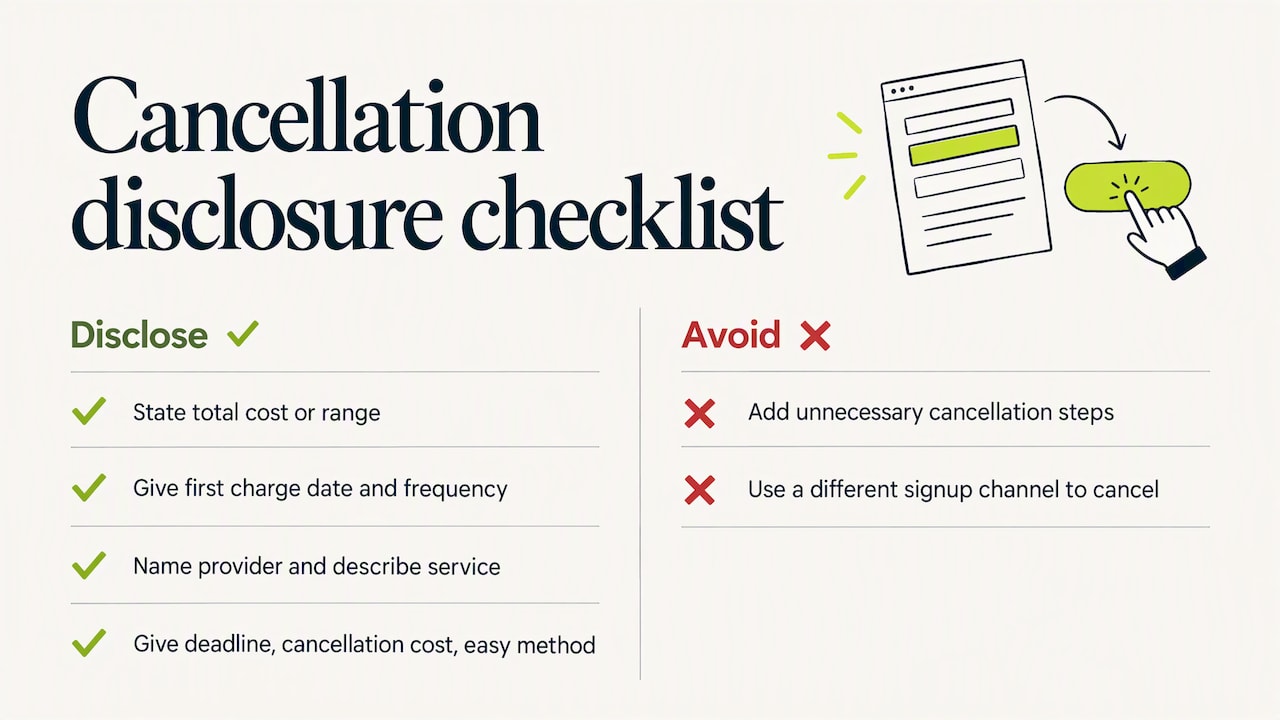
Recurring charges fall under consumer-protection scrutiny. Although the FTC order against Bridge It applied to one company in 2023, it shows what regulators expect from negative-option offers: before taking billing information, disclose the total cost or range, the first charge date, the billing frequency, the cancellation deadline, the provider name, what the service is, any cost of canceling, and a simple way to cancel. The order also expects a cancellation mechanism that is easy to find and use, avoids unnecessary steps and, for online enrollment, stops recurring charges through the same channel used to sign up.
Treat those as a design checklist for your enrollment page, even if your state's rules differ. State laws on automatic renewal vary, so have counsel check the rules where you operate.
Keep PHI out of payment records
A transaction that pairs a patient's name with diagnosis information contains PHI, according to Stripe's healthcare payments guide, and payment systems that staff access need appropriate permission structures. A membership platform guide adds that payment metadata should use an internal member identifier and plan code, not a diagnosis or a service description that reveals a condition. Name your plans neutrally. A plan called "Comprehensive" on a statement discloses far less than one named for a condition.
A BAA may be needed with vendors that handle PHI. Ask each vendor whether it will sign one, and have your compliance advisor confirm what your arrangement requires.
Regulatory attention is growing
Law firm Baker Donelson's 2026 review of concierge and consumer medicine notes that as membership models grow, compliance issues include scrutiny of management services organization fee structures, referral arrangements, fee-splitting and consumer-protection concerns. If you plan outside investment or a management company, bring in a healthcare attorney before you sign.
Metrics worth tracking
PPA's playbook recommends onboarding metrics that predict year-one retention, plus a planned cadence: a welcome week, a 30-day check-in and a 90-day review. A practical dashboard for a membership clinic includes:
- Active members versus panel ceiling, to see how much capacity remains.
- Monthly and annual recurring revenue, split by tier.
- Failed-payment rate and recovery rate, to judge your retry process.
- Churn by tenure, especially in the first 90 days.
- Onboarding completion, meaning intake forms done, first visit held and first care plan delivered.
- Staffing ratios, since the playbook also points to front-desk staffing, an operations lead and a patient experience manager as part of planning.
Perspective: why membership operations belong in the clinical record
We built LongevityEHR for cash-pay clinics around a common problem: the clinical work lives in one tool, the membership billing in another, and the patient portal in a third, and someone on the team has to reconcile them.
Our view is that a membership is a clinical relationship with a billing schedule, not a billing schedule with some clinical work attached. When the member's labs, care plan, visits and payments sit in one place, the front desk can see who is current, who is past due and what the member is owed at a glance.
That is why we put memberships and payments through the clinic's own Stripe account next to the chart, with a white-label patient portal carrying the clinic's brand. Clinics keep their payments relationship and their patient relationship in their own hands.
Our view is that the first 90 days of a membership deserve as much attention as the clinical work. We would rather help you spend that time on follow-up than on spreadsheets.
One system for memberships, records and payments
DPC practices commonly combine an EHR for clinical records, a membership billing platform and patient communication tools. That works, but each additional tool adds another login, another reconciliation and another place where PHI can end up. Our aim is to bring the pieces a cash-pay clinic needs into one platform.
LongevityEHR gives clinics a white-label patient portal, memberships and payments through the clinic's own Stripe account, scheduling with video visits, intake forms, clinical notes, care plans built from clinic templates, and AI lab extraction into the clinic's own biomarker ranges. Compliance: HIPAA, with a BAA on request. For clinics that run concierge or DPC-style panels, see our concierge medicine software page, and for a view of the whole platform, our feature overview.
Pricing and starting a trial
Every plan includes unlimited patients, and annual billing is 30% off.
| Plan | Monthly | Billed annually |
|---|---|---|
| Trial | $0 for 15 days | Not applicable |
| Core | $99 per provider a month | $69.30 a month ($831.60 a year) |
| Scale | $199 per provider a month | $139.30 a month ($1,671.60 a year) |
| Enterprise | Custom pricing | Custom pricing |
You can start on the Trial plan at $0 for 15 days and set up your membership tiers before you commit. See current plan details on our pricing page.


Run your longevity clinic on one system
- AI lab extraction with provider review
- Your ranges, every result as a trend
- Memberships through your own Stripe
15-day free trial. BAA on request.
Sources
- The Membership Medicine Model, PPA
- Concierge & DPC Practice Playbook, PPA
- What Is a Healthcare Membership and How It Works
- Prevalence, Characteristics, and Costs of Urgent Care, JAMA
- Stipulated Order for Permanent Injunction, FTC
- Healthcare Embedded Payments: A Guide for Businesses, Stripe
- State of Concierge & Consumer Medicine 2026, Baker Donelson
- Healthcare Membership Platform Development: A Complete Guide
- Direct Primary Care Software Guide 2026