
On this page
- What multi-location management means for a clinic
- Decide what to standardize and what to leave local
- One record across every site
- Access, permissions and privacy across locations
- Centralize billing, memberships and reporting
- What multi-location clinic software should do
- Perspective: grow the loop, not the spreadsheet
- A rollout plan for adding a site
- Run multiple sites on LongevityEHR

Key takeaways
- Run one patient record across all sites, with location attached to every visit, appointment and result, so any clinician can see the full history.
- Standardize predictable work (documentation, intake, lab review, care plan templates) and leave local variation to schedules, rooms, equipment and staffing.
- Set access by role first, then limit it to the sites each person works in, in line with the HIPAA minimum necessary standard.
- Centralize billing, membership administration and reporting, and keep clinical leadership accountable at each site.
- Choose software that handles multiple locations, memberships and labs in one place. LongevityEHR does, with a 15-day trial at $0.
Managing multiple locations in a clinic comes down to three decisions: which clinical work is identical at every site, which decisions stay local, and which single system holds the patient record so that no site works from a partial chart. Settling these three questions before opening a second site is easier than rebuilding processes after the third. This guide is general information for owners and operators of cash-pay longevity, functional medicine, concierge and hormone clinics in the United States. It is not legal, billing or clinical advice, and the policies you adopt should be reviewed by a qualified healthcare attorney, compliance professional and your medical director.
What multi-location management means for a clinic
In retail, managing multiple locations mostly means inventory, staffing and brand consistency. In a clinic, the stakes include continuity of care. The World Health Organization's practice brief on continuity and coordination of care defines continuity as care that is experienced as coherent and interconnected over time, and coordination as proactively bringing professionals together across settings. It also lists what happens when coordination fails: communication breakdowns, inadequate sharing of clinical information, medication reconciliation problems and duplicated investigations.
For a longevity clinic, the practical version looks like this. A patient has baseline labs drawn at one site, a follow-up visit at another, and a telehealth check-in from home. The patient expects one care plan, one set of biomarker targets and one membership. If each site keeps its own spreadsheet or its own account, the patient experiences three clinics instead of one.
The multi-location problem therefore has four layers:
- Clinical consistency: the same protocols, ranges and documentation standards.
- Information flow: one record, visible to the right people at the right sites.
- Operations: scheduling, staffing, rooms and equipment that differ by site.
- Administration: billing, memberships, reporting and compliance, usually run centrally.
Decide what to standardize and what to leave local
The most common mistake is treating this as all or nothing. A peer-reviewed article in the Journal of the American Board of Family Medicine, Standardization vs Customization, reports that standardizing work such as rooming, inbox management, order entry, care-gap closure and documentation can improve training and cross-coverage, make patient experiences more predictable and support efficient workflows. The same article recommends letting frontline professionals adapt processes to patient and local needs. Both halves matter.
A workable split for a cash-pay clinic group:
| Area | Standardize across sites | Leave to each site |
|---|---|---|
| Clinical content | Biomarker ranges, care plan templates, note structure, intake and follow-up forms | Clinician judgment for the individual patient |
| Patient experience | Branded portal, membership tiers, onboarding steps | Room setup, local touches, community events |
| Scheduling | Visit types, durations, video visit rules | Provider hours, room availability, local demand |
| Orders and results | Lab panels, review turnaround, escalation rules | Which draw location or partner lab is closest |
| Administration | Pricing, billing rules, reporting definitions | Day-to-day front desk routines |
| Compliance | Access policy, training, incident handling | Site-level checks by a named lead |
Two practical rules help. First, draft standards with site leads rather than for them, because a standard written in isolation is harder to adopt. Second, when a site repeatedly departs from a standard, treat that as information. Either the standard does not fit the work, or the site needs support.
Keep clinical ranges identical
In a longevity or functional medicine practice, the clinic's own optimal ranges are part of its clinical identity. If one site flags a fasting insulin value and another does not, patients notice. Store the ranges once, at the clinic level, and apply them to every site. In LongevityEHR, lab results are extracted by AI into the clinic's own biomarker ranges, and the provider reviews the output, so a result at any location is read against the same reference points. See AI lab extraction and biomarker tracking for how that works.
Standardize care plans, personalize the patient
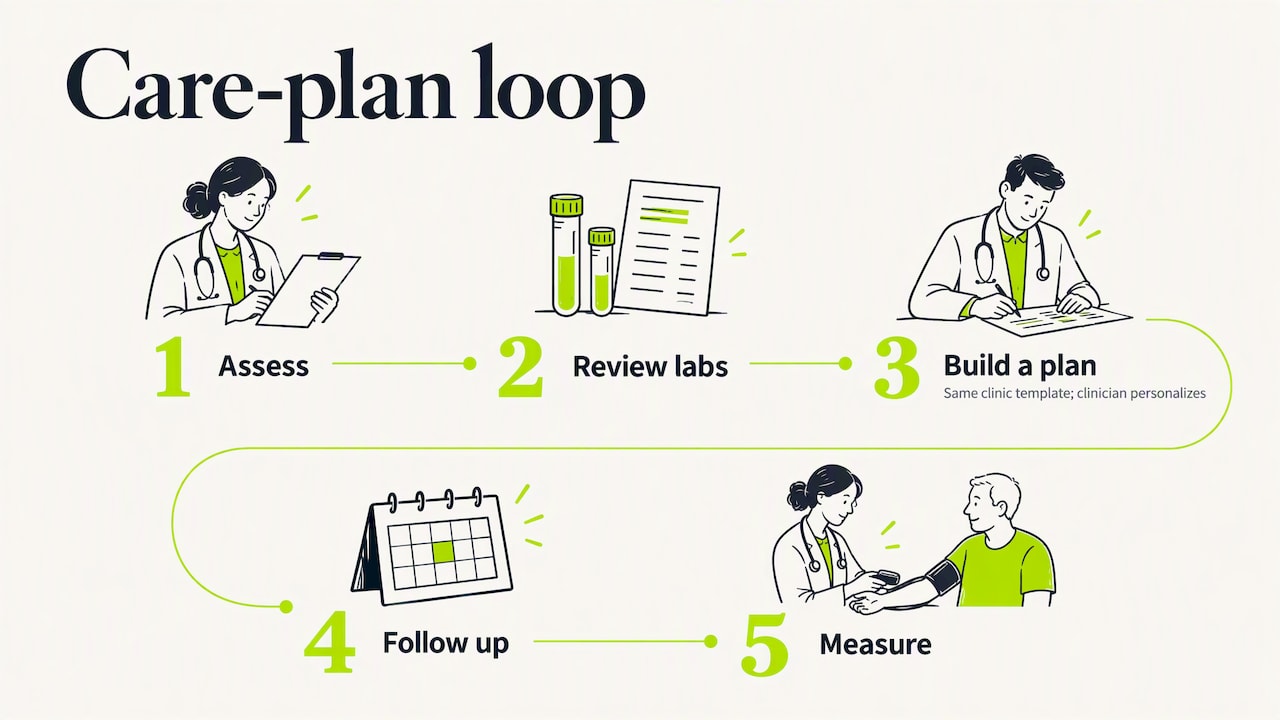
Care plans are a good place to apply the "repeatable loop" idea: assess, review labs, build a plan, follow up, measure. Templates keep that loop the same at every site, while the clinician adjusts each plan to the patient. LongevityEHR builds care plans from the clinic's own templates, so a new provider at a new site starts from the clinic's approach rather than a blank page. More detail is on the care plan software page.
One record across every site
The central technical requirement is a single patient identity that all locations share. When each site registers the same patient separately, results get split, medications get reconciled against partial lists and billing is duplicated. A well-built multi-location system keeps one patient identity while tying schedules, rooms, providers and visits to a specific location.
Federal certification criteria point the same way. The ONC certification guidance for EHR developers (2014 Edition) covers exchange of summary care records, electronic reconciliation of medications, problems and allergies, and privacy and security capabilities such as authentication, authorization, access controls and audit logs. Those are the same things a multi-site group needs inside its own walls, even when it is not a certified-technology buyer.
Handoffs between sites and between clinicians
The WHO brief names information-sharing protocols, shared records, common clinical protocols, care pathways and planned handovers as the tools of coordination. AHRQ's guidance on primary care-based care transitions adds explicit team roles, timely review of notifications and systematic two-way information exchange. For a clinic group, that translates into a few written rules:
- Who owns a patient's plan when the patient sees a clinician at a different site?
- Who reviews outside records, and within what time?
- When a result is abnormal, which role acts and which role documents?
- How does a telehealth visit get recorded so every site sees it?
AHRQ also describes a hybrid model at WellMed, in which centralized care management and specialist services were structurally linked to local primary care clinics, with weekly clinic-level meetings to review higher-risk patients and plan follow-up. That model was built for a much larger, insurance-based population, but the structure transfers: central standards, local huddles.
Access, permissions and privacy across locations
More sites mean more people touching more records. The HHS description of the minimum necessary standard expects covered entities to develop policies that limit workforce access to protected health information to what each role needs, and to limit uses and disclosures accordingly. Treatment disclosures between providers are generally treated differently under that standard, so have your compliance professional confirm how it applies to your structure.
A sensible access model has two layers:
- Role-based access. Front desk, medical assistant, nurse, physician, billing and administrator each see only what the role requires.
- Site scope. Where your policy calls for it, staff who work at one location are limited to that location's patients and operations, while clinical leaders and administrators see across sites.
LongevityEHR is HIPAA, with a BAA on request, and its controls include role-based access and tenant-isolated data. Details are on the security page. Whichever system you choose, sign the BAA before any patient data goes in, and document who has access to what.
Centralize billing, memberships and reporting
Administrative work is where central teams save the most time. Pricing, membership terms, payment handling and reporting definitions should not differ by site unless there is a deliberate reason. A patient on a membership should be charged once, under one set of terms, regardless of where they are seen.
For cash-pay clinics this is simpler than in insurance-heavy groups, but it still needs structure:
- One membership catalog. Tiers, included services and renewal terms are defined once. The membership software in LongevityEHR runs memberships and payments through the clinic's own Stripe account.
- One payout view. Because payments flow through your own Stripe account, finance reviews all sites in one place.
- Consistent billing rules. Our guide to subscription billing in a cash-pay clinic covers failed payments, pauses and cancellations, which are the places multi-site groups drift apart.
- Claims accuracy, where applicable. Clinics that also submit any insurance claims, for example through a separate medical practice, benefit from catching coding errors before submission. Revenue cycle automation is one way groups reduce rework when claims volume spreads across sites.
Central reporting needs the same discipline. Agree on how you count a new patient, an active member and a completed follow-up before you compare sites, or the comparison will mislead.
What multi-location clinic software should do
Use this checklist when evaluating any EHR for multiple locations.
| Requirement | What to look for |
|---|---|
| Single patient identity | One record per patient, with visits tied to a location |
| Location-aware scheduling | Providers, rooms and hours set per site; video visits available |
| Role-based access | Permissions by role, with an audit trail |
| Clinic-level standards | Shared biomarker ranges, templates, intake forms and note structure |
| Lab handling | Results extracted into your ranges, with provider review |
| Memberships and payments | One catalog, payments to your own account |
| Branding | A patient portal that carries your clinic's name and look |
| Reporting | Outcomes and utilization viewable across sites |
| Compliance | HIPAA safeguards and a BAA from the vendor |
| Fast rollout | Ability to add a site without custom development |
Interoperability is a secondary question for most cash-pay groups, but it is worth knowing about. ONC describes TEFCA as a policy and technology framework for secure network-to-network sharing, and its provider datasheet explains the benefits for providers. Ask any vendor how it supports your need to receive outside records, and verify the answer in writing.
Perspective: grow the loop, not the spreadsheet
A common pattern when a cash-pay clinic opens a second site: the first location runs on the founder's habits: the ranges in their head, the plan they always write, the follow-up they always remember. At a second site, those habits do not travel. The clinic then has two options: write everything down, or put it in the software.
We built LongevityEHR around the second option. The clinic's own biomarker ranges, care plan templates, intake forms and note structure live in the platform, so a new provider or a new site inherits the clinic's method on day one. Labs are extracted by AI into those ranges and a provider reviews every result. Memberships and payments run through the clinic's own Stripe account, and the patient portal carries the clinic's brand, so a patient sees one clinic regardless of the address.
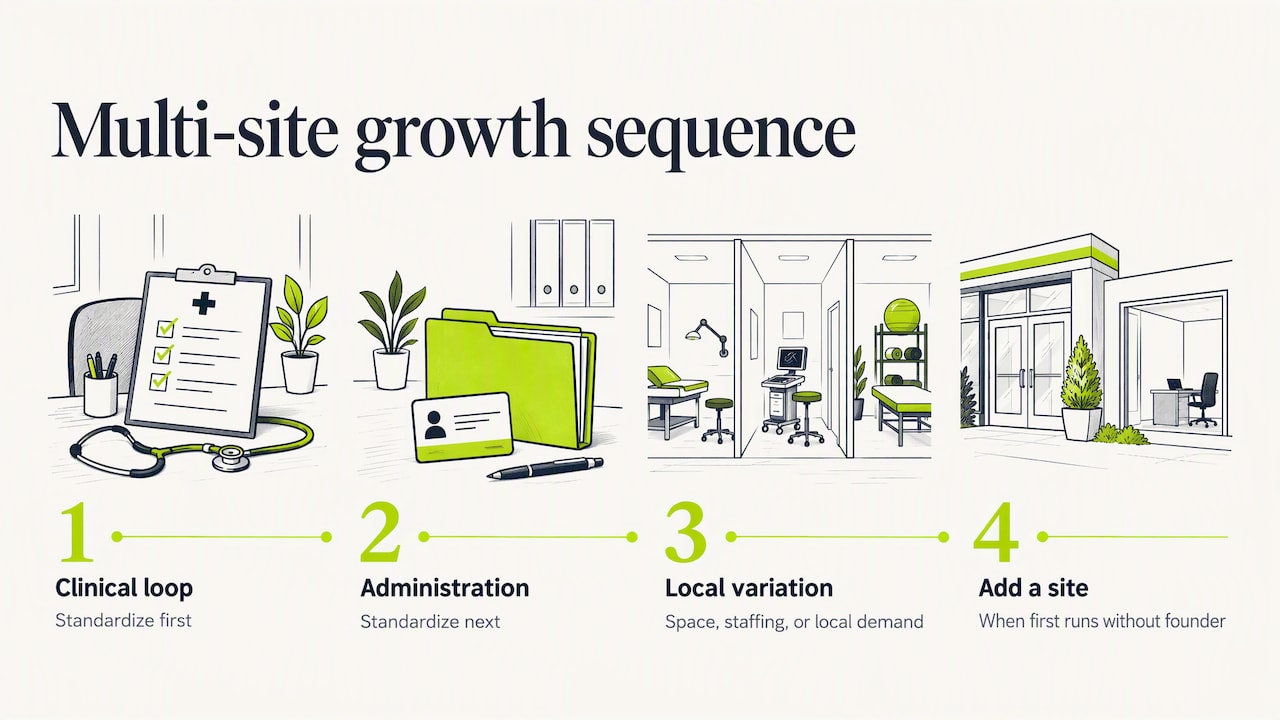
Our advice to operators: standardize the clinical loop first, then the administration, and let sites vary only where space, staffing or local demand require it. Add a site only when the first one runs without the founder in the room.
A rollout plan for adding a site
- Write down the clinical loop. Intake, baseline labs, review visit, plan, follow-up, outcomes. Name the role responsible for each step.
- Put the standards in the system. Ranges, templates, forms and note structure should be configured once, not recreated per site.
- Set roles and site access. Decide who sees what, and record it in a short access policy that your compliance professional has reviewed.
- Import patients and records. Bring existing patients into the single record before the new site opens, so that no one is registered twice.
- Configure scheduling per site. Providers, rooms, hours, visit types and video visit options.
- Train with a site lead. Include the people who will run the site in drafting the routines, then test with a few visits.
- Review after 30 and 90 days. Compare outcomes and operations across sites using agreed definitions, and adjust standards that are not working.
The AHRQ guidance recommends adapting to local resources and workflows with leadership and stakeholder input, and this plan follows that approach.
Run multiple sites on LongevityEHR
LongevityEHR is a white-label EHR for cash-pay longevity, functional medicine, concierge and hormone clinics. It supports management of multiple locations alongside AI lab extraction into your own ranges, care plans from your templates, clinical notes, intake forms, scheduling with video visits, memberships and payments through your Stripe account, and a branded patient portal. Clinics can launch in days without custom development.
Pricing is per provider, every plan includes unlimited patients, and annual billing is 30% off:
| Plan | Monthly | Billed annually |
|---|---|---|
| Trial | $0 for 15 days | Not applicable |
| Core | $99 per provider a month | $69.30 a month ($831.60 a year) |
| Scale | $199 per provider a month | $139.30 a month ($1,671.60 a year) |
| Enterprise | Custom pricing | Custom pricing |
Start on the pricing page with the 15-day trial, or see the full feature list. Concierge practices can read how the platform fits on the concierge medicine software page, and functional medicine groups on the functional medicine EHR page.

Run your longevity clinic on one system
- AI lab extraction with provider review
- Your ranges, every result as a trend
- Memberships through your own Stripe
15-day free trial. BAA on request.
Sources
- Continuity and coordination of care, World Health Organization
- Standardization vs Customization, Journal of the American Board of Family Medicine
- The Five Principles of Effective Primary Care-Based Care Transitions, AHRQ
- New Models of Primary Care Workforce, Case Example 5, AHRQ
- Certification Guidance for EHR Technology Developers, ONC
- TEFCA and Its Benefits for Healthcare Providers, ONC
- Minimum Necessary Requirement, HHS