
On this page
Key takeaways
- Without inflammation, ferritin tracks total body iron stores, and WHO recommends the ferritin test to diagnose iron deficiency in otherwise healthy people.
- WHO uses ferritin below 15 µg/L to indicate iron deficiency in apparently healthy adults, and below 70 µg/L in adults with infection or inflammation. In patients with anemia, the AGA recommends a 45 ng/mL cutoff.
- Inflammation, liver disease, obesity and malignancy can all raise ferritin. WHO advises against using ferritin alone to identify iron overload.
- Overload thresholds differ by sex: WHO uses above 150 µg/L for menstruating women and above 200 µg/L for men and non-menstruating women who are otherwise healthy.
- What it measures
- Ferritin, the iron-storage protein. Without inflammation, it tracks total body iron stores.
- Sample
- Serum or plasma. Use the same sample type for follow-up.
- Common units
- µg/L or ng/mL. The two are numerically equal.
- Main guideline reference
- WHO guideline on ferritin to assess iron status (2020). AGA guideline on iron deficiency anemia (2020).
What the ferritin test measures
Ferritin is an iron-storage protein present in all cells. A small amount circulates in the blood, and the ferritin test measures it in serum or plasma. In its 2020 guideline, the World Health Organization (WHO) states that in the absence of inflammation, plasma or serum ferritin is positively correlated with the size of total body iron stores: low in iron-deficient people and high in iron-loaded ones.
That condition, in the absence of inflammation, is the key to reading ferritin levels. WHO also notes that inflammation raises ferritin, so a result can go up for reasons that have nothing to do with iron stores.
Ferritin levels and iron deficiency
WHO recommends ferritin as a good marker of iron stores and as the test to diagnose iron deficiency in otherwise apparently healthy people. Its cutoffs depend on age and on whether infection or inflammation is present.
| Group | Ferritin indicating iron deficiency | Source |
|---|---|---|
| Apparently healthy adults (20 years and older) | Below 15 µg/L | WHO 2020 |
| Adults with infection or inflammation | Below 70 µg/L | WHO 2020 |
| Patients with anemia | 45 ng/mL preferred over 15 ng/mL as the diagnostic cutoff | AGA 2020 |
The difference between 15 and 45 is not a contradiction. WHO sets cutoffs for individuals and populations in general, while the American Gastroenterological Association (AGA) guideline addresses patients who already have anemia, where it recommends the higher cutoff when using ferritin to diagnose iron deficiency. The AGA adds that in inflammatory conditions or chronic kidney disease, tests such as CRP or transferrin saturation may be needed alongside ferritin.
High ferritin and iron overload
At the other end, WHO gives thresholds that may indicate a risk of iron overload. In otherwise healthy people, that is ferritin above 150 µg/L in menstruating women and above 200 µg/L in men and non-menstruating women. In adults who are not healthy, WHO uses above 500 µg/L.
Why inflammation raises ferritin
Because inflammation raises ferritin, it can hide iron deficiency behind a normal-looking number. WHO's answer is to measure inflammation at the same time. In areas of widespread infection or inflammation, it recommends assessing ferritin together with two acute-phase proteins, CRP and alpha-1-acid glycoprotein (AGP).
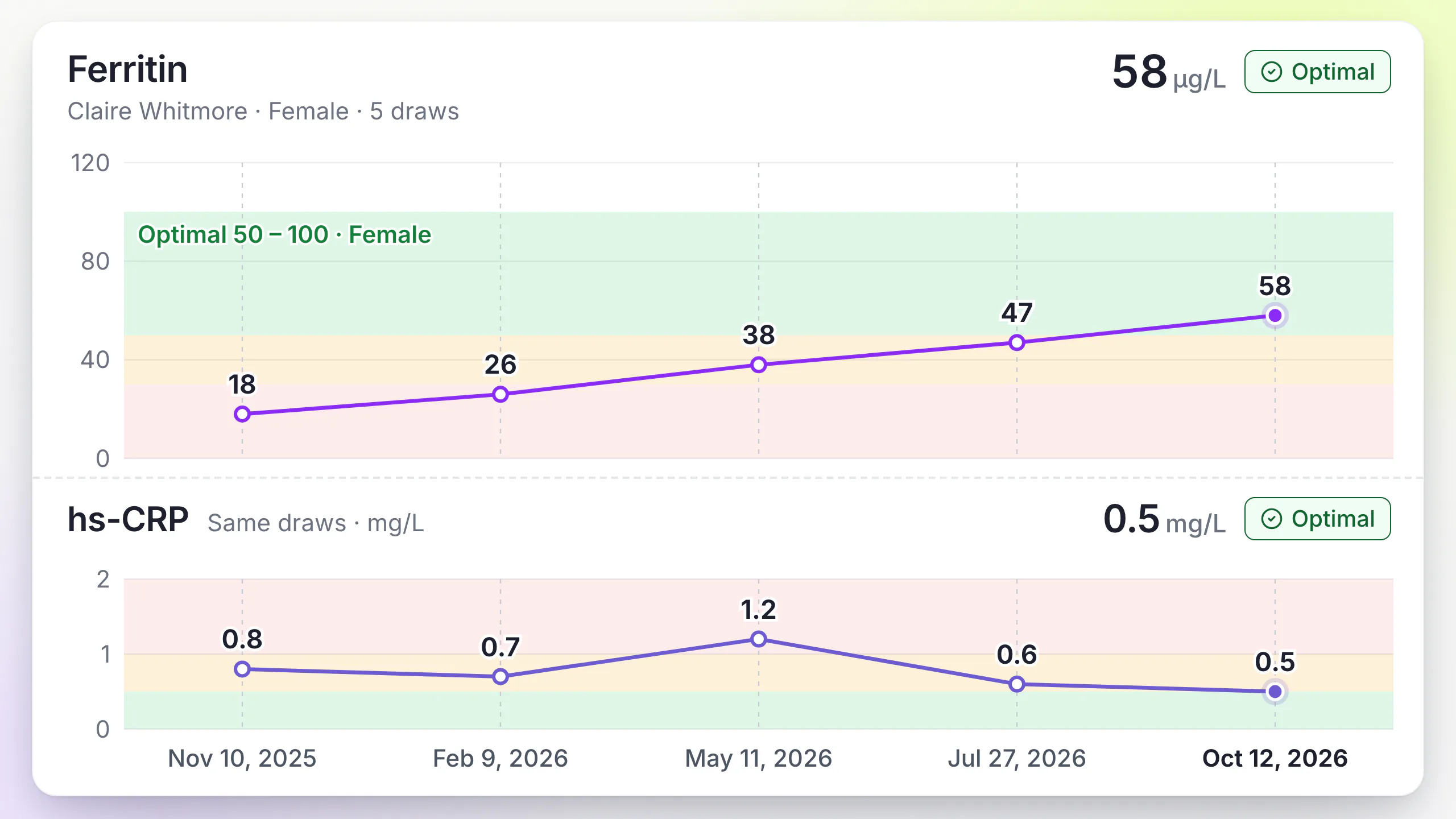
WHO describes several ways to account for inflammation: raising the deficiency cutoff (to 70 µg/L in adults), excluding results with raised CRP or AGP from population estimates, or applying correction formulas. For a clinic, the practical point is simpler: read ferritin next to an inflammation marker from the same draw, such as hs-CRP.
Sex differences in ferritin
Ferritin is one of the markers where sex changes the reading. WHO's overload thresholds are split by sex and menstrual status, 150 µg/L for menstruating women and 200 µg/L for men and non-menstruating women. WHO found the available studies were not sufficient to justify changing its existing cutoffs by sex or age group, and its deficiency cutoff for apparently healthy adults (below 15 µg/L) is the same for women and men.
A clinic setting its own optimal ferritin levels should decide explicitly whether its bands differ for women and men, and on what basis.
Defining optimal ferritin levels for your clinic
No guideline defines an optimal ferritin level. The WHO and AGA cutoffs mark deficiency and possible overload for specific purposes. A band in between that a longevity clinic calls optimal is the clinic's own decision, and it should be documented like one.
- Name the guidelines the lower and upper bounds draw on.
- Decide whether bands differ by sex, and by menstrual status where relevant.
- Say how the clinic reads ferritin when an inflammation marker from the same draw is raised.
- Set a review date for the range.
Our guide to optimal vs reference ranges covers how to set and document clinic ranges.
Tracking ferritin levels in LongevityEHR
WHO notes that ferritin increases in response to iron interventions and can be used to monitor them, and that the same method and sample type should be used for follow-up to keep variability down. That makes ferritin a marker clinics follow as a trend.
In LongevityEHR your clinic sets its own ferritin range, split by sex if you choose, and every released value is graded against the range that fits that patient. Each value keeps a snapshot of the range that applied on the day it was recorded, so later range changes never regrade history. See biomarker tracking.
Results come in through AI lab extraction: upload the lab PDF or image, and values are matched to your biomarkers, with unit mismatches flagged rather than converted. A provider reviews every result before it is released to the patient's portal. LongevityEHR classifies values against your ranges. It never interprets them, and your providers write the interpretation and the care plan.

Run your longevity clinic on one system
- AI lab extraction with provider review
- Your ranges, every result as a trend
- Memberships through your own Stripe
15-day free trial. BAA on request.
Sources
- World Health Organization. WHO guideline on use of ferritin concentrations to assess iron status in individuals and populations. Geneva: WHO, 2020. (accessed October 21, 2026)
- Ko CW, et al. AGA Clinical Practice Guidelines on the Gastrointestinal Evaluation of Iron Deficiency Anemia. Gastroenterology. 2020, 159(3):1085-1094. (accessed October 21, 2026)
This page is educational content for clinicians and clinic operators. It is not medical advice and does not replace clinical judgment. Ranges and thresholds vary by laboratory, method and guideline.