
On this page
Key takeaways
- Serum 25-hydroxyvitamin D is the main indicator of vitamin D status, reported in ng/mL or nmol/L (1 ng/mL equals 2.5 nmol/L).
- The Food and Nutrition Board, as summarized by NIH ODS, considers 20 ng/mL (50 nmol/L) or more sufficient for most people and links levels above 50 ng/mL (125 nmol/L) to potential adverse effects.
- The Endocrine Society's 2024 guideline no longer endorses its 2011 definition of sufficiency (at least 30 ng/mL) and suggests against routine 25(OH)D testing in the populations it considered.
- Neither NIH ODS nor the Endocrine Society identifies optimal vitamin D levels. A clinic's optimal range is its own documented decision, and 25(OH)D assays vary between labs.
- What it measures
- Serum 25-hydroxyvitamin D [25(OH)D], the main indicator of vitamin D status.
- Sample
- Serum.
- Common units
- ng/mL or nmol/L. 1 ng/mL equals 2.5 nmol/L.
- Main guideline reference
- Food and Nutrition Board thresholds as summarized by NIH ODS, and the Endocrine Society 2024 guideline.
What the 25-hydroxyvitamin D test measures
Vitamin D from sun exposure, food and supplements is biologically inactive. The liver converts it into 25-hydroxyvitamin D, or 25(OH)D, which the NIH Office of Dietary Supplements (ODS) describes as the main indicator of vitamin D status. 25(OH)D has a fairly long circulating half-life of about 15 days, which is why it is the form measured in the 25-hydroxyvitamin D test.
Labs report vitamin D levels in either ng/mL or nmol/L. One ng/mL equals 2.5 nmol/L, so 20 ng/mL and 50 nmol/L are the same value. Mixing the two units in one trend makes values hard to compare.
The Food and Nutrition Board thresholds
The ODS fact sheet for health professionals summarizes the thresholds from the Food and Nutrition Board (FNB) of the National Academies. The ODS is explicit that the concentrations associated with deficiency have not been definitively identified. The bands below are the conclusions of an FNB expert committee.
| nmol/L | ng/mL | FNB interpretation (as summarized by NIH ODS) |
|---|---|---|
| Below 30 | Below 12 | Associated with vitamin D deficiency |
| 30 to below 50 | 12 to below 20 | Generally considered inadequate for bone and overall health in healthy individuals |
| 50 or more | 20 or more | Generally considered adequate for bone and overall health in healthy individuals |
| Above 125 | Above 50 | Linked to potential adverse effects, particularly above 150 nmol/L (60 ng/mL) |
The same fact sheet states that optimal serum concentrations of 25(OH)D for bone and general health have not been established, because they are likely to vary by stage of life, by race and ethnicity and with the physiological measure used. It also notes that the FNB found the evidence on outcomes other than bone health inadequate or too contradictory to draw conclusions.
What changed with the Endocrine Society 2024 guideline
In June 2024 the Endocrine Society published Vitamin D for the Prevention of Disease, which updates and replaces its 2011 guideline on evaluating, treating and preventing vitamin D deficiency. The new guideline addresses people without established indications for vitamin D treatment or 25(OH)D testing.
- The panel found no clinical trial evidence to support routine 25(OH)D screening in the general population, or in people with obesity or dark complexion, and suggests against routine testing in all populations it considered.
- It found no clear evidence defining an optimal target level of 25(OH)D for disease prevention in those populations.
- In a companion guideline communication, the Society states it no longer endorses its earlier definitions of sufficiency (at least 30 ng/mL, or 75 nmol/L) or insufficiency (above 20 but below 30 ng/mL).
- The recommendations do not replace the Dietary Reference Intakes and do not apply to people with established indications for vitamin D treatment or testing.
The guideline's other recommendations concern supplementation in specific groups. Those are clinical decisions outside the scope of this page.
Where the bodies disagree, and why
Part of the confusion around optimal vitamin D levels comes from the 30 ng/mL figure. It came from the Endocrine Society's 2011 guideline, and the Society no longer endorses it. The positions side by side:
| Body | Position on 25(OH)D thresholds | Position on testing |
|---|---|---|
| Food and Nutrition Board (via NIH ODS) | 20 ng/mL (50 nmol/L) or more sufficient for most people. Above 50 ng/mL (125 nmol/L) linked to potential adverse effects. | Not addressed by the thresholds summarized here. |
| Endocrine Society, 2011 | Defined sufficiency as at least 30 ng/mL (75 nmol/L) and insufficiency as above 20 but below 30 ng/mL. | Suggested measuring 25(OH)D in patients at risk for deficiency. |
| Endocrine Society, 2024 | No longer endorses the 2011 definitions. No optimal target identified for disease prevention. | Suggests against routine testing in the populations considered, absent established indications. |
On intake guidelines, the ODS attributes the differences between bodies to an incomplete understanding of vitamin D biology, guidelines written for different purposes (public health versus clinical practice) and the use of observational studies alongside randomized trials in some of them. The Endocrine Society's 2024 communication makes a similar point about thresholds: earlier proposals rested largely on observational studies, which give weaker evidence than randomized trials. Laboratories and guidelines still differ, so check which thresholds a lab prints on its report.
Assay variability
The ODS notes that measuring 25(OH)D is complicated by considerable variability between the available assays, the two most common of which use antibodies or chromatography. A result can be falsely low or falsely high depending on the assay and the lab. The international Vitamin D Standardization Program has developed procedures to standardize 25(OH)D measurement.
How clinics define an optimal vitamin D range
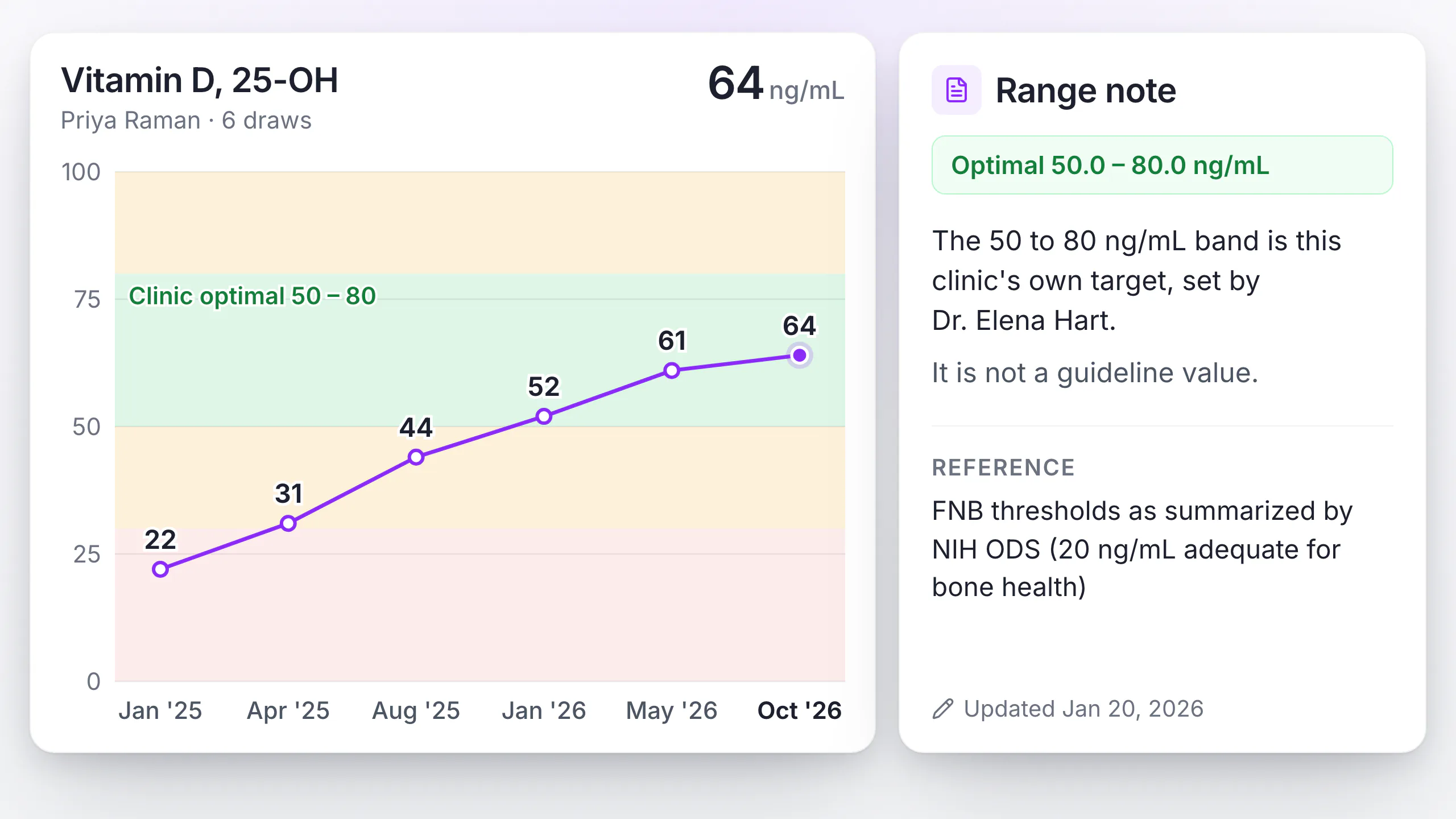
Since neither the FNB (as summarized by ODS) nor the Endocrine Society has established an optimal 25(OH)D level, a longevity clinic that uses an optimal band is making its own clinical decision. That is legitimate, and it is easier to defend when it is written down.
- State which body or evidence the band follows, and say so in the patient-facing explanation.
- Pick one unit for the biomarker and keep it.
- Decide whether the band has an upper bound, and note the FNB's adverse-effects threshold when you set it.
- Review the band when guidance changes, as it did in 2024.
Our guide to optimal vs reference ranges covers how to set, document and revisit clinic ranges.
Tracking vitamin D levels in LongevityEHR
In LongevityEHR your clinic sets its own range for vitamin D, per sex if you choose, and every released value is graded against it and added to a trend across draws. Each value keeps a snapshot of the range that applied when it was recorded, so if your clinic revises its band after a guideline change, past results keep the grade they had. See biomarker tracking.
Results arrive through AI lab extraction. Upload a lab PDF or image and the 25(OH)D value is matched to your vitamin D biomarker. A report in nmol/L against a biomarker configured in ng/mL is flagged for review and never silently converted. A provider reviews and releases every result before the patient sees it.
LongevityEHR does not interpret results or recommend doses. Your providers write the interpretation, and any plan changes live in the patient's care plan. For another marker where cutoffs depend on the guideline and its purpose, see ferritin.

Run your longevity clinic on one system
- AI lab extraction with provider review
- Your ranges, every result as a trend
- Memberships through your own Stripe
15-day free trial. BAA on request.
Sources
- NIH Office of Dietary Supplements. Vitamin D: Fact Sheet for Health Professionals (updated June 27, 2025). (accessed October 21, 2026)
- Demay MB, Pittas AG, et al. Vitamin D for the Prevention of Disease: An Endocrine Society Clinical Practice Guideline. J Clin Endocrinol Metab. 2024, 109(8):1907-1947. (accessed October 21, 2026)
- Endocrine Society. Vitamin D for the Prevention of Disease: guideline resources (June 3, 2024). (accessed October 21, 2026)
- McCartney CR, et al. Vitamin D Insufficiency and Epistemic Humility: An Endocrine Society Guideline Communication. J Clin Endocrinol Metab. 2024, 109(8):1948-1954. (accessed October 21, 2026)
- Holick MF, et al. Evaluation, treatment, and prevention of vitamin D deficiency: an Endocrine Society clinical practice guideline. J Clin Endocrinol Metab. 2011, 96(7):1911-1930. (accessed October 21, 2026)
This page is educational content for clinicians and clinic operators. It is not medical advice and does not replace clinical judgment. Ranges and thresholds vary by laboratory, method and guideline.