
On this page
Key takeaways
- A medical digital twin is a patient model continuously fed by real data such as labs, imaging, wearables and notes, used to simulate how a condition or an intervention might play out.
- Published research describes strong promise, but most work is in cardiology, oncology and hospital operations, and the National Academies have flagged substantial research gaps in verification, validation and uncertainty quantification.
- A twin is only as good as the data under it. Clean, longitudinal, clinic-defined biomarker data is the part a practice controls now.
- AI governance for a clinic comes down to a few habits: a named reviewer for every AI output, HIPAA safeguards, a business associate agreement (BAA) with vendors that handle protected health information, and a documented review schedule.
- Start by structuring labs, care plans and outcomes in one record. That is useful on its own and is the prerequisite for any twin-style analytics later.
A digital twin in healthcare is a virtual model of a patient, an organ or a care process that is updated with real data and used to test decisions before they are made in real life. For a cash-pay longevity, functional medicine, concierge or hormone clinic, the practical answer is that the twin itself is still mostly a research and hospital-system concept, while the foundation it depends on is something a clinic can build today: a structured longitudinal record, biomarker ranges the clinic controls, and clear rules for how AI output is reviewed by a provider.
This guide explains the concept at the level an operator needs, shows where the evidence stands, and lays out a governance routine for any AI that touches patient data. It is general information, not medical, legal or financial advice. Clinical, legal and billing decisions should be reviewed by a qualified professional.
What a digital twin in healthcare actually is
The term comes from engineering, where a twin is a virtual copy of a physical asset that stays in sync with sensor data. In medicine, the National Academies of Sciences, Engineering, and Medicine describe the idea in their 2023 report on foundational research gaps for digital twins: a set of virtual information constructs that mimic a physical system, updated with data from that system, and used to inform decisions. The same report stresses that the link between the model and the real patient runs in both directions: data flows in, and the model's output informs action.
A scoping review in npj Digital Medicine by Katsoulakis and colleagues mapped how the term is used across the literature and found a wide range of meanings, from imaging-based 3D organ models to population-level simulations. That breadth explains why search results for this topic look so different from one another.
For a clinic operator, it helps to separate four layers that all get called a "twin":
| Layer | What it models | Typical setting |
|---|---|---|
| Organ or device twin | A heart, a vessel or an implant, often from imaging | Academic centers, device makers |
| Patient twin | A person's physiology and disease course, updated with labs, wearables and notes | Research programs, early clinical pilots |
| Population twin | A cohort, used to simulate outcomes of a protocol | Health systems, researchers |
| Operational twin | Scheduling, staffing and resource flow | Hospitals and large groups |
Most of what a longevity clinic does lives in the patient layer, and the clinic's own cohort is a small version of the population layer.
Where the evidence stands
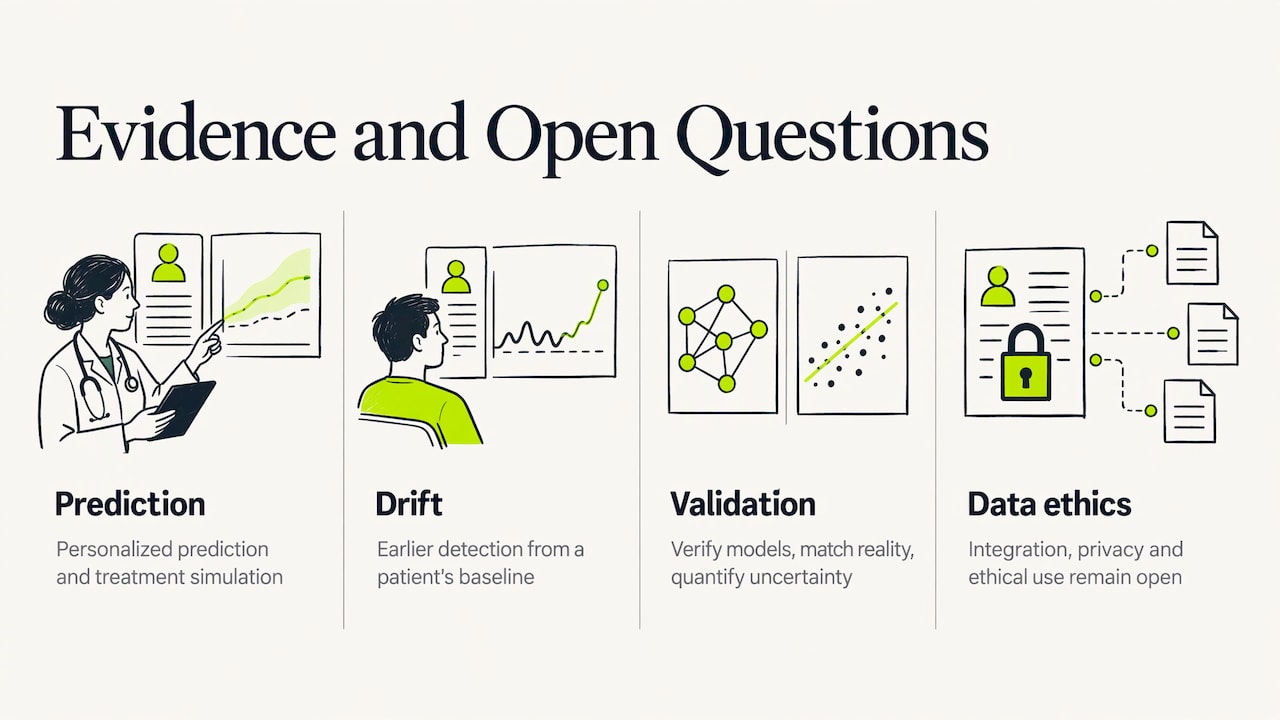
Published reviews agree on the promise: personalized prediction, simulation of treatment options and earlier detection of drift from a patient's baseline. They also agree on what is still unsettled. The National Academies report identifies verification, validation and uncertainty quantification as central research needs, meaning that a model has to be shown to be built correctly, to match reality, and to state how confident it is. It also raises questions on data integration, privacy and ethical use.
For an operator, that translates into a clear reading. The question is not whether to buy a twin, but whether the clinic's data is organized well enough that any model, now or later, has something reliable to learn from and that a provider can check its output against.
What a twin needs underneath
Every twin definition above depends on the same inputs:
- Structured lab data. Values stored as numbers with units and dates, not as PDFs in a folder.
- Defined reference ranges. Longevity practices often work to tighter or different optimal ranges than a lab's standard range. A model fed with the wrong range definitions draws the wrong conclusions.
- Longitudinal history. Trends across visits matter more than any single draw. Our guide to the longitudinal health record covers how clinics build one.
- Documented interventions. Care plans, dose changes and notes, tied to dates, so that cause and effect can be examined later.
- Outcomes. Without a record of what happened after an intervention, there is nothing to simulate against.
A clinic that has these five in one place has done most of the work that any future twin-style tool will require.
What this means for a cash-pay clinic
Large health systems pursue twins for populations of millions. A cash-pay practice has a different advantage: a defined patient base, a consistent protocol and freedom to set its own clinical ranges. That makes the quality of the record the deciding factor, not the sophistication of any model.
The practical steps, in order:
- Move lab results into structured fields. Manual transcription is slow and error-prone. AI extraction can read a lab report and place values into the clinic's own biomarker ranges, with a provider reviewing before anything is saved to the chart.
- Define your ranges once. Decide the optimal and reference ranges your clinicians use, and apply them consistently. The biomarker library is a useful reference for the markers longevity practices commonly track.
- Tie care plans to biomarkers. A plan built from clinic templates and linked to the markers it aims to move creates the cause-and-effect trail a model would need.
- Record visits and notes in the same system. Clinical notes, intake forms and follow-ups belong beside the labs, not in separate tools.
- Report on outcomes. Review how markers moved across your cohort after each protocol. This is a manual, clinician-led version of what a population twin would automate.
Device and wearable streams add to this picture. If your protocols rely on them, see how clinics approach wearable data integration, and keep the same rule: data that enters the record is reviewed by a provider before it drives a decision.
AI governance and responsible use in a clinic
As soon as AI reads a lab report, drafts a care plan or summarizes a visit, the clinic needs governance, whether or not it ever builds a twin. Governance does not need a committee at a ten-provider practice. It needs a short written policy that people follow.
Keep a clinician in the loop
The core principle is that AI output is a draft and a licensed provider owns the decision. The FDA's guidance on clinical decision support software draws lines between software that supports a clinician's independent review and software that does not, and explains which functions the agency treats as devices. Whether a particular tool falls under that guidance is a regulatory question worth reviewing with qualified healthcare counsel.
In practice, build the habit into the workflow: every extracted value and every drafted plan is reviewed and signed by a named provider before it reaches the patient.
Protect patient data under HIPAA
Any vendor that creates, receives, maintains or transmits protected health information for your clinic is a business associate. The HHS HIPAA guidance on business associates explains that a written contract, the BAA, is required. Before adopting any AI tool, confirm the vendor will sign one and that the tool is covered by it. A tool that sits outside the agreement is outside your HIPAA arrangement, however convenient it is.
The HIPAA Security Rule also expects the clinic itself to run a risk analysis and apply administrative, physical and technical safeguards. The HHS Security Rule summary is the official starting point. Role-based access, so staff see only what their job requires, is one common way practices put the minimum-necessary idea into daily practice.
Use a risk framework
The NIST AI Risk Management Framework is a voluntary US framework organized around four functions: govern, map, measure and manage. A small clinic can borrow its structure without adopting all of it:
- Govern: name who approves new AI tools and who reviews them each year.
- Map: list every place AI touches patient data or patient communication.
- Measure: spot-check outputs against source documents on a regular schedule.
- Manage: decide what happens when an output is wrong, and log it.
A one-page policy checklist
| Item | Question to answer in writing |
|---|---|
| Inventory | Which AI features are in use, and on which data? |
| Reviewer | Which provider signs off on each type of output? |
| BAA | Is every vendor that handles PHI covered by an agreement? |
| Access | Who can see which records, and how is that granted and removed? |
| Patient communication | How are patients told that AI assists with documentation or extraction? |
| Audit | How often are samples of AI output compared with source reports? |
| Incident | Who is told, and what is corrected, when an error is found? |
Review the finished policy with a healthcare attorney or compliance professional in your state. State rules on AI and patient disclosure vary and are changing.
A fictional example of the loop
Consider a fictional patient, "Patient A," at a hormone and longevity clinic. A lab report arrives as a PDF. The extraction tool places each value into the clinic's own ranges, and the provider reviews and corrects any value before saving it. The provider then selects a care plan from a clinic template, adjusting it for Patient A. Three months later, the follow-up labs are extracted and reviewed the same way, and the record now shows two dated points per marker, the plan that was active between them, and the visit notes.
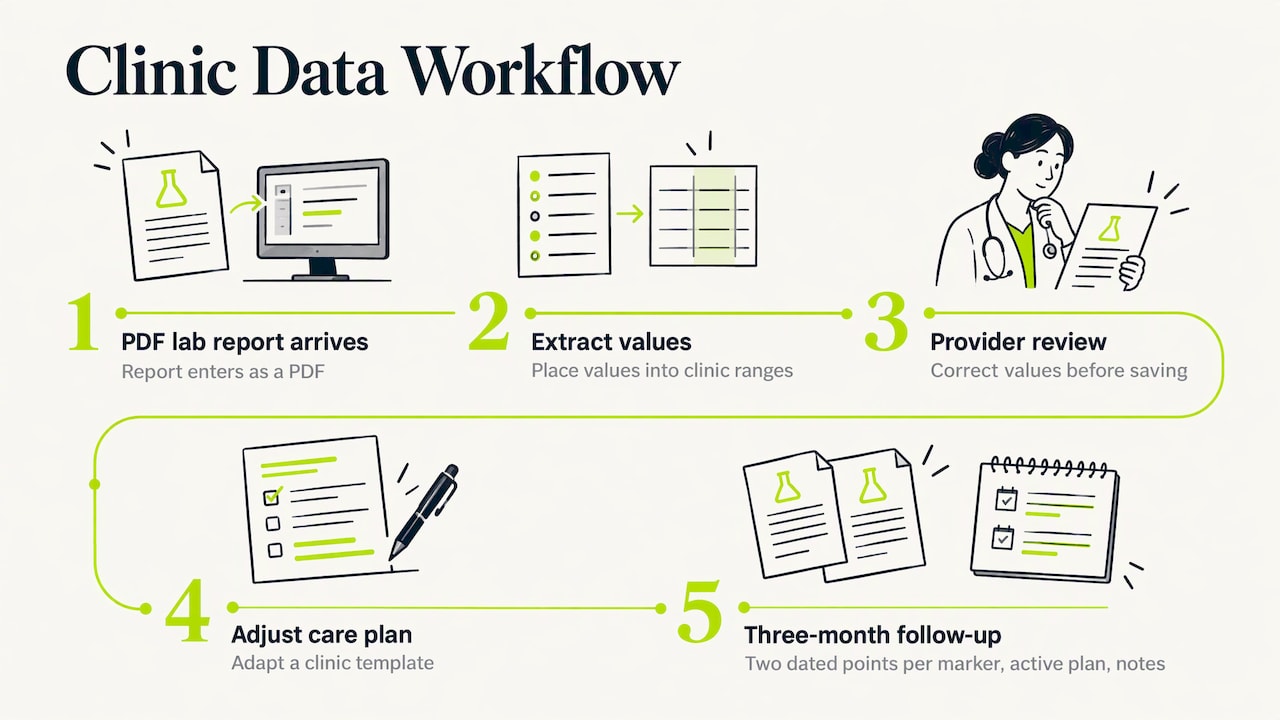
Nothing in this loop requires a twin. Yet if the clinic later adopts a modeling tool, or simply wants to review how a protocol performed across fifty patients, the structured record is already there. The same loop run across a clinic's patients is what turns individual charts into usable outcomes reporting.
Perspective
Our view is that the most useful thing a longevity clinic can do about digital twins is to stop treating them as a product to buy and start treating them as a standard for the record.
A twin asks for structured labs, ranges the clinic defines, dated interventions and outcomes. Those are the same things a good longevity practice needs to deliver proactive care. When a lab report is extracted into the clinic's own biomarker ranges and a provider reviews it, the chart gets better the same day. When care plans come from the clinic's own templates and sit beside notes, intake forms and visits, the story of each patient becomes readable.
We built LongevityEHR around that loop for cash-pay clinics: AI lab extraction with provider review, care plans from your templates, clinical notes, intake forms, scheduling with video visits, memberships and payments through your own Stripe account, and a white-label patient portal under your brand. LongevityEHR is HIPAA, with a BAA on request. We would rather a clinic have a clean record and a clear AI policy this quarter than a twin proposal it cannot feed.
Starting with the platform
LongevityEHR is white-label software for cash-pay longevity, functional medicine, concierge and hormone clinics. Clinics launch their branded portal in days without custom development, and every plan includes unlimited patients. Pricing is per provider:
- Trial: $0 for 15 days.
- Core: $99 per provider a month, or $69.30 a month billed annually ($831.60 a year).
- Scale: $199 per provider a month, or $139.30 a month billed annually ($1,671.60 a year).
- Enterprise: custom pricing.
Annual billing is 30% off. You can compare plans on the pricing page, or see how AI lab extraction works before you start a trial.
For a wider look at the tools clinics weigh, our overview of longevity technology walks through the categories and how to choose.

Run your longevity clinic on one system
- AI lab extraction with provider review
- Your ranges, every result as a trend
- Memberships through your own Stripe
15-day free trial. BAA on request.
Sources
- National Academies, Foundational Research Gaps and Future Directions for Digital Twins (2023)
- Katsoulakis et al., Digital twins for health: a scoping review, npj Digital Medicine (2024)
- FDA, Clinical Decision Support Software guidance
- HHS, HIPAA business associates guidance
- HHS, HIPAA Security Rule summary
- NIST, AI Risk Management Framework