
On this page
- What healthcare data privacy covers
- Why privacy matters to patients and to care
- The main privacy issue: sharing and reidentification
- What the HIPAA Privacy Rule requires
- Privacy and security are not the same thing
- State laws sit on top of HIPAA
- Practical steps for a cash-pay clinic
- Privacy in an integrated clinic platform
- Our perspective
- Choosing a plan that fits your practice
Key takeaways
- Healthcare data privacy governs who may use, share and obtain copies of patient information. Security covers the technical, physical and administrative controls that protect it. A clinic needs both.
- HIPAA applies to covered entities (providers, health plans, clearinghouses) and requires written safeguards from their business associates, including software vendors that handle protected health information.
- The minimum necessary standard means staff and systems should use and disclose only the information a purpose requires.
- The practical work is an information inventory, role-based access, staff training, a business associate agreement with each vendor, and a breach response plan.
- Review any of this with a qualified professional before you rely on it, because state laws and your own facts change the answer.
Healthcare data privacy is the set of rules and practices that keep identifiable patient information from being used or disclosed improperly, while still allowing the use that care requires. In the United States the baseline is the HIPAA Privacy Rule, which sets national standards for medical records and other individually identifiable health information. This guide explains what is covered, where privacy differs from security, and how owners of cash-pay longevity, functional medicine, concierge and hormone clinics can build privacy into daily operations. It is general information, not legal advice, and a qualified healthcare attorney or compliance professional should review your own situation.
What healthcare data privacy covers
HHS's summary of the HIPAA Privacy Rule describes protected information broadly. It includes identifiable information in oral, paper or electronic form that relates to physical or mental health, the care provided, or payment for care, along with identifying demographics such as name and address.
For a longevity clinic that definition reaches further than many owners expect. It includes:
- Lab reports and biomarker histories, including values your clinic tracks against its own ranges.
- Intake forms, health histories and clinical notes.
- Care plans, supplement and hormone protocols, and follow-up records.
- Appointment records and video visit details tied to a named patient.
- Payment and membership records connected to a patient's identity.
A review of global healthcare privacy challenges also draws a useful distinction. Broadly identifying personal data (an email address on a marketing list) is different from medical data generated during care. The second category carries the higher expectation of protection, and in a clinic the two often sit side by side.
Why privacy matters to patients and to care
Privacy is a clinical issue as much as a legal one. The American College of Physicians' 2021 position paper states that trust is essential to digital health: patients who fear inappropriate disclosure or use may withhold pertinent information, which can have negative clinical consequences. In a practice built on detailed histories, lifestyle data and repeated lab work, incomplete disclosure weakens the plan itself.
The OECD's 2022 report on health data governance makes the balance explicit. Health data use can improve quality and performance, but loss or misuse can cause personal, social and financial harm and erode public trust. For a cash-pay clinic, whose revenue depends on patient confidence and retention, that trust is part of the product.
The main privacy issue: sharing and reidentification
The American Heart Association's 2023 policy statement warns that even deidentified data may be reidentified, particularly genomic or geolocation data, and that health information is increasingly shared with commercial entities. This is where most real-world privacy problems start: not in a dramatic attack, but in routine decisions about who receives data and for what purpose.
For clinic operators, the practical questions are routine ones:
- Which vendors receive patient information, and under what written agreement?
- Does a marketing tool, website form or analytics script ever touch patient data?
- Who inside the clinic can see which records?
- Are patients told clearly how their information is used?
None of these require technical expertise to ask. They do require a documented answer.
What the HIPAA Privacy Rule requires
Who is covered
According to HHS, the Privacy Rule applies to covered entities: healthcare providers, health plans and healthcare clearinghouses. It also requires covered entities to impose specified written safeguards on their business associates. Whether a particular cash-pay practice is a covered entity depends on whether it conducts certain standard electronic transactions, and that is a question for your attorney or compliance advisor, not an assumption to make from the payment model alone.
Permitted uses and disclosures
The rule permits or requires specified uses, including treatment, payment and healthcare operations, disclosures to the individual, public-interest activities, limited data sets and qualifying research. Other uses generally require written authorization. The Office of the National Coordinator for Health IT adds in its patient guidance that HIPAA allows sharing for treatment and care coordination without separately asking the patient each time. It also says that, in general, health information cannot be given to an employer or used for sales calls or advertising without authorization, and that an authorization must identify who receives the information and how it will be used.
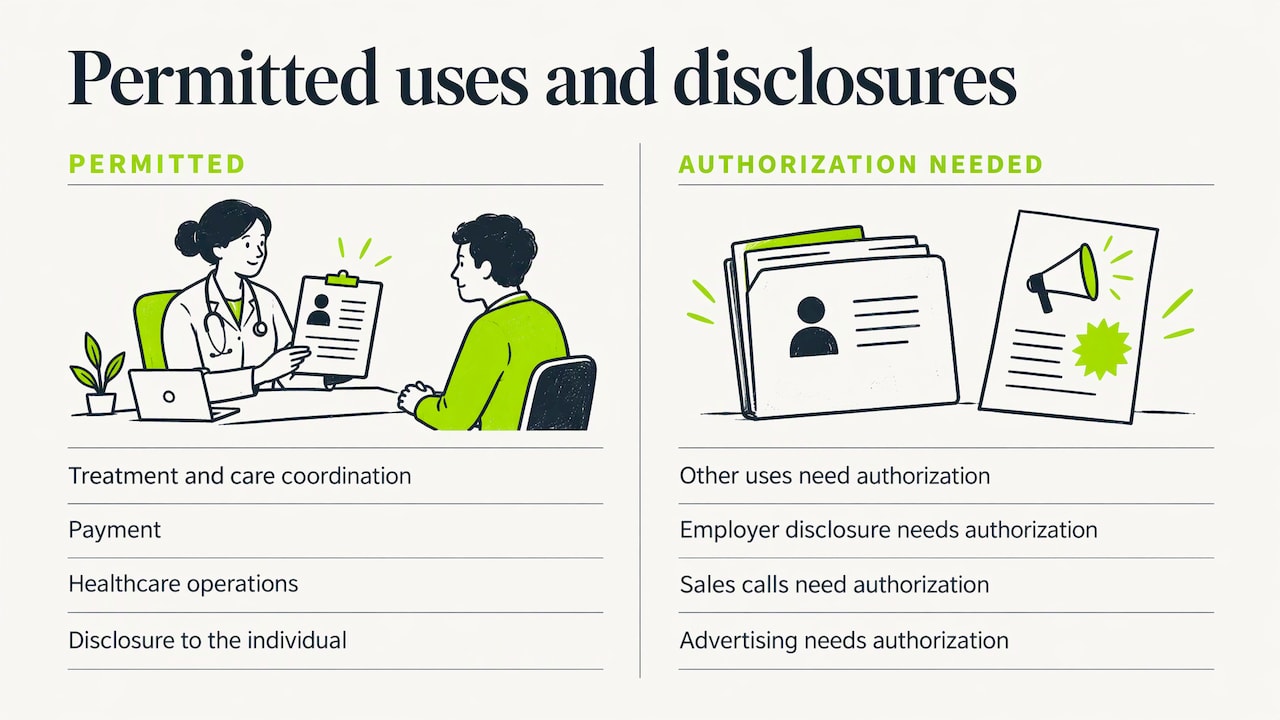
That second point matters for clinics that run marketing programs. A patient's lab results or protocol should not feed an advertising list without a proper authorization, and any such plan should be reviewed by counsel first.
The minimum necessary standard
HHS guidance requires covered entities to make reasonable efforts to use, disclose and request only the minimum protected health information needed for the purpose, unless using the entire record is reasonably justified. Operationally, this is the reason role-based access matters. A front-desk coordinator who schedules visits does not need the full clinical record, and a billing contact does not need every note.
Patient rights
The Health IT Playbook notes that patients generally have the right to inspect or obtain copies of protected health information in designated record sets, and to direct a covered entity to send a copy to a person or entity they choose. Clinics should have a defined process for these requests, including who receives them, who verifies identity and how fast they are fulfilled.
Privacy and security are not the same thing
The two terms are often used as if they were interchangeable. The Health IT Playbook separates them: privacy concerns the patient's rights and control over access, use, sharing and copies of health information, while security concerns the technical, physical and administrative controls that protect it. Privacy standards cover information in any form, while the security standards specifically cover electronic protected health information.
| Privacy | Security | |
|---|---|---|
| Core question | Who may use or receive this information, and why? | How is the information protected from unauthorized or accidental disclosure? |
| Scope | Information in any form (paper, oral, electronic) | Electronic protected health information |
| Typical clinic examples | Authorizations, notice of privacy practices, patient access requests, minimum necessary rules | Access controls, user accounts, device policies, audit practices, risk analysis |
| Who owns it | Clinic leadership and the designated privacy lead | Clinic leadership with IT and vendor support |
The World Health Organization's guidance on protecting personal data adds that confidentiality, integrity, authenticity, accuracy and availability must all be protected. A system that keeps data secret but loses it, or alters it, still fails the patient.
State laws sit on top of HIPAA
HIPAA is the federal floor, not the whole picture. Many states add their own health privacy, consumer data and breach notification requirements, and some treat wellness or consumer health data differently from clinical records. Longevity clinics often sit in that gray area, because they collect biomarker, wearable and lifestyle data that blurs the line between care and wellness. Ask a healthcare attorney licensed in your state which laws apply to each category of data you collect, and revisit the answer when you open a second location or begin treating patients in another state.
Practical steps for a cash-pay clinic
Government health privacy guidance, including the OAIC health privacy guide from Australia, converges on a similar set of habits. Australia's law differs from HIPAA, so treat that guide as a model of good practice, not as U.S. requirements. Translated into a U.S. cash-pay setting, a workable program looks like this.
- Inventory your data. List what patient information you hold, where it lives (EHR, email, shared drives, paper, messaging apps) and who touches it.
- Assign accountability. Name a privacy lead and a security lead, even if one person holds both roles in a small practice.
- Limit access by role. Give each role only what its work needs, and remove access the day someone leaves.
- Train staff. Cover onboarding and a refresher, with real scenarios such as a patient's family member calling for results.
- Put business associate agreements in place. HHS explains in its business associate contract guidance that the written contract must establish permitted uses, require appropriate safeguards and limit further disclosure. Every vendor that handles protected health information for you needs one.
- Keep a privacy policy and notice. Make sure what you tell patients matches what you actually do.
- Plan for a breach. The HHS Breach Notification Rule requires notice to affected individuals without unreasonable delay and no later than 60 days after discovery of a breach of unsecured protected health information. Decide in advance who investigates, who decides, and who contacts patients.
- Retire data deliberately. Define retention periods with your attorney and a documented method for destroying or deidentifying records when they are no longer needed.
The Health IT Playbook is explicit that practices are responsible for protecting protected health information in their EHR systems. Buying software does not transfer that responsibility. It does make the work easier when the system is built around the clinic's roles and workflows.
Privacy in an integrated clinic platform
Integration reduces one common privacy risk: patient data scattered across email threads, spreadsheets, consumer scheduling tools and personal devices. When labs, notes, care plans, scheduling and payments live in one system with defined roles, you have fewer places to inventory and fewer places to lose control. Other clinics describe the same logic from a European perspective in this piece on how private clinics protect clinical privacy, where consistent handling of records is central.
When you evaluate any platform, ask:
- Will the vendor sign a BAA, and how do you request one?
- Can you restrict access by role, so staff see only what they need?
- Is each clinic's data kept separate from other clinics' data?
- Where do payments and patient messages go, and under whose account?
- How does the vendor handle AI features, and does a clinician review the output before it enters the record?
On that last point, our guide to AI governance for cash-pay clinics covers the review habits worth setting. For patient communication, see the practical guide to HIPAA-compliant messaging, since texting and personal email are among the most common informal privacy gaps.
Our perspective
Most privacy failures in small clinics are workflow failures. A lab PDF is emailed to a personal account, a front-desk login is shared, a patient message ends up in a consumer chat app. The policy existed. The workflow made it hard to follow.
That is why we built LongevityEHR as a single connected system for cash-pay practices: AI lab extraction into the clinic's own biomarker ranges (with provider review), care plans from clinic templates, clinical notes, intake forms, scheduling with video visits, memberships and payments through the clinic's own Stripe account, and a white-label patient portal. When the care loop lives in one place, the clinic has fewer copies of patient data to track and a clearer picture of who can see what.
On compliance, we describe ourselves in one way: HIPAA, with a BAA on request. We would rather say that plainly than overstate it. Your obligations as a clinic still include your own policies, training and legal review, and a platform supports that work without replacing it.
Choosing a plan that fits your practice
If you are replacing scattered tools with a single platform, LongevityEHR offers a 15-day trial at $0, so your team can test the workflow before committing. Every plan includes unlimited patients, and annual billing is 30% off.
- Core: $99 per provider a month, or $69.30 a month billed annually ($831.60 a year).
- Scale: $199 per provider a month, or $139.30 a month billed annually ($1,671.60 a year).
- Enterprise: custom pricing.
See the details on the pricing page, or read how we approach HIPAA support and the BAA.
If you run a concierge or direct primary care model, the concierge medicine software page shows how memberships and payments fit together.

Run your longevity clinic on one system
- AI lab extraction with provider review
- Your ranges, every result as a trend
- Memberships through your own Stripe
15-day free trial. BAA on request.
Sources
- Summary of the HIPAA Privacy Rule, HHS
- Data privacy in healthcare: Global challenges and solutions
- Health Information Privacy, Protection, and Use in the Expanding Digital Health Ecosystem, American College of Physicians
- Health Data Governance for the Digital Age, OECD
- Principles for Health Information Collection, Sharing, and Use, American Heart Association
- Your Health Information Privacy, ONC
- Privacy & Security, Health IT Playbook
- The protection of personal data in health information systems, WHO
- Guide to health privacy, OAIC
- Business Associate Contracts, HHS
- Breach Notification Rule, HHS
- How private clinics protect clinical privacy