
On this page
- What HIPAA actually requires for access control
- The minimum necessary standard, and why roles fit it
- Role-based access in simple terms
- Designing roles for a cash-pay clinic
- A practical setup sequence
- Managing access through the staff lifecycle
- What is changing in the rules
- Where the platform matters
- Try it on your own roles
- Our perspective

Key takeaways
- HIPAA lets organizations choose role-based, user-based, attribute-based or another reasonable access-control method, as HHS Office for Civil Rights explains. Role-based is the usual choice for small clinics.
- The minimum necessary standard means each role should see only the categories of PHI its job requires, with any exception for full-chart access stated and justified in writing.
- Unique user IDs and emergency access procedures are required under the Security Rule. Termination procedures and workforce clearance are addressable specifications.
- Access has a lifecycle: grant at onboarding, adjust at role change, revoke at departure, and review on a fixed schedule.
- A proposed Security Rule update would make documented access management a required specification, so building the habit now avoids rework later.
HIPAA does not name role-based access control as a mandate, but it requires every covered entity to limit access to electronic protected health information (ePHI) to the people who need it, and role-based access is the most practical way for a clinic to do that. For a cash-pay longevity, functional medicine, concierge or hormone clinic, the work comes down to four decisions: which roles exist, what each role can see, how access changes when staff change, and how those decisions are documented. LongevityEHR is HIPAA, with a BAA on request, and is built with role-based access and tenant-isolated data, so clinics can put those decisions into practice from the first day.
This article is general information for clinic owners and operators in the United States. It is not legal advice, and your policies should be reviewed by a qualified healthcare attorney or compliance professional.
What HIPAA actually requires for access control
Two parts of HIPAA shape how a clinic assigns permissions.
The Privacy Rule sets national standards for individually identifiable health information. HHS summarizes it as covering health plans, clearinghouses and health care providers that conduct certain transactions electronically, and it protects that information in any form: electronic, paper or oral. A clinic that bills insurance electronically is plainly covered. Cash-pay clinics should confirm their status with counsel rather than assume, because the answer depends on whether the practice conducts covered electronic transactions, and many practices that are cash-pay in marketing still transmit some transactions, for example when they issue claims or verify eligibility.
The Security Rule covers ePHI specifically and is where access control lives. The Summer 2021 HHS Office for Civil Rights newsletter on controlling access to ePHI states that organizations may consider role-based, user-based, attribute-based or any other access-control mechanism they deem appropriate. It also notes that access controls are not limited to software: firewalls, network segmentation and network access control can also limit access to systems that hold ePHI.
In plain terms: HIPAA tells a clinic what outcome to reach (only approved people and programs reach ePHI) and leaves the method to the clinic. Role-based access is a method, and a defensible one.
The specific standards behind it
The 45 CFR Part 164 Security Standards matrix lists the standards that matter most for permissions:
| Standard | Citation | Relevant specifications | Status |
|---|---|---|---|
| Workforce Security | §164.308(a)(3) | Authorization and/or supervision, workforce clearance procedure, termination procedures | Addressable |
| Information Access Management | §164.308(a)(4) | Access authorization, access establishment and modification | Addressable |
| Access Control (technical) | §164.312(a)(1) | Unique user identification, emergency access procedure | Required |
| Access Control (technical) | §164.312(a)(1) | Automatic logoff, encryption and decryption | Addressable |
Addressable does not mean optional. It means the clinic must assess whether the specification is reasonable and appropriate for its environment and either implement it or document an equivalent alternative. The technical standard itself requires policies and procedures that allow access only to persons or software programs granted access rights under the information access management standard.
The minimum necessary standard, and why roles fit it
The Privacy Rule's minimum necessary requirement is the reason role-based access exists in most clinics. HHS guidance on the minimum necessary requirement says a covered entity's policies must identify the persons or classes of persons who need access to PHI to do their jobs, the categories of PHI they need, and the conditions that apply to that access. A "class of persons" is exactly what a role is.
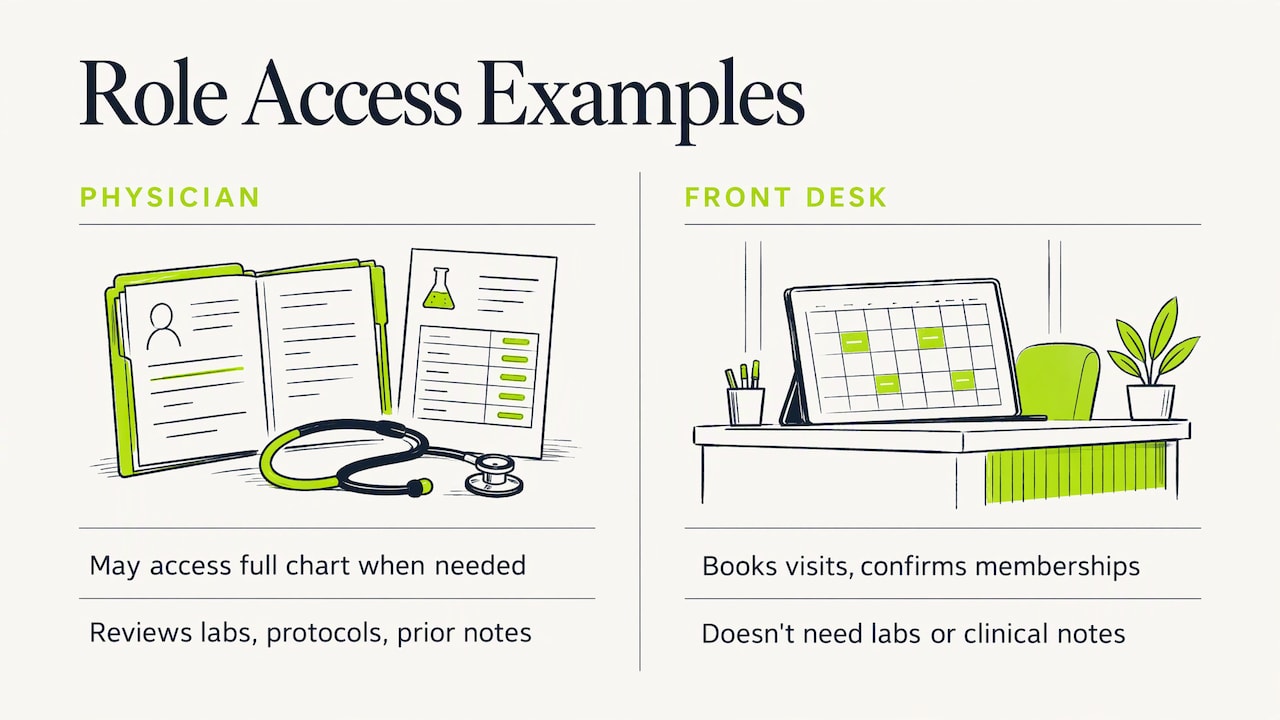
The same guidance gives clinicians room. Doctors, nurses and others involved in treatment may be permitted to access the entire medical record when needed, and where the whole record is necessary, the policy should say so explicitly and explain why. The standard also does not apply to disclosures to or requests by a provider for treatment purposes, disclosures to the patient, or disclosures made under the patient's authorization.
This matters for a longevity practice. A physician reviewing a patient's lab trends, hormone protocol and prior notes needs the full chart. A front-desk coordinator booking visits and confirming memberships does not need lab results or clinical notes. Written role definitions capture that difference.
Role-based access in simple terms
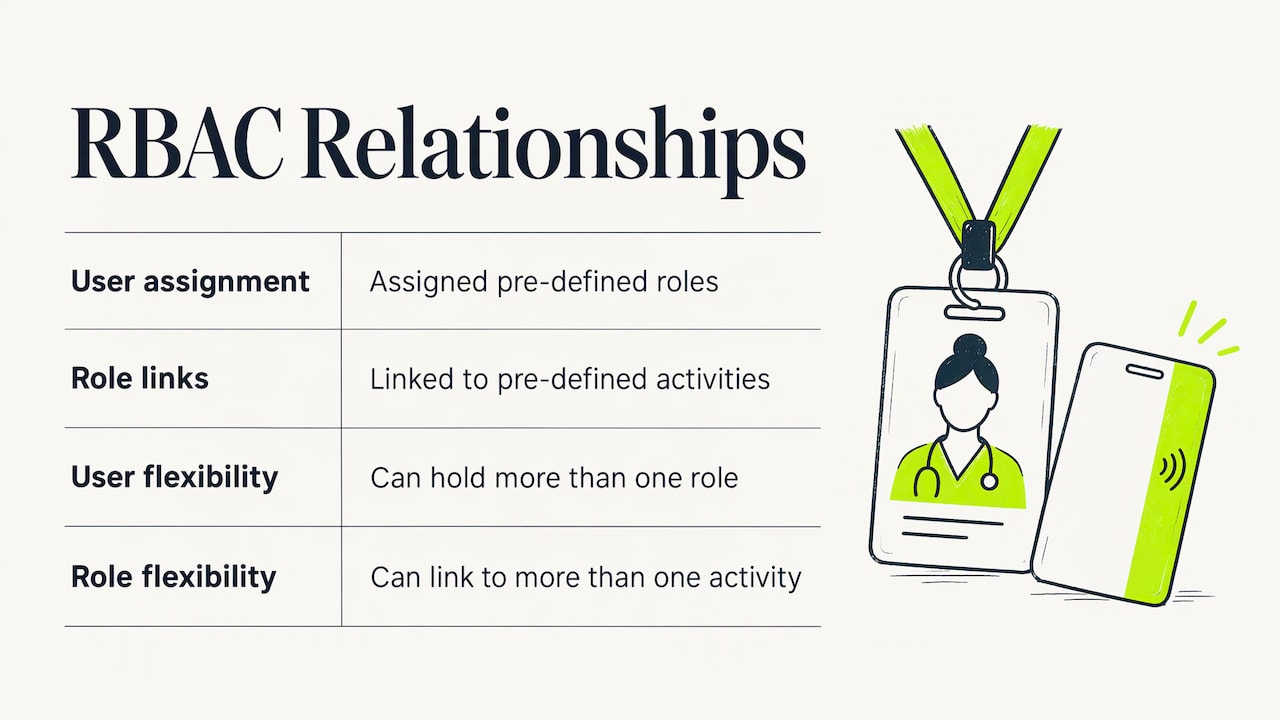
Role-based access control (RBAC) means permissions attach to roles, not to individual people. NHS England Digital describes the model in four ideas: users are assigned pre-defined roles, roles are linked to pre-defined activities, a user can hold more than one role, and a role can be linked to more than one activity. Access is therefore decided by the role a person holds, not by one-off settings for each individual.
The Council on Pharmacy Standards frames the practical shift as moving from access by default to denial by default: a new user starts with access to nothing, and an administrator grants only what the defined job function requires. That is the least-privilege principle, and it is the posture an auditor expects to see.
Designing roles for a cash-pay clinic
The HHS 405(d) HICP guide for small health care organizations lists role-based access as Cybersecurity Practice #3: tailor each user's access to specific workplace requirements and grant new accounts only the access their job or role needs. For a small clinic, that starts with a short inventory.
A fictional example
Consider a fictional clinic, Meridian Vitality, with two physicians, a nurse practitioner, a health coach, a front-desk coordinator and an outside bookkeeper. This example is illustrative only and does not describe any real clinic or patient.
| Role | Typically needs | Typically does not need |
|---|---|---|
| Physician | Full chart, labs, care plans, clinical notes | Billing configuration |
| Nurse practitioner | Full chart for assigned patients, notes, care plans | Clinic-wide administrative settings |
| Health coach | Care plan tasks, progress tracking, relevant biomarkers | Full clinical notes, billing details |
| Front desk | Scheduling, intake status, membership status | Lab results, clinical notes |
| Bookkeeper | Payment and membership reports | Any clinical content |
The exact boundaries are a clinical and compliance judgment for each practice. The principle is to write down who needs what and why, so that every grant has a reason on file.
Questions that sharpen the roles
- Which tasks does each job perform weekly, and which data do those tasks touch?
- Who needs to edit versus only view?
- Do any roles need to see data across multiple locations, or only their own site?
- Which roles are outside contractors, and do they fall under a business associate agreement?
- Who approves access requests, and who is responsible for removing access?
The OCR newsletter notes that access control policies typically address who may request access, who is authorized, who is responsible for authorizing requests, and the criteria for granting access to particular systems, applications and data by workforce role. Answering the questions above produces that policy.
A practical setup sequence
The following sequence draws on NIST SP 800-66 Revision 2, the NIST guide to implementing the Security Rule (it replaced Revision 1 in February 2024). It advises selecting an access control method, establishing standards for granting access with formal authorization, defining roles and responsibilities for all job functions, and separating duties so only the minimum necessary ePHI is available to each staff member.
- Choose the method. Role-based access is the usual fit for a clinic with a few defined job types. Document the choice in the risk analysis.
- Define the roles. List every job function and the categories of PHI each needs. Keep the number of roles small. Five to eight clear roles are easier to maintain than twenty overlapping ones.
- State full-chart access explicitly. For clinical roles that need the whole record, write that down with the justification, as the HHS minimum necessary guidance describes.
- Require unique user accounts. Every person signs in under their own credentials. Shared logins make it impossible to know who viewed what.
- Set an approval path. Name who approves new access, who enters it, and where the approval is recorded.
- Train before access is switched on. Workforce members should understand the policy they are working under before they see patient data.
- Schedule reviews. Decide the frequency up front and put it on the calendar.
An approach from the AHIMA Journal is also useful for small teams: start with a basic role-based process, assess the risk of not having stricter controls, and tighten in stages. A clinic does not need to launch with a perfect matrix, only a documented and consistent one that improves.
Managing access through the staff lifecycle
Role design starts once and gets revisited at each access review. Access management is continuous, and gaps tend to open as staff join, change roles and leave.
Onboarding
Grant only the access the new role requires, nothing inherited from a colleague's account. The HICP guide is direct on this point: new accounts receive access to the computers, devices and programs required for the job or role.
Role changes
When a coordinator moves into a coaching role, the HICP guidance is to terminate prior-role access before enabling the new permissions. Skipping that step produces accumulated access, where a long-tenured employee quietly holds the union of every role they have ever had.
Offboarding
The Security Rule's termination procedures specification, §164.308(a)(3)(ii)(C), calls for procedures to end access to ePHI when a workforce member's employment ends. The HICP guide stresses that prompt termination matters most for cloud-based systems, where access depends on credentials rather than presence at a particular computer, and that any shared or generic accounts should be updated when someone leaves. A departure checklist typically covers the EHR, email, remote access, any device holding PHI, and any shared passwords the person knew.
Emergency access
Unique user identification and an emergency access procedure are both required under §164.312(a)(1). The policy should say who may obtain urgent access to a chart outside their usual role, how that is approved, and how it is reviewed afterward. Our guide to the EHR audit trail explains what records support that review and how long clinics generally keep them.
Periodic reviews
The HICP guide directs practices to review access on a predetermined time frame. A quarterly review of the user list against the current staff roster, with the reviewer's name and date recorded, is a simple routine that produces evidence.
What is changing in the rules
Two developments are worth tracking, and both should be confirmed with counsel.
The Privacy Rule final rule. On November 16, 2026, HHS announced a final rule modernizing the HIPAA Privacy Rule. It strengthens individuals' access rights, including access to electronic PHI through personal health apps, shortens response times and removes the requirement to seek written acknowledgment of the Notice of Privacy Practices. It takes effect 60 days after Federal Register publication. AHA News reports that the access-request response window moves from 30 days to 15 days and that compliance is required 240 days after publication. For access control, the practical effect is that the staff who handle patient record requests need a clearly defined role and a clear process.
The proposed Security Rule update. The January 2025 Security Rule proposal (90 FR 898) would make information access management, meaning documented policies for role-based access to ePHI, a required specification and would remove the required versus addressable distinction. It would also mandate multi-factor authentication and encryption. It is a proposal, not a final rule, so current requirements remain those in the existing regulation. Clinics that document roles and reviews now are positioned for either outcome.
Where the platform matters
Policies on paper only work if the software enforces them. In a cash-pay clinic, one system often holds scheduling, intake forms, clinical notes, lab-derived biomarker data, care plans, memberships and payments. When these live in separate tools, access has to be managed in each one, and offboarding means remembering every login. A single platform with role-based permissions reduces the number of places a departed employee's access can linger.
LongevityEHR is HIPAA, with a business associate agreement (BAA) on request, and uses role-based access and tenant-isolated data. Clinics use it for AI lab extraction into their own biomarker ranges, care plans from clinic templates, clinical notes, intake forms, scheduling with video visits, memberships and payments through the clinic's own Stripe account, and a white-label patient portal. Our security and HIPAA page describes the security approach, and the guides on healthcare data privacy and assigning and closing clinic tasks cover related routines.
Try it on your own roles
LongevityEHR offers a Trial plan at $0 for 15 days, which gives a clinic time to map its roles against its own workflow. Every plan includes unlimited patients, and annual billing is 30% off.
- Core: $99 per seat a month, or $69.30 per seat a month billed annually ($831.60 a year).
- Scale: $199 per seat a month, or $139.30 per seat a month billed annually ($1,671.60 a year).
- Enterprise: custom pricing.
See the plans and pricing to start a trial.
Our perspective
Many access problems in small clinics are not technical failures. They are small habits: a shared login at the front desk, a coach with the same view as the physician because it was easier to set up that way, a former contractor whose account nobody closed.
We build LongevityEHR around the idea that a clinic should be able to express its own structure in the software. A longevity practice already thinks in roles: the physician who owns the plan, the coach who runs it day to day, the coordinator who keeps the schedule and memberships moving. Role-based access with tenant-isolated data lets the platform reflect that structure, so permissions follow the job and not the person.
Our advice to owners is to write the role list before choosing settings, keep it short, and review it every quarter. Pair that with software that covers HIPAA, with a BAA on request, and access control stops being a project and becomes part of how the clinic runs.

Run your longevity clinic on one system
- AI lab extraction with provider review
- Your ranges, every result as a trend
- Memberships through your own Stripe
15-day free trial. BAA on request.
Sources
- Controlling Access to ePHI, HHS Office for Civil Rights newsletter
- Summary of the HIPAA Privacy Rule, HHS.gov
- 45 CFR Appendix A to Subpart C of Part 164, Security Standards matrix
- Minimum Necessary Requirement, HHS.gov
- National role-based access control for developers, NHS England Digital
- RBAC and Least-Privilege Principles, Council on Pharmacy Standards
- HICP Technical Volume 1: Cybersecurity Practices for Small Health Care Organizations, HHS 405(d)
- NIST SP 800-66 Revision 2, Implementing the HIPAA Security Rule: A Cybersecurity Resource Guide
- Business Associates, HHS.gov
- Access Controls: Striking the Right Balance, AHIMA Journal
- HHS Issues New Final Rule to Modernize the HIPAA Privacy Rule
- OCR finalizes HIPAA privacy rule for coordinated care and individual engagement, AHA News
- HIPAA Security Rule To Strengthen the Cybersecurity of Electronic Protected Health Information, Federal Register