
On this page
Key takeaways
- AI lab extraction is a pipeline: text recognition, field identification, normalization of units and names, then a structured table the clinic can track over time.
- Extraction is not interpretation. Recognizing a value and flagging a deviation is not the same as clinical reasoning, which stays with the provider.
- Published accuracy figures are high but not perfect, which is why a provider review step before values are accepted is a sound design.
- Clinics should require HIPAA safeguards, a business associate agreement (BAA), role-based access and a clear human-in-the-loop workflow.
- LongevityEHR extracts lab values into the clinic's own biomarker ranges, with provider review, on every plan including the 15-day $0 trial.
AI reads a lab report in two broad steps. First, it converts the document (a PDF, scan or photo) into machine-readable text. Second, it identifies the parts that matter, such as test name, result, unit, reference range and flag, and writes them into a structured table. Interpretation, meaning what a result implies for a particular patient, is a separate step that belongs to the clinician. For a cash-pay clinic, the practical value is that values land in the chart as data rather than as a stack of attachments, ready for tracking and review.
This guide explains how that extraction works, what published research says about accuracy, which safeguards matter, and how a clinic can build a review workflow around it. It is general information for clinic owners and operators, not medical, legal or financial advice. Clinical, billing and compliance decisions should be reviewed by a qualified professional.
What happens when AI reads a lab report
A lab report is built for human eyes. Layouts differ between laboratories, results sit in tables, columns, side notes and footers, and the same test can carry different names. Automated extraction has to turn that layout into rows of data.
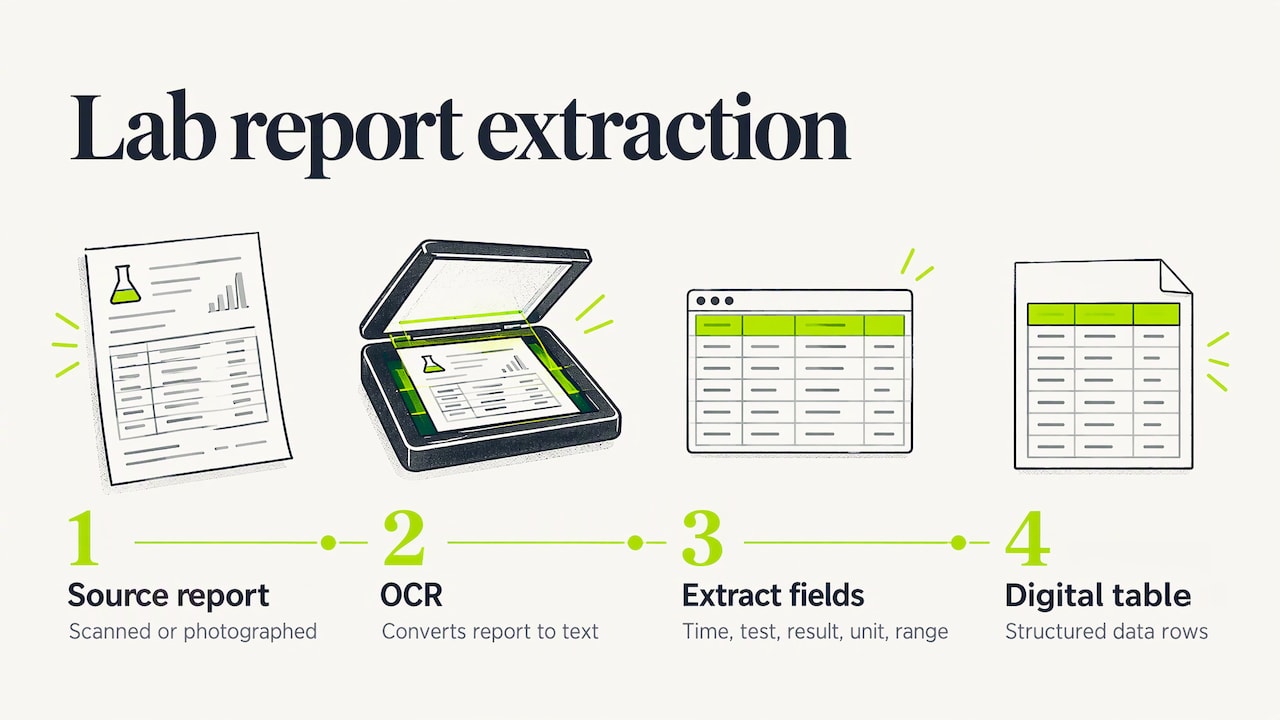
A 2023 peer-reviewed study on paper-based laboratory reports describes a two-stage pipeline: optical character recognition (OCR) converts scanned or photographed reports into text items, then information extraction identifies the report time, test name, result, unit and reference range and outputs a digital table. Newer systems often use language models for the second stage, but the shape of the job is the same.
Stage 1: reading the document
If the report is a digital PDF with embedded text, the text can often be read directly. If it is a scan or a phone photo, OCR has to recognize characters first. Image quality, skew, small fonts and table borders all affect this stage.
Stage 2: identifying the fields
Once text exists, the system must decide which strings are which. A line such as a glucose result with a unit and a range has to be split into test name, value, unit, reference range and flag. Language models help here because they handle varied layouts without a template for each laboratory.
Stage 3: normalizing to a standard meaning
Extracted text is not yet useful for tracking. "Hemoglobin A1c," "HbA1c" and "A1C" must resolve to one biomarker, and units must be comparable across draws. A review of laboratory interoperability identifies LOINC, NPU, UCUM and SNOMED CT as terminology standards that support machine-readable semantic interoperability. In a clinic, the equivalent step is mapping each extracted row to a biomarker in the practice's own library.
Stage 4: provider review and filing
The final step is human. The provider checks the extracted rows against the source document, corrects anything that needs it, and accepts the values into the patient's record. This is where extraction becomes a dependable part of care.
Extraction versus interpretation
The two are often confused, particularly because consumer tools that explain results in plain language are widely advertised. The distinction matters for clinics.
| Task | What it means | Who is responsible |
|---|---|---|
| Extraction | Capturing test name, value, unit, range and flag from a document | Software, checked by the provider |
| Normalization | Matching each row to a standard biomarker and unit | Software, with clinic-defined mappings |
| Range comparison | Placing the value against reference or clinic-defined ranges | Software, using ranges the clinic sets |
| Interpretation | Deciding what a pattern means for this patient and what to do | Licensed clinician |
The 2023 EFLM Working Group perspective on language models in laboratory medicine notes that recognizing tests and flagging deviations is not equivalent to clinically meaningful interpretation, since context, limitations and follow-up reasoning remain essential. The same reasoning applies to a clinic's workflow: software moves data, and the provider reads it in context.
Context also has to travel with the number. The interoperability review cited above cautions that an isolated result is not necessarily interpretable, because interpretive comments, measurement uncertainty and specimen context must stay attached to it. A good extraction workflow keeps the source document one click from the structured row.
How accurate is automated extraction?
No single figure applies to every tool, but published studies give a realistic picture.
- In an evaluation of 153 paper-based reports, OCR averaged 0.93 accuracy and information extraction scored 0.86 F1. The authors note that OCR could misrecognize or merge text and misplace lines.
- A 2025 study of breast pathology reports found a BioBERT model's average parsing performance was 0.99901 across five-fold validation, while performance varied by field and was lower for some margin variables.
- A 2025 surgical pathology cohort study found a locally deployed language model agreed with human reviewers on about 89% of 1,008 answers, compared with 99% agreement between the two human reviewers. The model was faster but less accurate than either reviewer.
- The same study found that binary or categorical questions performed better than context-dependent ones, with concordance ranging from 100% to 75% depending on the question.
Two lessons follow. First, structured, well-defined fields such as value, unit and range are the easiest to extract, while anything that depends on context is harder. Second, accuracy varies by field and by document type, so a review step is a normal part of any responsible design, not an afterthought.
Older experience with automated laboratory reporting points the same way. A CDC review of automated laboratory reporting documented missing transmissions, terminology mismatches, false positives and duplicate or preliminary results, along with a continuing need for manual checking and recoding. Automation reduces manual entry, and checking remains part of the process.
Common failure points to design around
- Merged or shifted table lines in scans, which can attach a value to the wrong test.
- Unit differences between laboratories, such as mg/dL versus mmol/L.
- Preliminary and corrected results arriving as separate documents.
- Handwritten annotations or stamps over printed values.
- Reference ranges that differ by laboratory, sex or age.
Each of these is a reason to show the provider the extracted row beside the source page before the value is accepted.
Reference ranges versus the clinic's own ranges
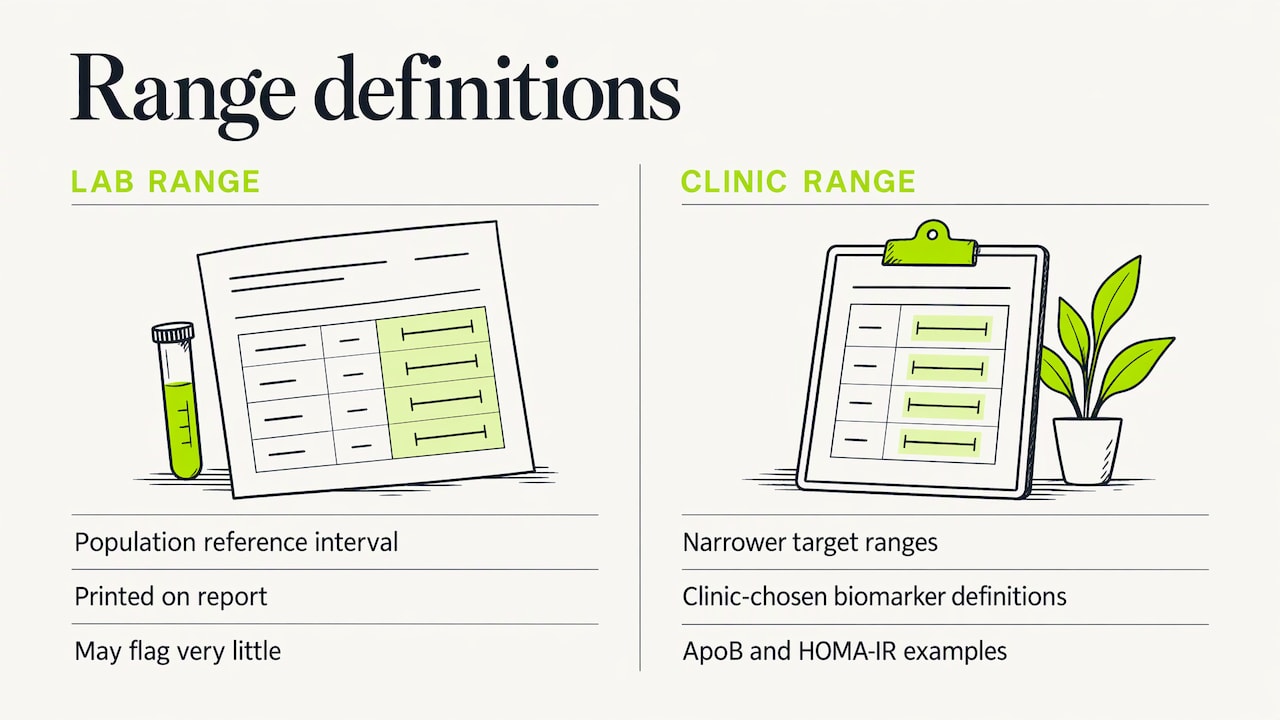
Longevity, functional and hormone practices often work to narrower target ranges than the population reference interval printed on the report. That makes the range-comparison step more important than it is in a standard primary care setting. A system that only reads the laboratory's printed range will flag very little for a patient the clinic wants to optimize.
For this reason, extraction in a longevity setting should map each value into the practice's own biomarker definitions and compare it with the ranges the clinic has chosen. Our page on optimal lab ranges versus reference ranges covers the difference, and the biomarker analysis guide covers tracking methods. Markers such as ApoB and HOMA-IR are good examples where clinics commonly define their own targets.
Safeguards a clinic should require
Privacy and security
Lab reports are protected health information. For entities subject to HIPAA, the ONC's guide to privacy and security of electronic health information describes safeguards including risk analysis, business associate arrangements, written safeguards and ongoing security review. Before any vendor touches patient documents, a clinic should confirm that a BAA is available, that access is role-based, and that each clinic's data is kept separate from other customers' data. A compliance advisor or health care attorney should review the arrangement for the clinic's specific situation.
Human oversight
The American Medical Association's policy on AI in health care recommends risk-based validation and qualified human intervention points, with earlier clinician judgment where potential harm is greater, and says clinicians should be able to intervene in or override medical AI outputs. In practice, that means no extracted value should reach a patient-facing view or a care plan until a provider has reviewed it. Our piece on AI governance for cash-pay clinics goes through how to document those rules.
Deployment discipline
Clinical laboratory guidance on machine learning recommends tested prediction pipelines and APIs, isolated sandbox environments before production, and monitoring of latency, uptime, scalability and security. Clinics buying a hosted product do not run this infrastructure themselves, but the same questions are fair to ask any vendor: how changes are tested, how issues are reported, and how the human review step is built in.
A framework for the evaluation
The CARE framework, published in 2025, organizes AI implementation around clinical use case, data, data pipeline, code, clinical user experience, technology infrastructure, clinical orchestration and regulatory compliance. It can serve as a checklist when a clinic reviews any extraction tool.
Building a review workflow
A repeatable loop keeps extraction useful and safe. A practical version for a clinic looks like this:
- Receive the report. Upload the PDF or image to the patient's record, from the laboratory portal or from the patient.
- Extract. The software reads the document and proposes rows for each biomarker.
- Review. A provider or a trained team member under provider direction compares each row with the source page, with attention to units, flags and decimal places.
- Accept and file. Approved values enter the patient's biomarker history and appear against the clinic's chosen ranges.
- Act. The provider writes notes and updates the care plan, using the trend rather than a single draw.
- Share. Results and plan are released to the patient through the clinic's portal, in the timing the provider chooses.
If a clinic also orders labs through its own channels, lab ordering and extraction can feed the same record, which reduces re-keying.
How to tell whether it is working
Published evidence on whether extraction improves timely, informed care in cash-pay practices is thin, so a clinic is best served by measuring its own workflow. Useful internal measures include:
- Time from report received to provider review.
- Time from review to the patient seeing results and a plan.
- Share of extracted rows the provider corrects, tracked by laboratory and by field.
- Staff minutes spent on manual data entry per report.
- Whether follow-up visits and retests happen on the intended schedule.
A falling correction rate and a shorter turnaround from receipt to patient communication indicate that the workflow is helping. Review the figures quarterly, and have a qualified professional advise on any change that touches clinical protocols.
Our perspective
We built the extraction in LongevityEHR around one idea: the clinic decides what a good number is, and the software does the typing.
In a longevity practice, a lab report is the start of a longitudinal record. The value of a result comes from seeing it beside the last three draws and against the ranges your clinicians have chosen. That is why our AI lab extraction places values into the clinic's own biomarker ranges rather than only repeating the printed reference interval, and why a provider reviews the extracted rows before they are accepted.
We think this is the right division of labor. The software removes the repetitive data entry and keeps the source document attached. The clinician keeps the judgment. Care plans are then drafted from your own templates, notes sit in the same record, and the patient sees the result in a portal that carries your brand.
We think the whole loop belongs in one place, from intake forms and scheduling with video visits to memberships and payments through the clinic's own Stripe account. We designed the platform for that loop. LongevityEHR is HIPAA, with a BAA on request.
Trying AI lab extraction in your clinic
LongevityEHR is a white-label EHR for cash-pay longevity, functional medicine, concierge and hormone clinics. Its AI lab extraction reads uploaded lab reports into your own biomarker ranges for provider review, and sits alongside biomarker tracking, clinical notes, intake forms and a branded patient portal.
Every plan includes unlimited patients, and annual billing is 30% off. Current pricing is on the pricing page:
| Plan | Monthly | Billed annually |
|---|---|---|
| Trial | $0 for 15 days | Not applicable |
| Core | $99 per provider a month | $69.30 a month ($831.60 a year) |
| Scale | $199 per provider a month | $139.30 a month ($1,671.60 a year) |
| Enterprise | Custom pricing | Custom pricing |
The 15-day trial is a practical way to run a few of your own reports through the review workflow described above.

Run your longevity clinic on one system
- AI lab extraction with provider review
- Your ranges, every result as a trend
- Memberships through your own Stripe
15-day free trial. BAA on request.
Sources
- Extracting laboratory test information from paper-based reports (PMC, 2023)
- Potentials and pitfalls of ChatGPT and natural-language artificial intelligence models for laboratory medicine (EFLM, 2023)
- Preparing Laboratories for Interconnected Health Care (2021)
- Leveraging natural language processing for efficient pathology data extraction (PLOS One, 2025)
- Using Large Language Models to Automate Data Extraction from Surgical Pathology Reports (PMC, 2025)
- Automated Laboratory Reporting of Infectious Diseases (CDC, 2003)
- Guide to Privacy and Security of Electronic Health Information (ONC, 2015)
- AMA policy H-480.931 on AI and health care
- Validating, Implementing, and Monitoring Machine Learning in the Clinical Laboratory (2024)
- Establishing a comprehensive AI implementation framework (CARE, 2025)