
On this page
- Why cash-pay clinics process payments differently
- What a cash-pay clinic needs to accept
- How to compare fees, settlement and total cost
- Connecting payments to the EHR
- Security and compliance: HIPAA and PCI DSS
- Common problems and how to prevent them
- Perspective
- How LongevityEHR handles memberships and payments
- A setup checklist before you go live
Key takeaways
- Cash-pay clinics skip the insurance claim cycle, so payment processing is the revenue cycle: card, ACH, recurring membership charges and package payments.
- Connect payments to the EHR so each charge is tied to a patient, a membership and a visit without manual entry.
- Compare processors on total effective cost, payout timing, recurring billing support, dispute handling and who owns the merchant account.
- HIPAA and PCI DSS (the card industry security standard) are separate duties. Keep clinical detail out of payment records and ask your EHR vendor for a BAA.
- Our platform runs memberships and payments through the clinic's own Stripe account, inside a white-label patient portal.
For a cash-pay clinic, the best medical practice payment processing runs inside the same system that holds the patient record, the membership and the schedule, and deposits funds into an account the clinic owns. Payments then follow the care, not a separate terminal or spreadsheet. That arrangement removes re-keying, makes recurring membership billing predictable, and keeps patient information in one place. This guide covers what to accept, what to compare on fees and settlement, which security duties apply, and how to connect payments to the EHR.
Why cash-pay clinics process payments differently
In most of U.S. health care, the provider's contract is with the patient, but a third party often does the paying. PwC's guide to provider revenue describes how a provider bills a payer using standardized medical codes and the payer pays its share according to the terms of the arrangement. That is the model most "healthcare payment processing" content is written for: claims, remittances, patient balances after adjudication.
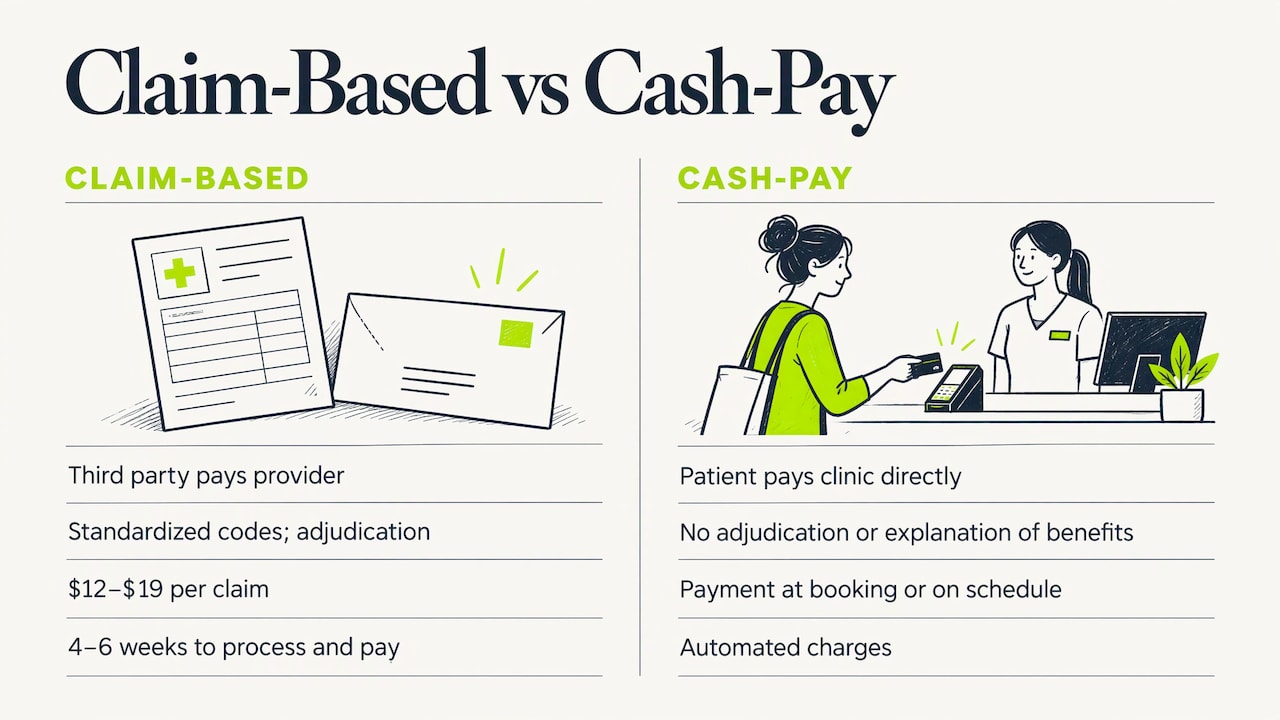
A longevity, functional medicine, concierge or hormone clinic usually works the other way. The patient pays for a membership, a panel, a protocol or a visit directly. There is no adjudication, no explanation of benefits and no balance to chase six weeks later. The payment is the transaction.
The cost of the claim model explains why this matters. A peer-reviewed analysis of administrative spending on financial transactions in U.S. health care reports an average transaction cost of $12 to $19 per claim, with each claim taking 4 to 6 weeks on average to process and pay. The same paper identifies immediate payment assurance and extensive automation as the traits of more efficient payment systems in other industries. A cash-pay clinic can have both by design: the patient pays at booking or on a schedule, and the charge is automated.
One caution on terminology. Under HIPAA, "payment" has a defined meaning that covers a provider's activities to obtain payment or be reimbursed, including billing and collection. When this guide says payment processing, it means the card and bank transfer mechanics of collecting money, and the HIPAA implications of that data are covered below.
What a cash-pay clinic needs to accept
Start from the patient journey and the revenue types, not from the processor's feature list.
| Revenue type | Typical payment need | What to look for |
|---|---|---|
| Monthly or annual memberships | Recurring card or ACH charge | Automatic retries, card updater, clear receipts |
| Visits and consultations | Card on file or payment at booking | Saved payment methods, deposits for no-shows |
| Lab panels and protocols | One-time online payment | Invoice links, itemized receipts |
| Packages and prepaid programs | Larger one-time or installment charges | Installment options, refund controls |
| In-person purchases | Card reader or tap to pay | Reader support, same merchant account as online |
Three principles keep the setup simple.
Save the payment method once. A patient who enters a card at enrollment should not be asked again at every visit. Stored credentials are what make recurring billing work.
Offer the methods your patients use. Cards and wallets cover most clinics. ACH bank transfers cost less per transaction on large charges, which matters for high-ticket memberships and annual plans. ACH runs on the NACHA Operating Rules, which govern the network's electronic funds transfers.
Use one merchant account for every channel. If online payments, in-person payments and membership billing land in different accounts, reconciliation becomes a monthly project. One account, one payout report.
For a deeper look at recurring revenue mechanics, see our guide to managing subscription billing in a cash-pay clinic and the overview of healthcare membership models, pricing and billing.
How to compare fees, settlement and total cost
The headline rate is rarely the number that matters. Evaluate the total cost of getting paid across a representative month of your own volume.
- Effective rate. Take a recent month of transactions and divide total fees by total volume. Include per-transaction fees, monthly fees, gateway fees, reader hardware and any statement or compliance fees.
- Pricing structure. Flat-rate pricing is easy to forecast. Interchange-plus pricing separates the card network's cost from the processor's markup and can be cheaper at higher volume, but is harder to read. Know which you are signing.
- Payout timing. Ask how many business days pass between a charge and the deposit, and whether the schedule changes for new accounts. Cash flow on a membership business depends on it.
- Disputes and refunds. Find out the fee per chargeback, how evidence is submitted and whether refunds return the original processing fee.
- Recurring billing features. Failed-payment retries, expiring-card handling and receipts should be built in, not a separate paid product.
- Account ownership. Confirm the clinic is the merchant of record and that funds go directly to the clinic's bank account. If the software vendor pools your funds, you depend on their payout schedule and their risk decisions.
- Contract terms. Check term length, early termination fees and the notice needed to leave.
If you plan to pass fees on to patients, check the card network rules and your state's law before adding a surcharge, and have your attorney review the language. Many clinics instead price the fee into the membership and avoid the question.
A useful habit: re-run the effective-rate calculation every quarter. Volume mix changes as memberships grow, and so does the right pricing structure.
Connecting payments to the EHR
The integration question, how to integrate payments with an EHR, comes down to where the payment event is created and what it is attached to.
Two integration patterns
Native payments inside the EHR. The charge is created from the patient record, the membership or the visit, so the payment is tied to the patient from the first click. No export, no matching.
A separate processor with a manual or file-based link. Staff run the card elsewhere, then record it in the chart. This works at low volume and fails as it grows: duplicate entries, missed membership renewals, and no reliable answer to "who has paid?"
What should connect
- The patient and the plan they are on
- The amount, date and payment status of each charge
- Failed payments, visible to the front desk without logging in to a processor dashboard
- Refunds and credits, recorded against the original charge
- A payout report that matches the clinic's bank deposits
If your clinic also bills insurers for any services, a different set of standards applies. The American Medical Association's EFT toolkit explains that HHS adopted the NACHA CCD+Addenda as the Healthcare EFT Standard, effective January 1, 2014, and that health plans must provide it when a physician requests it. Most cash-pay clinics never touch this layer, but it is the reason insurer payments and patient payments are managed separately.
Put payment capture where patients already are
A patient is most likely to pay when payment is part of an action they are already taking: enrolling in a membership, booking a visit or completing paperwork. Tie payment to intake forms and scheduling so the card is captured at the moment of commitment, not in a follow-up email.
Security and compliance: HIPAA and PCI DSS
Two frameworks apply to a clinic taking cards, and they are often confused.
PCI DSS covers card data
The PCI Data Security Standard governs how cardholder data is handled. Small merchants validate with a Self-Assessment Questionnaire, a self-validation tool with different versions depending on how you accept cards. The simplest path is to use hosted payment fields or a hosted checkout so that card numbers never touch your own systems or staff notes. Never write card numbers in a chart, a message or a spreadsheet.
HIPAA covers health information
A payment record can reveal that a person is a patient of your clinic, and an itemized description can reveal more. Keep the description of each charge general, for example a membership name, and keep clinical detail in the record. Whether a given payment vendor is a business associate depends on what it does with protected health information, so this is a question for your compliance counsel, not a rule of thumb.
The EHR is different: it holds the chart. The ONC guide EHR Contracts Untangled says a provider must agree with its EHR vendor on how to safeguard PHI under HIPAA, through a separate BAA or by incorporating it into the EHR contract, and advises stating that the BAA takes precedence in any conflict. Get the BAA in place before patient data enters the system. LongevityEHR is HIPAA, with a BAA on request; our approach is described on our security page.
This section is general information. Have a qualified healthcare attorney or compliance professional review your payment flows and vendor agreements.
Common problems and how to prevent them
- Declined recurring charges. Expired cards are the usual cause. Choose a setup that retries automatically and notifies the patient, and review a failed-payment list weekly.
- Unclear descriptors. A bank statement line the patient does not recognize becomes a dispute. Use a descriptor that matches the clinic's public name.
- Unclear cancellation terms. Many chargebacks come from patients who did not understand how a membership renews. State the term, the renewal date and the cancellation process in the enrollment flow and the receipt.
- Split systems. Payments in one tool, memberships in another, and notes in a third means staff reconcile by hand. Consolidate.
- Funds held by a third party. If the vendor is the merchant of record, payouts and risk holds are in their hands. Prefer an account in the clinic's name.
- Card data in the wrong place. Staff who take cards by phone sometimes write them down. Provide a secure way to send a payment link instead.
- No reconciliation routine. Match deposits to the payout report at least weekly, and match the payout report to patient charges monthly.
Perspective
Most guides on payment processing for medical practices are written around claims and insurers. Our clinics do not live there. Their revenue is memberships, panels and protocols paid for directly by the patient, so the useful question is not which terminal to buy but where the payment sits in the patient's journey.
We built memberships and payments into the platform for that reason. The clinic connects its own Stripe account, the money goes to the clinic, and the charge is tied to the patient, the membership and the patient portal the clinic has branded as its own. Staff are not matching a processor report to a chart at month end.
Our advice to an operator choosing a setup: put the payment method, the membership and the visit in the same record, own your merchant account, and write down your reconciliation routine before you launch. A clinic that does those three things spends its time on patients, not on payment exceptions.
How LongevityEHR handles memberships and payments
LongevityEHR is white-label EHR software for cash-pay longevity, functional medicine, concierge and hormone clinics. Memberships and payments run through the clinic's own Stripe account, alongside scheduling with video visits, intake forms, clinical notes and a branded patient portal. Every plan includes unlimited patients, and annual billing is 30% off.

Pricing is per provider:
| Plan | Monthly | Billed annually |
|---|---|---|
| Trial | $0 for 15 days | Not applicable |
| Core | $99 per provider a month | $69.30 a month ($831.60 a year) |
| Scale | $199 per provider a month | $139.30 a month ($1,671.60 a year) |
| Enterprise | Custom pricing | Custom pricing |
See the membership and payments overview for how it works, or start on the pricing page with the 15-day trial.
A setup checklist before you go live
- List every revenue type you will charge for and the cadence of each.
- Choose a merchant account in the clinic's name and confirm payout timing.
- Calculate the effective rate on a sample month, including every fee.
- Confirm payments connect to the patient record and the membership.
- Sign a BAA with your EHR vendor and have counsel review payment vendor terms.
- Use hosted payment fields so card numbers stay out of your systems and notes, and complete your PCI self-assessment.
- Write the enrollment, renewal and cancellation language, and show it at checkout.
- Set a weekly failed-payment review and a monthly reconciliation.

Run your longevity clinic on one system
- AI lab extraction with provider review
- Your ranges, every result as a trend
- Memberships through your own Stripe
15-day free trial. BAA on request.
Sources
- PwC, Fundamentals of provider revenue cycle
- HHS, Uses and disclosures for treatment, payment, and health care operations
- Active steps to reduce administrative spending associated with financial transactions in US health care
- ONC, Electronic Funds Transfer for Payments to Health Care Providers
- American Medical Association, Electronic Funds Transfer Toolkit
- PCI Security Standards Council, Completing a Self-Assessment
- ONC, EHR Contracts Untangled