
On this page
- What telemedicine EHR integration actually means
- The information that should move between systems
- Three integration models compared
- The standards behind connected systems
- What to plan before you integrate
- What the evidence says about workflow and outcomes
- Where connected systems still fall short
- Privacy and security when systems connect
- Our perspective
- How this works in LongevityEHR
- A short evaluation checklist for any telehealth and EHR setup
Key takeaways
- Integration ranges from documenting a video visit by hand afterward to running scheduling, documentation and billing inside a single system. The closer to one system, the less re-entry.
- The data that matters most before and after a visit: medications, active problems, recent labs, visit notes, orders and referrals.
- Federal certification rules call for HL7 FHIR Release 4 APIs, but a connection alone does not remove duplicate work. Judge the workflow, not the connector.
- Plan for access roles, a data security plan and HIPAA obligations, including a business associate agreement (BAA) with any vendor that handles protected health information.
- LongevityEHR keeps scheduling, video visits, notes, intake forms, labs, care plans, memberships and payments in one platform, so the telehealth workflow does not depend on a bridge between separate products.
Telemedicine EHR integration means a video visit and the patient record work as one system: the clinician sees history before the call, documents during it, and the visit lands in the chart without retyping. For a cash-pay longevity, functional medicine, concierge or hormone clinic, the practical goal is simple. Scheduling, the video visit, notes, labs, care plans and payment should all touch the same patient record. This guide explains the integration models, the data that should move, the standards behind them, and a planning checklist. It is general information, not legal, clinical or financial advice, and any implementation should be reviewed by a qualified healthcare attorney, compliance professional or IT specialist.
What telemedicine EHR integration actually means
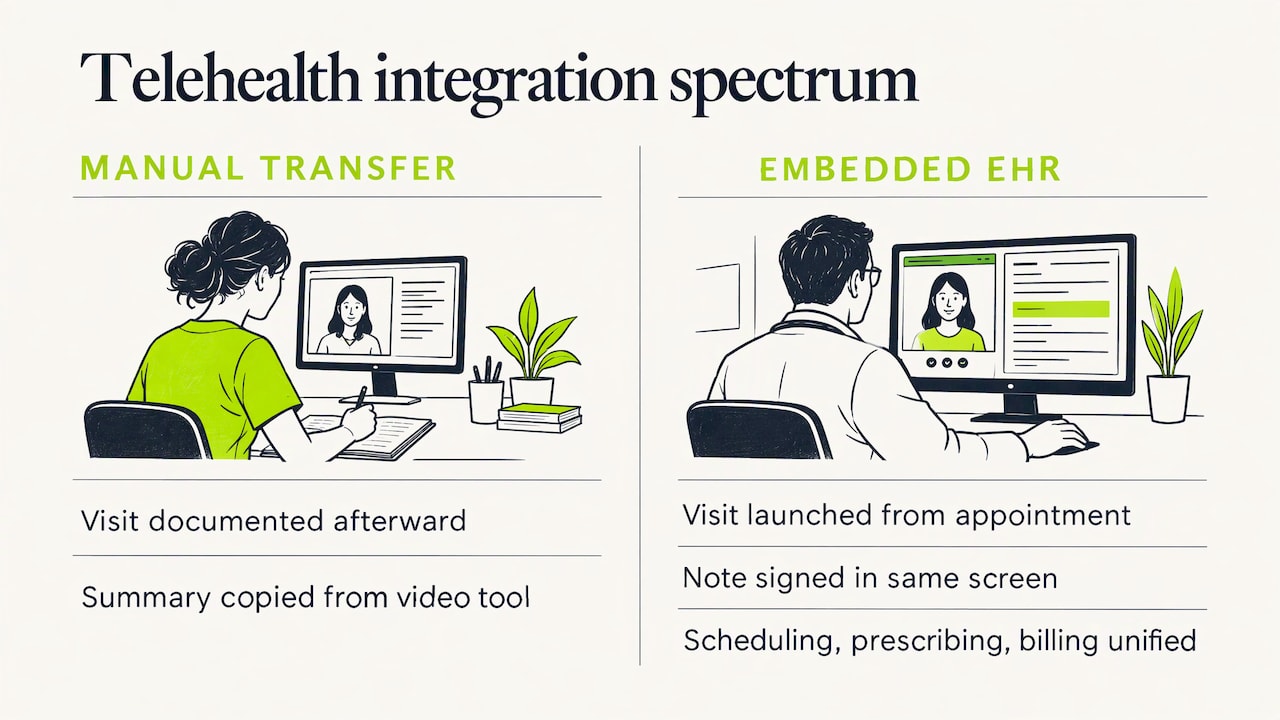
In the telehealth setting, integration links virtual encounters to the central record. According to a National Telehealth Authority overview, the spectrum runs from documenting a visit manually in the EHR afterward to embedding the telehealth platform inside the EHR, where scheduling, documentation, prescribing and billing share one system.
That spectrum is the useful frame. Two clinics can both say they are "integrated" and have very different days. In one, a medical assistant copies a visit summary from a video tool into the chart each evening. In the other, the clinician opens the chart, starts the visit from the appointment, and signs the note in the same screen.
The same overview notes that integration is a direct application of interoperability as the Office of the National Coordinator for Health Information Technology (ONC) defines it: the ability of systems to exchange, interpret and use data. Exchange alone is not enough. The receiving system has to make the data usable for the next clinician.
The information that should move between systems
For a longevity or functional medicine practice, the useful payload is broader than a visit note. The same overview lists medications, active problems, recent labs, visit notes and summaries, prescription orders and referrals as the items typically exchanged. In a practice built around biomarkers and long treatment arcs, each has a specific job.
| Data | Before the visit | After the visit |
|---|---|---|
| Medications and active problems | Clinician reviews current regimen and history | Changes recorded against the same chart |
| Recent labs and biomarkers | Trends reviewed against the clinic's own ranges | New results added to the longitudinal view |
| Intake and follow-up forms | Patient history ready before the call | Responses stay attached to the record |
| Visit notes and summary | Prior notes visible | Note signed and filed in the chart |
| Care plan | Current plan opened during the visit | Plan updated and shared with the patient |
| Orders and referrals | Pending items visible | New orders linked to the encounter |
If any row requires a human to copy data between screens, that row is where errors and lost time accumulate. A longitudinal health record only works if every virtual encounter feeds it.
Three integration models compared
Most clinics end up in one of three arrangements.
| Model | How it works | Typical friction | Fits |
|---|---|---|---|
| Manual documentation | Video visit runs in a separate tool, clinician writes the note in the EHR afterward | Double entry, delayed notes, no chart view during the call | Very low telehealth volume |
| Connected systems | A separate telehealth product exchanges data with the EHR through an interface or API | Mapping gaps, vendor dependence, two logins, troubleshooting across two support teams | Clinics already committed to both products |
| Single system | Scheduling, video visit, documentation and billing share one platform | Fewer moving parts; the clinic depends on one vendor's feature set | Practices that want one workflow from booking to follow-up |
A 2017 account of Nemours' experience in Becker's Hospital Review describes the integrated ideal: the physician works inside the telehealth platform, views the record pulled from the EHR before the video visit, documents directly, and a visit summary is sent to the EHR afterward. That is a health system's example, but the pattern applies to any size of practice.
The standards behind connected systems
When two separate products must talk, they rely on shared standards. The ONC's 2020 final rule, published in the Federal Register, adopted a standardized API certification criterion at 45 CFR 170.315(g)(10) that requires HL7 FHIR Release 4 for API-enabled services covering single-patient and multiple-patient data.
For an operator, three practical points follow:
- Ask which standard and which version a connection uses. FHIR is the common language for modern health data APIs, but it describes how data is packaged, not whether your workflow is complete.
- Certification applies to certified health IT. Whether a particular vendor is subject to it, and what that means for your clinic, is a question for the vendor and your compliance adviser.
- A cash-pay clinic often needs fewer external connections than a hospital. If scheduling, video, notes and labs live in one platform, the number of interfaces to build and maintain drops sharply.
What to plan before you integrate
The WHO's Consolidated telemedicine implementation guide (2022) warns against siloed telemedicine efforts and recommends identifying common components and shared services that can be reused or linked, such as unique IDs for patients, health workers and facilities, terminology management and shared health records. The same guide recommends describing business process workflows, with an example of a telemedicine program integrated with an electronic medical record, and lists laboratory information systems among other potential integrations.
Translated for a private clinic, a planning pass looks like this:
- Map the visit from booking to follow-up. Write down every step: self-scheduling, intake forms, reminder, video visit, note, orders, lab review, payment, next appointment. Mark each step that currently involves a second system or a manual copy.
- Define one patient identity. The same patient should not exist as two records in two tools. Decide where the master record lives.
- List the data each clinician needs on screen during the call. Medications, active problems and recent labs are the baseline.
- Decide who may see what. Physicians, nurse practitioners, coaches and front desk staff rarely need identical access.
- Plan data migration. Existing patients should arrive with their history, not as blank charts.
- Document the downtime plan. Decide what happens to a scheduled video visit if the connection fails.
For the scheduling piece specifically, the clinic's patient self-scheduling guide walks through setup.
What the evidence says about workflow and outcomes
The evidence for integrated records and telehealth is encouraging but narrower than vendor marketing often suggests.
The Nemours account above reports that an integrated experience streamlines provider workflows, lets physicians spend more time treating patients, and allows visit details and results to be shared electronically with the patient's primary care physician, supporting continuity across multiple states. It is a single organization's reported experience, not a controlled trial.
A 2020 study by Reed and colleagues, published in PMC, looked at patients with diabetes and a shared inpatient-outpatient EHR. Use of the shared record was associated with a shift toward follow-up through telemedicine and outpatient lab tests without an in-person visit (from 22.9% to 27.0%), with no statistically significant difference in 30-day emergency department returns or readmissions. The setting is health system diabetes care, so treat it as a signal about how shared records and virtual follow-up can coexist, not as a prediction for a longevity clinic.
Where connected systems still fall short
A connection can exist while clinicians still do duplicate work. Research on this is consistent.
A 2026 qualitative study in PLOS Digital Health found that many digital health technologies are not interoperable with standard clinical software, pushing staff into inefficient workarounds, and attributed limited interoperability across EHR platforms largely to vendors' business models. Participants also felt that federal efforts such as Meaningful Use incentives had not yet produced functional real-world data exchange.
A 2025 qualitative study in JMIR Formative Research, conducted in Riyadh, grouped barriers to EHR-based telehealth into six domains: technical and functional issues, service delivery, integration and coordination, prescriptions and results, privacy and security, and contextual or regulatory factors. The setting differs from US private practice, but the categories are a useful audit list.
A 2021 review in PMC adds that interoperability reaches beyond technical connections to agreements between parties, governance, shared workflows, standardized data elements, safety and privacy, and can be pursued at technical, syntactic, semantic, organizational and legal levels.
The lesson for a buyer: ask what the clinician sees and types, not only whether an interface exists. Useful questions include:
- Does the clinician see recent labs and medications on the same screen as the video visit?
- Is the visit note written once, in the chart, or copied from elsewhere?
- Are billing and membership events tied to the encounter, or reconciled later?
- Who supports the connection when something breaks?
Privacy and security when systems connect
Every additional system that handles protected health information adds a place where access has to be controlled. The WHO guide says data security must address risks to confidentiality and to data integrity, such as unauthorized alteration, and recommends a defined data security plan for storing, transferring and processing sensitive information, including who is authorized to access what and different access levels for different professionals.
For a US practice, HIPAA is the governing framework. In practical terms:
- Role-based access. Match each staff role to the minimum records it needs.
- Business associate agreements. A vendor that handles protected health information on your behalf generally needs a BAA with your clinic. Confirm this for every tool in the visit path, and have a healthcare attorney review your agreements.
- Fewer vendors, fewer agreements. Each separate product in the video, notes and billing chain is another vendor to evaluate.
- Patient-facing channels. Intake forms, portals and video links all carry patient data and belong in your risk assessment.
LongevityEHR is HIPAA, with a BAA on request. Details are on the security page. Your own compliance obligations depend on your practice, states and arrangements, so have them reviewed by a qualified professional.
Our perspective
We built LongevityEHR for cash-pay clinics, and in our view the hard part of telehealth is rarely video quality. It is what happens after the call: a note retyped, a lab result found in another tab, a membership charge reconciled by hand.
Our view is that the cleanest integration is the one a clinic never has to build. When scheduling, video visits, clinical notes, intake forms, biomarker data, care plans and Stripe payments sit in one platform, the visit is simply part of the chart. There is no interface to map, no second login to manage, and one vendor relationship to review for HIPAA purposes.
For longevity practices this matters more than for a typical primary care office. The work is longitudinal: labs repeat, care plans evolve, and members return on a rhythm. Each virtual follow-up should add to the same record that the next visit starts from.
Clinicians should still read the output. Our AI lab extraction places results into the clinic's own biomarker ranges, and the provider reviews them before they shape a plan. That is the pattern we recommend for any automation in the visit loop.
How this works in LongevityEHR
LongevityEHR puts the telehealth workflow inside the clinical platform. Scheduling with video visits lives beside clinical notes and intake forms. Results can be extracted with AI lab extraction into the clinic's own biomarker ranges, care plans are built from the clinic's templates, and memberships and payments run through the clinic's own Stripe account. The patient portal is white-label, so patients see the clinic's brand. The full feature list shows how the pieces fit.
Pricing is per provider, every plan has unlimited patients, and annual billing is 30% off:
| Plan | Monthly | Billed annually |
|---|---|---|
| Trial | $0 for 15 days | Not applicable |
| Core | $99 per provider a month | $69.30 a month ($831.60 a year) |
| Scale | $199 per provider a month | $139.30 a month ($1,671.60 a year) |
| Enterprise | Custom pricing | Custom pricing |
Clinics can start with the 15-day trial and see the visit-to-chart loop with their own workflow. Plans and current terms are on the pricing page.
If you are comparing options by type, the guide to longevity clinic software lays out the criteria, and the EHR for longevity clinics page covers labs, plans and the portal together.
A short evaluation checklist for any telehealth and EHR setup
Whether you choose connected products or a single platform, run the same test.
- Count the logins a clinician uses between opening the schedule and signing the note.
- Count the retyped items per visit, including medications, vitals and summaries.
- Check what the clinician sees during the call: current medications, active problems and recent labs.
- Trace a payment: does a visit or membership charge connect to the patient record without manual matching?
- Review access roles for physicians, other clinicians and front desk staff.
- Confirm HIPAA coverage for each vendor in the chain, including whether a BAA is available.
- Ask who supports a failure and how a missed or dropped visit is handled.
- Test patient experience: booking, intake forms, joining the video visit and viewing the plan afterward, under your own branding.
A clinic that answers these eight items clearly knows whether its integration is real or only nominal.

Run your longevity clinic on one system
- AI lab extraction with provider review
- Your ranges, every result as a trend
- Memberships through your own Stripe
15-day free trial. BAA on request.
Sources
- Telehealth and Electronic Health Record (EHR) Integration, National Telehealth Authority
- How telehealth and EHR integration deliver complete, effective care, Becker's Hospital Review
- ONC final rule, Federal Register, May 1, 2020
- Consolidated telemedicine implementation guide, WHO, 2022
- Inpatient-Outpatient Shared Electronic Health Records, PMC, 2020
- Digitally delivered, systemically challenged, PLOS Digital Health, 2026
- Usability, Benefits, and Barriers of EHR-based telehealth, JMIR Formative Research, 2025
- Interoperability frameworks linking mHealth applications, PMC, 2021