
On this page
- What the direct primary care model is
- How membership fees and panel sizes work
- What a membership typically includes
- DPC compared with concierge medicine and insurance-based care
- How DPC practices make money and stay sustainable
- Setting up the operation: a repeatable member loop
- A perspective from our team
- Run the DPC member loop in LongevityEHR

Key takeaways
- DPC is a membership arrangement: the patient pays a monthly, quarterly or annual fee directly to the physician, and the practice does not bill insurers on a fee-for-service basis.
- Typical figures: panels of 200 to 600 patients, adult fees of roughly $50 to $100 a month, and visits that run far longer than in insurance-based practices.
- Whether a DPC arrangement counts as insurance is decided by state law, not by the contract's wording, so the contract has to match your state's rules and a healthcare attorney should review it.
- Without claims, the software you need changes: recurring payments, member scheduling, intake, notes and care plans matter more than coding and billing.
- Our Core plan is $99 per seat a month, or $69.30 per seat a month billed annually, every plan includes unlimited patients, and a 15-day trial costs $0.
The direct primary care (DPC) model replaces insurance billing with a flat recurring membership fee paid by the patient, which covers most or all primary care services. For a cash-pay clinic, the model works when the membership is the center of the operation: enrollment, recurring payments, scheduling, visit notes and follow-up all need to live in one system built around members rather than claims. LongevityEHR is built for that kind of practice, and the sections below cover the model itself and the operating routine behind it.
What the direct primary care model is
The American Academy of Family Physicians (AAFP) describes DPC as an alternative to fee-for-service insurance billing in which family physicians charge a monthly, quarterly or annual fee that covers all or most primary care services. Patients gain access and time with their physician. Physicians gain simpler revenue, lower overhead and less administrative burden.
The Society of Actuaries (SOA) gives the most precise working definition in its 2020 report. A DPC practice charges a recurring membership fee for most or all primary care services, does not charge per-visit amounts greater than the monthly fee equivalent, and does not bill third parties on a fee-for-service basis. The American College of Physicians frames it as a form of direct patient contracting, a billing and payment arrangement between patient and clinician. Patients often pair it with a high-deductible health plan or a health savings account for needs outside the DPC relationship.
Three features follow from these definitions:
- A direct agreement. The contract is between the physician and the patient, or the physician and an employer.
- A flat recurring fee. The price is known up front for a defined set of services.
- No claims. The practice does not submit to payers, so it does not code visits for reimbursement.
How membership fees and panel sizes work
The fee is the practice's revenue engine, so its structure shapes everything else. The AAFP's 2024 Direct Primary Care Data Brief reports monthly fees of $20 to $49 for children and $50 to $100 for adults aged 65 or younger, with family fees of $100 or higher. It also reports that 62% of practices charge an enrollment fee and 7% charge a per-visit fee.
Panel size is the other lever. The same brief puts the average DPC panel at 402 patients. The New York State Bar Association cites a range of 200 to 600 patients, against an average of 2,500 in traditional primary care.
| Element | Typical DPC pattern | Source |
|---|---|---|
| Adult monthly fee | $50 to $100 | AAFP 2024 data brief |
| Child monthly fee | $20 to $49 | AAFP 2024 data brief |
| Enrollment fee | Charged by 62% of practices | AAFP 2024 data brief |
| Average panel | 402 patients | AAFP 2024 data brief |
| Panel range | 200 to 600 patients | NYSBA 2024, SOA 2020 |
| Average visit length | About 40 minutes, versus 13 to 16 in traditional practices | SOA 2020 |
A simple worked example, using a fictional practice. A physician with 400 adult members at $75 a month collects $30,000 a month in membership revenue, before enrollment fees and before any add-on services. The figure is an illustration of the arithmetic, not a forecast: fees, panel size and overhead differ by practice and market.
What a membership typically includes
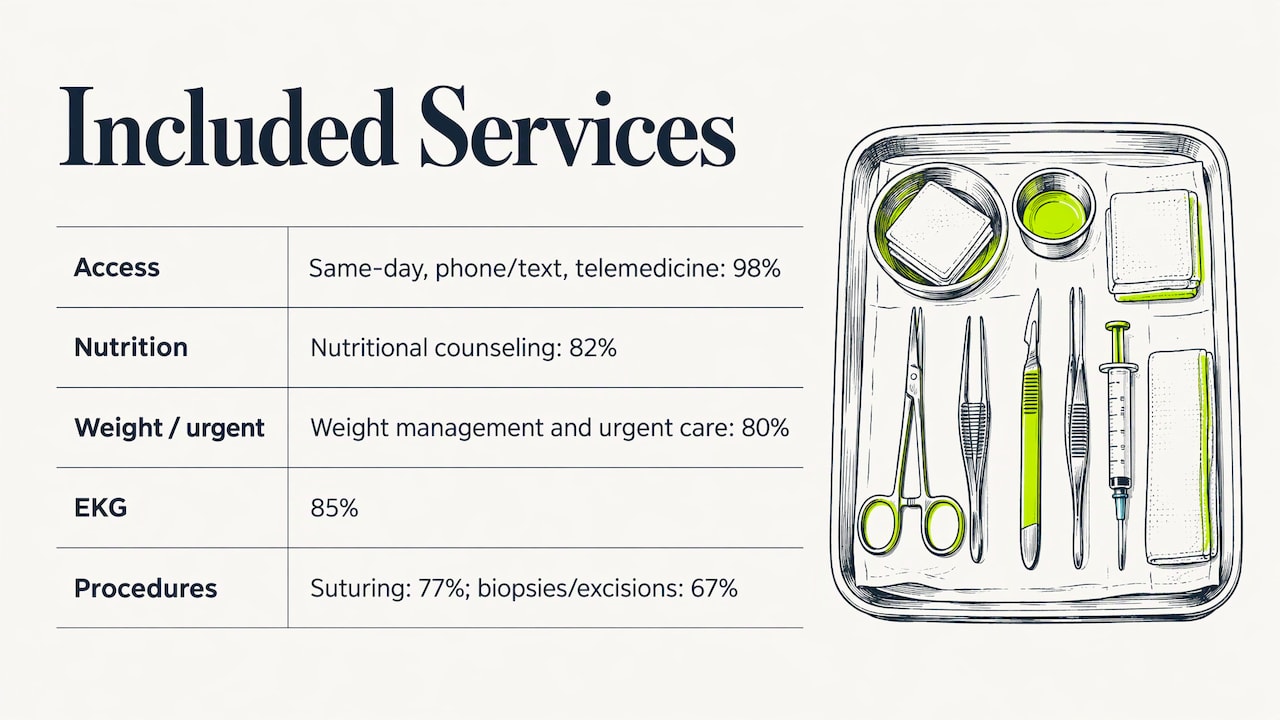
The AAFP data brief shows how broad a DPC membership usually is. Same-day appointments, phone and text consults and telemedicine are included in the fee at 98% of practices. Nutritional counseling (82%), weight management (80%) and urgent care or walk-in appointments (80%) are also common. Among procedures, EKG (85%), suturing (77%) and biopsies or excisions (67%) lead the list.
The AAFP adds that services often include extended office visits, clinical and laboratory services, consultative services, care coordination and comprehensive care management. A 2015 review of 116 DPC practices, cited in a 2018 paper in the Journal of the American Board of Family Medicine, found average membership fees of $77.38 a month.
What the membership does not cover matters just as much. The Louisiana Academy of Family Physicians notes that the membership does not cover hospitalizations or outside subspecialist visits. Members still need separate coverage for those needs, and your enrollment materials should say so clearly.
For longevity, functional medicine and hormone practices, this scope is a natural fit. Extended visits, lab review, nutrition and weight work, and ongoing follow-up are already the core of the service. The questions are how you package them and how you track them over time. Our membership pricing guide and our overview of healthcare membership models cover tiering and pricing in more depth.
DPC compared with concierge medicine and insurance-based care
The three models are often confused. The AAFP's comparison draws the lines this way: DPC runs on monthly membership fees paid by patients or sometimes employers, relies solely on those fees rather than insurance or government programs, and serves patients across income levels. Concierge medicine charges higher annual fees, may also bill insurance or government programs, and caters to higher-income populations.
| Direct primary care | Concierge medicine | Insurance-based primary care | |
|---|---|---|---|
| Who pays | Patient or employer, flat fee | Patient, higher annual fee | Insurer, per visit or service |
| Bills third parties | No | May | Yes |
| Typical panel | 200 to 600 | Varies | Around 2,500 |
| Coding and claims | None | Depends on the model | Required |
For an operator, the practical difference is the billing stack. The LAFP explains that DPC physicians do not handle CPT or ICD-10 coding or claims and typically do not charge per visit, so a practice needs no billing department. Instead it uses software that automatically drafts patients' checking accounts or credit cards. That is a membership and payments problem, not a revenue cycle problem.
How DPC practices make money and stay sustainable
Revenue is membership fees multiplied by panel size, plus enrollment fees and any add-on services the practice prices separately. Cost is the physician's time, space, supplies and software, and the DPC model keeps the last two items light because there is no claims work to staff.
The AAFP data brief gives the operator view. Of respondents, 84% described their practices as full DPC, and 97% cited the potential to provide better care as the main reason for opening one. The two major concerns were capital and cash flow (54%) and membership recruitment (50%). Both point to the same discipline: predictable recurring collection and a clear enrollment process.
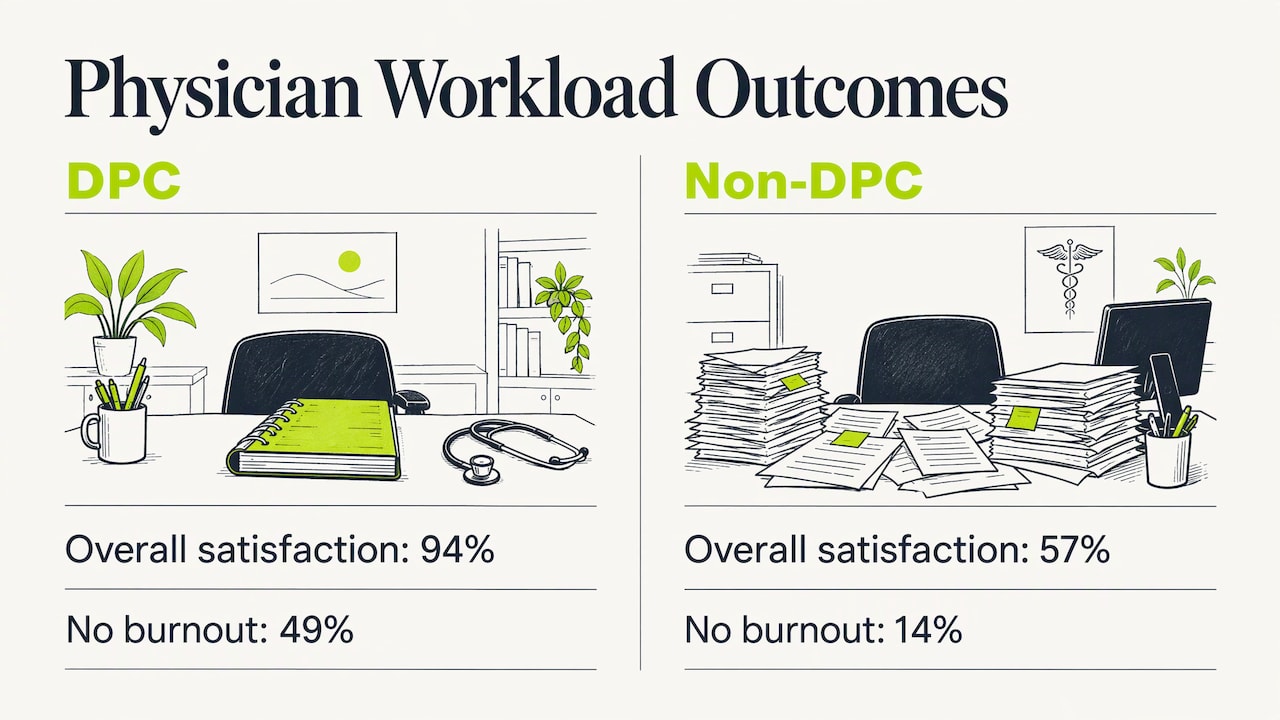
The model also appeals to physicians on workload. In the same brief, 94% of DPC physicians were satisfied with their overall practice, against 57% of non-DPC physicians, and 49% reported no burnout, against 14%. The AAFP's Family Practice Management blog attributes this to the reduced administrative burden of not billing insurance. A survey of AAFP members fielded in July 2017 and published in 2021 in PubMed Central found the same themes: respondents ranked lower administrative burden and better doctor-patient relationships as the most important benefits.
Employers are a second buyer. The SOA analysis of a DPC option in one employer's self-insured plan found about half of eligible members enrolled, with a statistically significant 12.64% reduction in overall health care demand and a 40.51% reduction in emergency department usage after risk adjustment. It is one plan, so treat it as an example of what an employer conversation can draw on.
Setting up the operation: a repeatable member loop
Mechley's 2021 paper in PubMed Central lists the startup challenges for a DPC practice: financial security, startup capital, practice operations, legal and compliance knowledge, medical technology complexities and marketing aptitude. A practical way to handle them is to build one loop and run every member through it.
1. Define the membership and the contract
Decide the fee, the enrollment fee, what is included and what is priced separately. Mechley notes that DPC contracts state clearly that the arrangement is not health insurance or a health plan as defined by the Affordable Care Act and state laws. The NYSBA adds that a DPC membership bought on an insurance exchange would not meet minimum essential coverage requirements. Labels do not settle the question: state law decides whether an arrangement is insurance, and the contract has to match it. If you still see Medicare patients (the AAFP brief puts 20% of DPC patients over age 65), Medicare rules on opting out or staying non-participating also affect whether you can charge them a membership for covered services. Because these rules differ by state and payer, have a healthcare attorney review the agreement before you enroll anyone. This article is general information, not legal advice.
With LongevityEHR you set up memberships and take payments through your clinic's own Stripe account, so recurring fees go through your processor. See our guide to medical practice payment processing and the memberships and payments page.
2. Enroll and collect intake
Enrollment is where capital and recruitment concerns become real. Each new member needs a signed agreement, history, consent and baseline data. Custom intake forms let you collect those items in the same system that later holds the chart, and a branded patient portal gives members a front door that carries your clinic's identity, not a vendor's.
3. Schedule extended and virtual visits
The 40-minute average visit reported by the SOA only holds if the calendar is built for it. Scheduling with video visits lets you offer in-person and telehealth appointments from the same availability. In LongevityEHR, in-app scheduling is included from the Core plan up, not in the 15-day trial. Since 98% of DPC practices include telemedicine in the fee, virtual access is part of the baseline expectation. Our post on telemedicine and EHR integration explains what to connect and why.
4. Document the visit and build the plan
Without claims, notes serve clinical continuity rather than coding. Clinical notes and care plans built from your own templates keep each member's plan consistent from visit to visit, so the next appointment starts where the last one ended.
5. Bring labs into the chart
Lab review is a large part of a DPC or longevity membership. AI lab extraction reads incoming lab reports into your clinic's own biomarker ranges, and a provider reviews the result. That keeps the clinical judgment with the physician while removing the retyping. More on this is on our AI lab extraction and biomarker tracking pages.
6. Protect patient data
DPC practices remain subject to state and federal compliance and licensure requirements. LongevityEHR is HIPAA, with a BAA on request. Details are on our security and HIPAA page. Confirm your own obligations with a qualified compliance professional.
If you are starting from zero, our guides on starting a cash-pay clinic and starting a longevity clinic walk through licensure, structure and launch order.
A perspective from our team
We build software for cash-pay practices, and in the DPC model the membership is the product. The patient is not buying a visit. They are buying an ongoing relationship with a clinic, and the clinic's job is to make that relationship visible every month: the plan, the labs, the next appointment, the payment that simply works.
That is why we put memberships, payments, scheduling, notes, care plans and the patient portal in one platform. A clinic that no longer bills insurance has no reason to run its operation through tools designed around claims. The effort that used to go into coding can go into follow-up.
Longevity, functional medicine and hormone clinics are well placed for this model. Longer visits, lab-driven decisions and repeat contact are the way they already practice. Our view is that the clinics that do best will be the ones that treat the member loop as a system and set it up once, with their own branding, their own biomarker ranges and their own Stripe account.
Run the DPC member loop in LongevityEHR
LongevityEHR is a white-label EHR for cash-pay longevity, functional medicine, concierge and hormone clinics. It brings AI lab extraction into your own biomarker ranges, care plans from your templates, clinical notes, intake forms, scheduling with video visits, memberships and Stripe payments, and a branded patient portal into one platform. Clinics can launch in days without custom development.

Pricing is per seat, every plan has unlimited patients, and annual billing is 30% off:
| Plan | Monthly | Billed annually |
|---|---|---|
| Trial | $0 for 15 days | n/a |
| Core | $99 per seat a month | $69.30 per seat a month ($831.60 a year) |
| Scale | $199 per seat a month | $139.30 per seat a month ($1,671.60 a year) |
| Enterprise | Custom pricing | Custom pricing |
See the pricing page to start the trial, or read about our concierge medicine and DPC software.

Run your longevity clinic on one system
- AI lab extraction with provider review
- Your ranges, every result as a trend
- Memberships through your own Stripe
15-day free trial. BAA on request.
Sources
- Direct Primary Care Model For Family Physicians, AAFP
- 2024 Direct Primary Care Data Brief, AAFP
- Answers to six common questions about direct primary care, AAFP Family Practice Management
- Direct Primary Care: Evaluating a New Model of Delivery, Society of Actuaries
- The Direct Primary Care Model: Considerations for New York, NYSBA
- Direct Patient Contracting, American College of Physicians
- Direct Primary Care: Applying Theory to Potential Changes, JABFM
- Direct primary care: Family physician perceptions, PubMed Central
- Direct Primary Care: A Successful Financial Model, PubMed Central
- What is Direct Primary Care (DPC)?, Louisiana Academy of Family Physicians