
On this page

Key takeaways
- Precision medicine guides prevention and treatment using individual differences in genes, environment and lifestyle, rather than the expected response of an average patient.
- The workflow has six stages: question, intake, data collection, interpretation, plan, and ongoing monitoring. The last stage is what makes it a loop.
- Most failures happen in data handling: results trapped in PDFs, ranges that do not match the clinic's protocols, and plans that are never re-measured.
- Structured, searchable data and a maintained knowledge base matter more than any single test.
- LongevityEHR puts the loop in one portal, starting with a 15-day trial at $0.
A precision medicine workflow is a repeatable loop: define the clinical question, collect structured patient data, interpret results against the individual, build a plan, and re-measure. Clinics that run this loop in one system, rather than across disconnected lab portals, notes and spreadsheets, spend less time re-entering data and more time acting on it. LongevityEHR is built for that loop in cash-pay practices: AI lab extraction into the clinic's own biomarker ranges, care plans from clinic templates, scheduling with video visits, memberships and a white-label portal.
This guide is general information for owners and operators of longevity, functional medicine, concierge and hormone clinics in the United States. It is not medical, legal or financial advice, and clinical, legal and billing decisions should be reviewed by a qualified professional.
What precision medicine means in a clinic
The NIH describes precision medicine as an approach that accounts for individual differences in genes, environments and lifestyles instead of relying on the expected response of an average patient. MedlinePlus Genetics contrasts it with one-size-fits-all care, which develops strategies for the average person with less consideration of individual variation. The FDA frames the goal as the right treatment for the right patient at the right time.
In oncology and rare disease, this often means genomic sequencing. In a longevity, hormone or functional medicine practice, the same logic is usually applied through serial biomarkers, history, lifestyle data and patient-reported outcomes. The workflow below applies to both, and the principle is identical: the plan follows the individual's data, and the data is re-checked over time.
The six stages of a precision medicine workflow
Published genomic-medicine frameworks describe a sequence of referral, triage, intake, phenotyping, testing eligibility, interpretation, counseling and management. A cash-pay clinic does not need every step of a hospital genomics service, but the skeleton carries over.
| Stage | What happens | Where it commonly breaks |
|---|---|---|
| 1. Clinical question | Patient or referrer states a concern and a goal | Goals live in a visit note and are never revisited |
| 2. Intake | History, family history, symptoms, consent | Paper or generic forms that cannot be searched |
| 3. Data collection | Labs, imaging, device data, questionnaires | Results arrive as PDFs and are retyped |
| 4. Interpretation | Results read in clinical context | Lab reference ranges differ from the clinic's targets |
| 5. Plan | Individualized protocol, follow-up schedule | Plans are free text, so nothing triggers follow-up |
| 6. Monitoring | Re-measure, adjust, report outcomes | No trend view, so decisions rest on the last visit |
Stage 1: Define the clinical question
The same framework notes that the workflow can begin when a patient or primary-care provider identifies a concern and frames it as a clinical question. In a cash-pay practice, that question is often a goal: metabolic health, hormone optimization, cardiovascular risk, cognitive performance. Write it down in a structured place, because every later stage is measured against it.
Common failure: a vague goal such as "optimize health" gives nothing to re-measure. Specify which markers or symptoms should change, and over what interval.
Stage 2: Structured intake
Intake gathers medical, developmental and family histories, examination findings and consent, according to the genomic-medicine framework. The same paper reports that its electronic platform supported triage through conditional logic and let patients share information and consent forms securely.
For your clinic, this means intake forms that capture answers in fields rather than in a scanned packet. LongevityEHR includes custom intake forms and clinical notes, so the history your provider reviews is the history the rest of the workflow can use.
Stage 3: Collect data in a form you can use
Inputs for precision medicine can include clinical information, laboratory and molecular assays, imaging, social and environmental factors, biosensors and multiple omics layers, according to an NCBI review of precision medicine tools. Not every clinic uses all of them. Many longevity practices start with comprehensive blood panels and add wearable or questionnaire data.
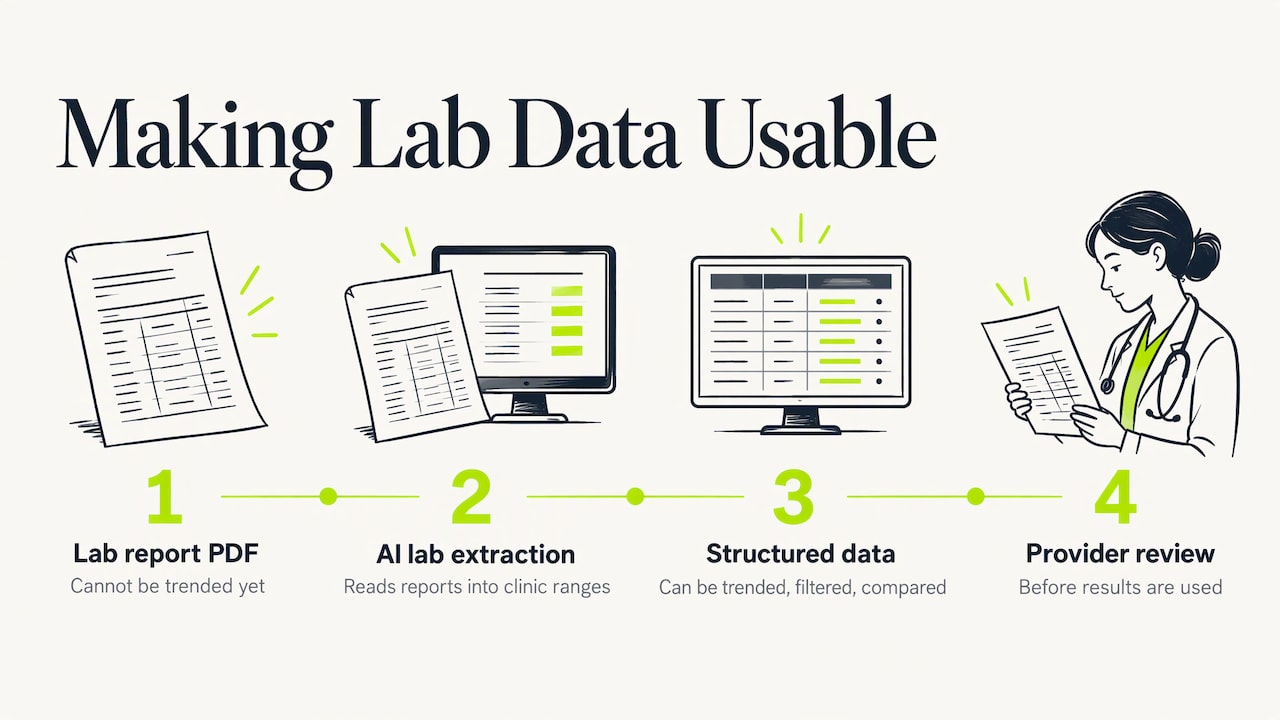
The American Heart Association's science advisory separates structured EHR data (laboratory tests, medications, vital signs, coded diagnoses) from narrative notes and scanned documents, and notes that natural-language processing can convert narrative text into structured data. The practical lesson: a lab result sitting in a PDF cannot be trended, filtered or compared until someone turns it into data.
That step often costs a clinic the most staff time. LongevityEHR's AI lab extraction reads lab reports into the clinic's own biomarker ranges, with provider review before results are used. If you also want to understand how the markers themselves are analyzed and tracked, the guide on biomarker analysis methods goes deeper.
Stage 4: Interpret in context
Clinicians select findings for assessment, evaluate their clinical impact, consider their relevance to the patient's indication, and place them in the context of everything known about the patient, as a review of genomics in precision medicine describes. The key phrase is context: a value is meaningful relative to the patient and to the target the clinician has chosen.
This is why range handling matters. A conventional laboratory reference range describes a population. Many longevity and functional medicine protocols use narrower targets. With biomarker tracking and custom clinic ranges, the same result is flagged against the ranges your clinic actually uses, so interpretation matches your protocol rather than a lab's default.
Decision support should inform, not replace, the clinician. In an oncology precision-medicine clinic study, a multidisciplinary team reviewed molecular results and classified options by evidence level, and the treating oncologist kept the final decision. The same division of labor applies to any AI-assisted step: software prepares, the provider decides.
Stage 5: Build the individualized plan
A plan turns interpretation into action: nutrition, sleep, exercise, supplements, medications where appropriate, repeat testing and visit cadence. The 2024 Genomes in Clinical Care article notes that a molecular diagnosis can change pharmacotherapy, prompt specialist referral, avoid unnecessary procedures or stop ineffective treatment, but that this requires defined workflows, standardization and quality control.
Standardization is the useful idea for a small clinic. If every provider writes plans from scratch, quality varies and follow-up is inconsistent. Care plans built from clinic templates let your protocols be applied consistently while each plan is still adjusted to the individual patient. Prescribing, where your providers use it, is covered separately under e-prescribing.
Stage 6: Monitor and update
This stage separates a precision workflow from a one-time panel. A 2024 review on EHRs and genomics recommends storing data in structured, secure and interoperable formats so it can be reanalyzed as knowledge changes, and notes that decision support can alert clinicians when new evidence warrants a second look. The PREDICT pharmacogenomics tutorial makes a related point: decision support is not a one-time build, and its knowledge base must be maintained so earlier results can be reinterpreted.
For a clinic, the monitoring stage looks like this:
- Schedule the re-test interval at the moment the plan is created.
- Compare each new result to the previous values, not only to the range.
- Record what changed in the plan and why.
- Report outcomes at the clinic level so you can see which protocols work for which patients.
What software has to do for the workflow to hold
A 2017 review on EHRs and precision medicine lists the useful capabilities: standardized data that can be exchanged, structured and searchable test results, natural-language processing for narrative notes, and point-of-care decision support with alerts and reminders. The PREDICT tutorial adds that guidance should be human-readable, anticipatory, actionable and adaptable, with governance and clinician education behind it.
Translated into a checklist for a cash-pay clinic:
- Results become data. Lab reports are extracted into fields, not stored as attachments.
- Ranges are yours. Flags reflect your clinic's targets.
- Plans are structured. Templates drive consistency and follow-up.
- Visits are connected. Scheduling, video visits and notes sit in the same record.
- Revenue is connected. Memberships and payments run alongside care, not in a separate tool.
- Patients see it. A branded portal keeps the plan and results in front of the patient between visits.
If you are weighing EHR categories, the explainer on EHR vs EMR clarifies why a record built to be shared and extended suits this model. For functional medicine specifically, see how a functional medicine EHR with custom lab ranges handles the same loop.
Running the workflow responsibly
Precision approaches raise real governance questions. Published perspectives on the field point to data privacy, informed consent and unequal access as ethical issues that grow with adoption. For a clinic, these become operating habits:
- Consent. Document what data you collect and how it will be used, in the intake process.
- Privacy. Under HIPAA, a vendor that handles protected health information on your behalf is generally a business associate, and the rules call for a written contract setting permitted uses and safeguards. LongevityEHR is HIPAA, with a BAA on request, and uses role-based access. Your counsel should review your own obligations.
- Human review. Keep a clinician approving every AI-assisted output. Our note on AI governance for cash-pay clinics covers a practical policy.
- Access. Consider how your intake, portal and communication work for patients with different levels of digital comfort.
A fictional example of one loop
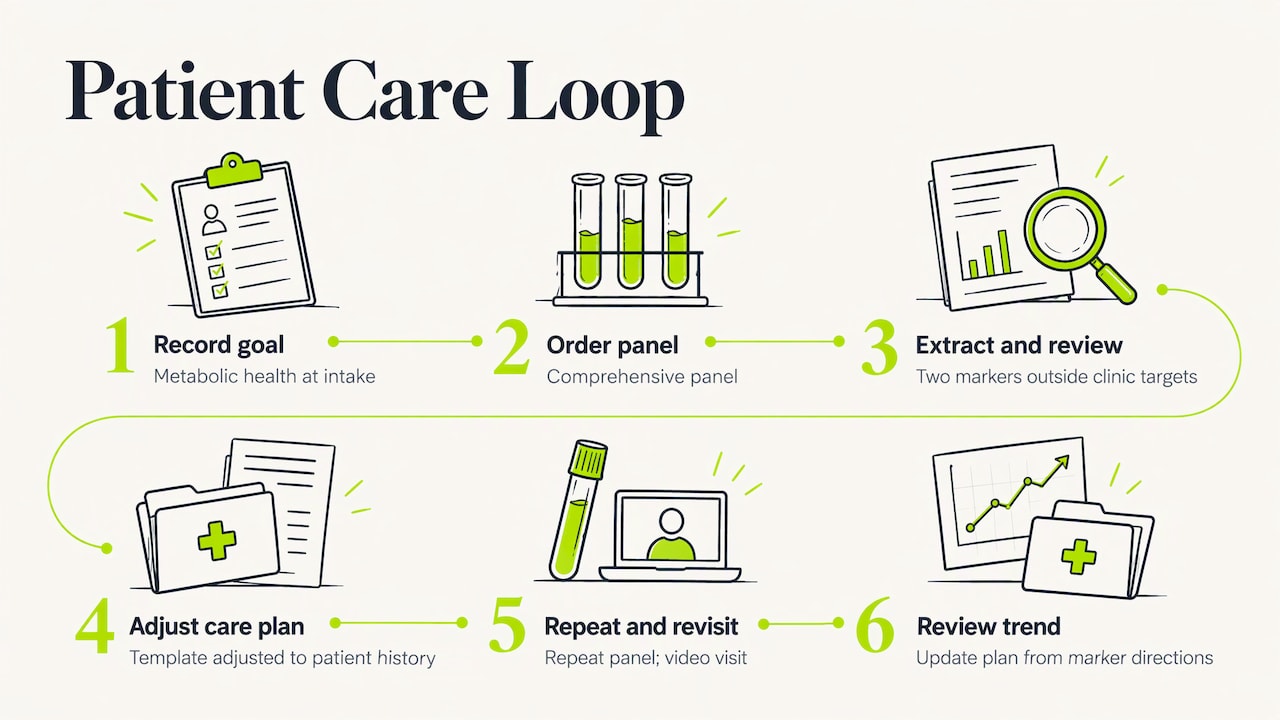
Consider a fictional patient, "Patient A," a 52-year-old who joins a clinic membership with a goal of improving metabolic health. The clinician records the goal at intake and orders a comprehensive panel. The lab report is extracted into the clinic's biomarker ranges and reviewed by the provider, who notes two markers outside the clinic's targets. The provider applies a care plan template, adjusts it for the patient's history and schedules a repeat panel and a video visit. At the follow-up, the trend view shows the direction of each marker, and the provider updates the plan. Nothing in this example is a real case, and clinical choices in practice rest on the treating provider's judgment.
Where LongevityEHR fits
LongevityEHR is a white-label EHR for cash-pay longevity, functional medicine, concierge and hormone clinics. It brings AI lab extraction, clinic-range biomarker tracking, care plans from your templates, clinical notes, intake forms, scheduling with video visits, memberships and payments through your own Stripe account, and a branded patient portal into one system. Clinics launch in days without custom development, and every plan includes unlimited patients.
Pricing is per provider:
| Plan | Monthly | Annual billing |
|---|---|---|
| Trial | $0 for 15 days | Not applicable |
| Core | $99 per provider a month | $69.30 a month, billed as $831.60 a year |
| Scale | $199 per provider a month | $139.30 a month, billed as $1,671.60 a year |
| Enterprise | Custom pricing | Custom pricing |
Annual billing is 30% off. You can start on the 15-day trial and see the workflow with your own templates and ranges. For a broader overview, see EHR for longevity clinics.
Our perspective
We think the value of precision medicine in a clinic is not in any single test. It is in the loop: a goal, structured data, a plan the clinician owns, and a re-measure that feeds the next decision.
Clinics in this space usually already have the clinical skill. What slows them is administrative friction: lab PDFs to retype, ranges that do not match their protocols, and plans that live in documents nobody revisits.
That is why LongevityEHR puts extraction, your own biomarker ranges, templated care plans, scheduling, memberships and the patient portal in one place. The provider reviews and decides, and the system keeps the loop moving.

Run your longevity clinic on one system
- AI lab extraction with provider review
- Your ranges, every result as a trend
- Memberships through your own Stripe
15-day free trial. BAA on request.
Sources
- The Promise of Precision Medicine, NIH
- What is precision medicine? MedlinePlus Genetics
- Precision Medicine, FDA
- The practice of genomic medicine, Frontiers in Medicine
- Precision medicine: Concept and tools, PMC
- Merging Electronic Health Record Data and Genomics, AHA
- Building the foundation for genomics in precision medicine
- Coordinating an Oncology Precision Medicine Clinic
- Genomes in clinical care
- It Is in Our DNA, JMIR Bioinformatics and Biotechnology
- A Tutorial for Pharmacogenomics Implementation, PREDICT
- Integrated Precision Medicine: The Role of Electronic Health Records
- Disparities in the Field of Precision Medicine, PMC
- Business Associate Contracts, HHS