
On this page
- What a virtual visit note has to do
- The core fields, in one table
- Identity, location and who else is in the room
- Consent: what to chart and where states differ
- Privacy and technology
- Clinical content: history, vitals and exam limits
- Technical problems and moving to in-person care
- Assessment, plan and follow-up
- A fictional example note
- What changes by state and payer
- Building the note into the clinic workflow
- LongevityEHR for virtual visit documentation
- Our perspective

Key takeaways
- Chart the telehealth-specific facts every time: modality, patient and clinician locations, participants, consent, start and end time.
- Record what the visit could not assess: patient-reported vitals are labeled as patient-reported, and exam limits are stated.
- Document technical problems and any decision to continue, reschedule or move to in-person care.
- End the note with the plan, education and follow-up, the same as a virtual checkout.
- Rules differ by state and payer, so build the template around the strictest rule that applies where the patient is located.
A virtual visit note holds the same clinical content as an in-office note, plus a short set of telehealth-specific facts: that the visit was virtual, where the patient and clinician were, who else was present, what consent was given, which technology was used, and what happened if it failed. For cash-pay longevity, functional medicine, concierge and hormone clinics, this record protects the patient, the clinician and the membership relationship. It is also easiest to keep consistent when the note, intake forms, scheduling and video visit sit in one system. This guide is general information, not legal or billing advice. Have your compliance counsel, state licensing board guidance and any payer you bill review your final templates.
What a virtual visit note has to do
A telehealth note serves three readers: the next clinician who opens the chart, a payer or auditor reviewing the claim, and a licensing board if a complaint ever arises. The clinical core is unchanged: history, assessment, plan. The additions answer a different question: was this encounter appropriate to conduct remotely, and can someone reconstruct how it was conducted?
The HHS telehealth workflow guidance recommends documenting intake details such as identity verification, symptoms, medical history and vitals when appropriate. It also says to document that the encounter was telehealth and to use telehealth-specific billing codes or a modifier when applicable. The CMS telehealth toolkit for providers adds that clinicians should gather as much clinical data as possible and finish the visit with a care plan and any referrals.
The core fields, in one table
A peer-reviewed article on telehealth documentation recommends recording the encounter date, consent, visit modality, patient and provider locations, participant names and roles, and start and end time when time matters for billing. The table below turns that into a template checklist.
| Field | What to record | Why it matters |
|---|---|---|
| Encounter type | Statement that the visit was conducted by live video (or audio only, if that was the modality) | Supports telehealth coding and shows the modality used |
| Date, start and end time | Actual times, not scheduled times | Needed where time-based billing applies |
| Patient location | City and state at the time of the visit | Licensure and payer rules follow the patient's location |
| Clinician location | Where the clinician was practicing from | Required by some state payer policies |
| Participants | Names and roles of everyone present on both ends | Privacy and consent |
| Identity verification | How the patient was identified | Essential for new patients |
| Consent | Verbal or written, what was explained, date | Required by many states and payers |
| Technology | Platform and any problems | Shows how the visit was conducted |
| Clinical content | History, patient-reported data, exam findings and limits, assessment | The medical record itself |
| Plan and follow-up | Orders, education, next appointment, who is responsible | Continuity of care |
Identity, location and who else is in the room
The CMS toolkit advises confirming a new patient's identity, explaining the visit, and charting consent when it is required. It also advises identifying who is in the patient's room, assuring privacy, and explaining what to do if the connection drops, including collecting a callback number.
In practice, a one-line opening block covers most of this:
- Identity confirmed by name and date of birth (or by the method your policy sets).
- Patient located in a named city and state.
- Others present, with names and roles, and the patient's agreement to their presence.
- Callback number confirmed.
Location is the field most often skipped and the one with the most consequence. The American Medical Association's telehealth playbook notes that telehealth rules vary by state and recommends applying the rules where the patient is located, including licensure and reimbursement policies. A clinic that serves patients across state lines, which is common for longevity and hormone practices, needs the patient's state in every note.
Consent: what to chart and where states differ
There is no single national consent rule for all payers, so the template should capture what happened rather than assume one standard. Two state examples show the range:
- New York's Department of Health, in its February 2023 Medicaid guidance, says written telehealth consent is not required, but informed consent must be documented in the patient chart before or during the first telehealth visit, and recording a visit requires consent.
- Georgia Medicaid's December 2024 notice says the rendering provider must obtain a signed member consent form before an initial telehealth service and tell the member that telehealth can be refused without losing future care or covered services.
These apply to Medicaid programs, and a cash-pay clinic may not bill Medicaid at all. They still illustrate why a consent field should record the form (verbal or signed), the date and what the patient was told. Your state's medical board and your counsel decide what your clinic needs.
A practical consent entry reads: "Telehealth explained, including benefits, limits and privacy considerations. Patient agreed to proceed. Verbal consent obtained [date]." If the patient signs a consent form at intake, the note can reference it. If the visit is recorded, record that separate consent as well.
Privacy and technology
Chart the platform used and that the patient was in a private setting, or note the exceptions. If the clinic uses video and messaging inside its own portal, the technology field can be near-identical across visits, which keeps notes short. Visit documentation sits inside a wider privacy program: see the clinic guide to healthcare data privacy and the notes on HIPAA compliant messaging for what sits around the note itself.
Washington State Health Care Authority's January 2025 telemedicine billing guide shows how detailed a payer can be: for its distant-site services it requires documentation of modality, clinical appropriateness, assistive technology, client and provider locations, provider personnel, attendees and service time where applicable. A note that captures all of those fields satisfies most other payers' lists too.
Clinical content: history, vitals and exam limits
The clinical sections should read like any other note, with a few adjustments.
History and symptoms. Document as you would in person, including current medications, supplements and interval changes. For longevity and hormone practices, that often means protocol adherence, side effects and recent lab review.
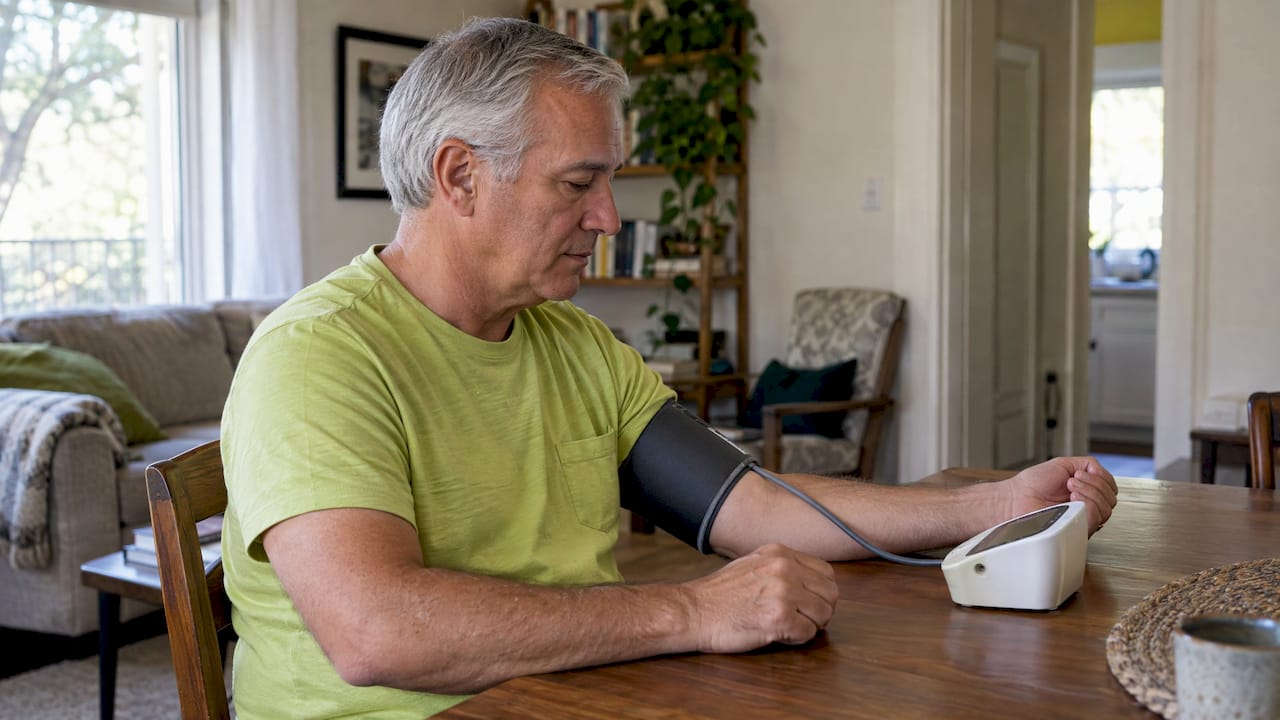
Vitals. The University of Texas Health Science Center at San Antonio's telemedicine visit training says to record patient-reported vitals as patient-reported and to note when the patient assists with the exam. A home blood pressure cuff reading, a wearable heart rate or a home scale weight belongs in the note with its source named.
Examination. State what was observed by video (general appearance, speech, visible skin, movement) and what could not be examined. A line such as "Abdominal exam not performed, virtual visit" is clearer than silence.
Lab data. Longevity visits often center on biomarkers. Record which results were reviewed, the date of the draw and how the clinic's own reference ranges were applied, so the plan can be traced to the data behind it.
Technical problems and moving to in-person care
Two situations need an explicit entry: a technical failure and a decision that video is not enough.
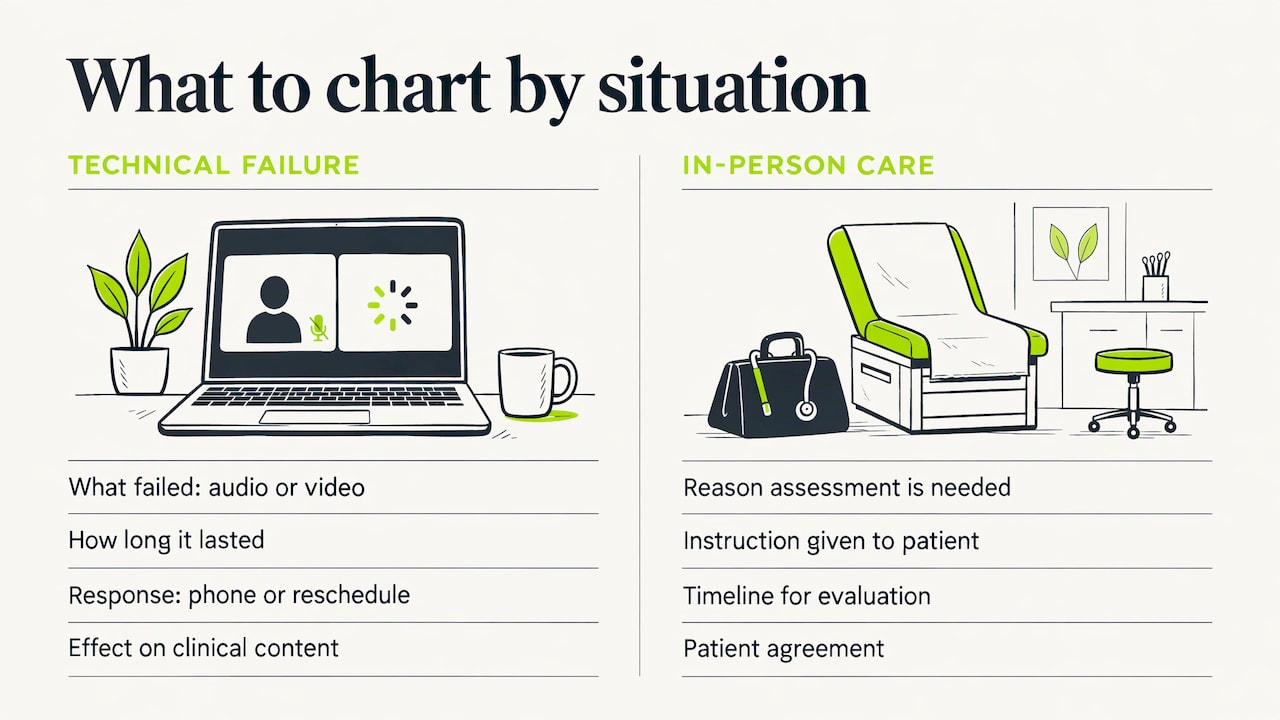
For technical problems, record what failed (audio dropped, video froze), how long, what you did (switched to phone, rescheduled) and whether the clinical content of the visit was affected. If the visit was completed by phone after video failed, the modality field must say so, because the code and the payer rules may differ.
For appropriateness, the Washington guide recommends a technology backup plan and telling patients how to obtain in-person care in an emergency or when otherwise needed. Document that the patient was told. If, during the visit, the clinician decides an in-person assessment is needed, chart the reason, the instruction given and the timeline. Example: "Reported new chest tightness on exertion. Video assessment insufficient. Advised same-day in-person evaluation. Patient agreed." Emergencies follow your emergency protocol and are never managed on video alone.
Assessment, plan and follow-up
The close of the note is where memberships succeed or stall. The National Association of Community Health Centers' 2023 guidance on telehealth quality measures describes a virtual checkout that includes patient education, a patient plan and a follow-up appointment when appropriate. A cash-pay clinic can adopt the same sequence:
- Assessment: the clinician's impression and the reasoning behind it.
- Plan: orders, changes to protocols, lifestyle recommendations, with the date they start.
- Education: what the patient was told, and in what form (verbal, portal message, written plan).
- Follow-up: next visit date, labs due, who is responsible for each action.
- Escalation: what the patient should do if symptoms worsen.
When the plan comes from a clinic template, the note should still show what was individualized for this patient. A care plan with a clear start date and owner for each item is much easier to defend and to follow than a paragraph of advice. For more on structure, see the clinic guide to clinical documentation templates.
A fictional example note
The following is a fictional example, not a real patient.
Virtual visit, follow-up. Live video, 10:02 to 10:24, Nov 3. Patient located in Austin, Texas. Clinician in clinic office. Patient alone, private room. Identity confirmed. Callback number confirmed. Telehealth consent on file, reaffirmed verbally.
Interval history: Reports improved sleep, mild morning fatigue. Adherent to current protocol.
Objective: Patient-reported home BP 118/76. Appears well on video, speech normal. No physical exam performed (virtual visit). Labs from Oct 20 reviewed against clinic ranges.
Assessment and plan: Continue protocol. Repeat labs in 12 weeks. Education on sleep timing provided and sent through the portal. Follow-up video visit in 6 weeks. Patient advised to seek in-person care for new or worsening symptoms.
That note runs about 120 words and still covers modality, location, consent, privacy, data source, limits, plan and follow-up.
What changes by state and payer
Because rules vary, the safest approach is a single template that meets the strictest rule you face, then trims nothing. Three checks keep it current:
- Review the medical board and payer guidance for each state where patients are located, at least once a year. These rules move as temporary flexibilities end and states update policy.
- Confirm with counsel how consent, recording and prescribing rules apply to your services.
- If you bill any insurer or program, confirm its modifier and place-of-service requirements with that payer directly.
Questions such as the CMS definition of telehealth or what changed in 2026 are answered by the current CMS and HHS telehealth pages and by your own payer contracts, because they change on a schedule outside any clinic's control.
Building the note into the clinic workflow
Documentation fails when it depends on memory. Each of the pieces above is easier to keep consistent when it is part of the visit flow rather than something typed afterward:
- Intake forms capture history, medications and consent before the visit.
- Scheduling with video visits ties the appointment, the video session and the note to the same patient record.
- Clinical notes give the clinic a fixed structure for the telehealth fields above. See SOAP notes software for longevity clinics.
- Care plans from clinic templates carry the plan and follow-up into something the patient can see.
- A branded patient portal is where education and follow-up instructions are delivered and recorded.
For how these pieces connect, the guide to telemedicine EHR integration lays out what to connect and why, and EHR task management covers closing out follow-up work.
LongevityEHR for virtual visit documentation
LongevityEHR is white-label EHR software built for cash-pay longevity, functional medicine, concierge and hormone clinics. It brings clinical notes, custom intake and follow-up forms, scheduling with video visits, care plans from clinic templates, and a white-label patient portal into one platform, with memberships and payments running through the clinic's own Stripe account. AI lab extraction places results into the clinic's own biomarker ranges. LongevityEHR is HIPAA, with a BAA on request.
Pricing is per provider, and every plan has unlimited patients. Annual billing is 30% off.
- Trial: $0 for 15 days.
- Core: $99 per provider a month, or $69.30 a month billed annually ($831.60 a year).
- Scale: $199 per provider a month, or $139.30 a month billed annually ($1,671.60 a year).
- Enterprise: custom pricing.
See plans and start the trial.

Our perspective
Documentation problems in cash-pay clinics are often structural rather than clinical: the video link lives in one tool, the note in another, the consent form in a third, and the follow-up in someone's inbox.
We built LongevityEHR around the idea that a visit is a loop: intake, scheduling, the video visit, the note, the care plan and the follow-up belong in one record. When the note sits next to the schedule and the plan, the telehealth fields are easier to complete on every visit, and a clinic can answer a payer, a board or a patient from the same chart.
For a clinic that wants to grow without adding administrative staff, we think one platform with a branded portal, memberships through your own Stripe account and notes structured for your protocols is the practical route. It is designed so a clinic can launch in days rather than months.

Run your longevity clinic on one system
- AI lab extraction with provider review
- Your ranges, every result as a trend
- Memberships through your own Stripe
15-day free trial. BAA on request.
Sources
- Planning your telehealth workflow, Telehealth.HHS.gov
- Telehealth for providers: what you need to know, CMS
- Patient clinical documentation in telehealth environment, PubMed Central
- AMA Telehealth Implementation Playbook
- Medicaid Update Special Edition, New York State Department of Health, February 2023
- Georgia Medicaid telemedicine notice, December 2024
- Telemedicine policy and billing guide, Washington State Health Care Authority, January 2025
- Conducting a primary or acute care telemedicine visit, UT Health San Antonio
- Quality measures during a telehealth visit, NACHC, 2023