
On this page
- What biohacking practice management actually involves
- The five workflows a clinic has to organize
- What the membership evidence suggests
- Choosing software for a biohacking clinic
- Privacy, consent and documentation
- Where clinics lose time, and how to prevent it
- An illustration: a fictional clinic's first quarter
- Our perspective
- Pricing and how to start

Key takeaways
- Biohacking and longevity care is longitudinal. The practice runs on repeated measurement, so the record has to hold trends, not only visit notes.
- Five workflows carry the clinic: intake, labs and biomarkers, care plans, scheduling with follow-up, and memberships with payments.
- Clinics report that structured follow-up and patient-reported outcomes bring better adherence and lower attrition.
- HIPAA applies to clinics that transmit health information electronically in standard transactions, so the system choice is also a compliance choice.
- LongevityEHR starts with a 15-day trial at $0, then Core at $99 per seat a month, with unlimited patients on every plan.
Biohacking practice management is the discipline of running a cash-pay clinic around continuous data: baseline labs, biomarker trends, individualized plans and recurring follow-up, rather than isolated visits. Clinics that do it well keep intake, lab results, care plans, scheduling, memberships and payments in one connected record. LongevityEHR is built for exactly this kind of practice: a white-label platform where labs, biomarkers, care plans, scheduling and memberships share one portal.
What biohacking practice management actually involves
A general primary care practice is organized around the encounter: a patient is scheduled, seen, coded and billed. A biohacking or longevity practice is organized around the patient's trajectory. A 2025 peer-reviewed framework for healthy longevity clinics describes this care as a tailored strategy in which the patient takes an active part, with significant lifestyle changes made jointly by the clinic's specialists and the patient. That collaborative model changes what the practice has to manage.
Three differences matter operationally:
- The unit of work is the program, not the visit. A patient enrolls for months, and the value sits in the changes between visits.
- Data volume per patient is high. Panels of dozens of markers, repeated at intervals, need to be read against the clinic's own ranges and not only a lab's printed reference interval.
- Revenue is recurring and cash-pay. Memberships, packages and card payments sit at the center of the business, with no insurance claims cycle.
If the practice is still being set up, the guide to starting a longevity clinic covers licensure, clinical leadership and launch planning. The rest of this article assumes a clinic exists, or is about to, and needs its operations to hold together.
The five workflows a clinic has to organize
An international roundtable on longevity clinics, published in 2026, reports that consensus best practices are emerging, that comprehensive intake assessments still need work, and that multidisciplinary teams give a more holistic view of health. For an operator, that translates into five workflows that should be defined before software is chosen.
1. Intake
Intake sets the baseline. It typically gathers medical history, goals, medications, lifestyle habits and consent. The failure mode is paper or PDF forms that get re-keyed by staff, which delays the first visit and introduces errors.
What to decide: which questions are universal, which depend on the service line (hormone, metabolic, cognitive, performance), and who reviews responses before the first appointment. LongevityEHR supports custom intake forms, so each service line can have its own set, and clinical notes live in the same record as the responses.
2. Labs and biomarkers
This is where most clinics lose hours. Lab reports arrive as PDFs from different labs, in different layouts, with different units and reference ranges. Staff retype values into a spreadsheet or the chart, and the clinic's own optimal ranges live in a separate document that nobody opens at the point of care.
A workable routine has four parts:
- Define the clinic's target ranges per marker, by sex and age band where relevant.
- Capture every result into a structured field, never only as an attached file.
- Review each extraction against the source report before it enters the chart.
- Display trends across draw dates so the provider sees direction, not just a single value.
LongevityEHR extracts lab report values with AI into the clinic's own biomarker ranges, and the provider reviews the result before it is used. The detail of how tracking works is on the biomarker tracking page, and the AI lab extraction page shows the extraction step. For background on methods, see the biomarker analysis guide.
3. Care plans
A care plan turns results into actions: nutrition, sleep, training, supplements, prescriptions where licensed, and the next measurement date. The operational problem is consistency. When every provider writes plans from scratch, quality varies and the time per patient rises.
The fix is a set of clinic templates, one per common pattern, that the provider adapts for the individual. LongevityEHR builds care plans from the clinic's own templates and keeps them attached to the patient record, so progress can be tracked against the plan. More on this is on the care plan page.
4. Scheduling and follow-up
Follow-up is where outcomes are won or lost. The roundtable reports that clinics using structured follow-up systems and systematic collection of patient-reported outcomes on healthspan, function and satisfaction saw improved adherence, reduced attrition and better engagement. The feedback also informed how interventions were designed.
In practice, this means scheduling is part of the care model:
- A retest interval is set when the plan is written, not remembered later.
- Video visits are offered for check-ins, so a quarterly review does not require travel.
- Each visit produces a clinical note tied to the same record as labs and the plan.
LongevityEHR includes scheduling with video visits and clinical notes in the same system as the biomarker and care plan data.
5. Memberships and payments
Cash-pay clinics sell programs: a founding-member tier, a quarterly panel, a hormone optimization package. Managing these in a separate billing tool means someone reconciles who has paid, who has lapsed and who is entitled to which visit.
LongevityEHR runs memberships and payments through the clinic's own Stripe account, so funds go to the clinic. Details are on the memberships and payments page.
What the membership evidence suggests
Published data on a large US holistic telehealth program offers a useful model of how recurring care performs. The 2023 peer-reviewed study of that program describes a 12-month subscription with up to ten visits a year, split evenly between clinician visits and health coach visits. Patients opened the portal about 14 times a month on average and sent between four and seven messages a month to their care team.
Two lessons carry over to a biohacking clinic. First, a membership with a defined visit cadence keeps patients engaged between measurements. Second, a portal that patients actually use is part of the care. That is why portal branding and message flow deserve the same attention as the clinical record.
The table below shows how a clinic might structure a program, as an illustration and not a clinical recommendation:
| Program element | Operational question | Where it lives in the system |
|---|---|---|
| Baseline panel | Which markers, which ranges? | Biomarker ranges and lab extraction |
| Initial plan | Which template, who signs off? | Care plan from clinic template |
| Check-in visits | How often, by video or in person? | Scheduling with video visits |
| Retest | When is the next draw? | Plan and schedule |
| Billing | Monthly or annual, what is included? | Membership through the clinic's Stripe account |
Choosing software for a biohacking clinic
Software selection should follow the workflows above. A clinic that buys a general medical record and adds a spreadsheet for biomarkers, a form tool for intake, a billing tool for memberships and a separate portal ends up with four places where one patient's data lives. The roundtable notes that data-driven personalization and longitudinal tracking platforms have become standard features of longevity clinics, which is a signal of what patients and peers now expect.
Use these criteria:
- Biomarkers with your ranges. The system should let the clinic define its own ranges, not only display the lab's.
- Lab intake without retyping. Extraction should be reviewable by a provider before values are accepted.
- One patient record. Intake, notes, plan, labs and schedule should be visible together.
- A branded portal. Patients should see the clinic's name and identity, not a vendor's.
- Payments the clinic controls. Funds should flow through the clinic's own merchant account.
- HIPAA support. A clinic that is a covered entity needs a vendor willing to sign a business associate agreement (BAA), the contract that governs how a vendor handles protected health information.
- Pricing that scales per seat. Cost should track the size of the team, not the number of patients.
LongevityEHR covers each of these: custom clinic ranges, AI lab extraction with provider review, a connected patient record, a white-label portal, Stripe payments through the clinic's own account, HIPAA, with a BAA on request, and per-seat pricing with unlimited patients on every plan. The full list is on the features page, and a broader view of the category is in the longevity technology overview.
Privacy, consent and documentation
Any practice that handles patient data needs to settle the compliance basics before taking its first patient. Under the HIPAA Privacy Rule summary from HHS, health care providers who transmit health information electronically in connection with standard transactions are covered entities. They may use or disclose protected health information only as the rule permits or requires, or as the individual authorizes in writing.
A cash-pay clinic should not assume it falls outside this. Whether a given practice is a covered entity depends on its own transactions, so that determination, along with state licensure, scope of practice for each provider type, informed consent language and telehealth rules, belongs with a qualified healthcare attorney or compliance professional. This article is general information and not legal or clinical advice.
On the platform side, LongevityEHR is HIPAA, with a BAA on request, and uses role-based access and tenant-isolated data. More is on the security page.
Where clinics lose time, and how to prevent it
Most operational drag in a biohacking practice comes from a short list of causes:
- Lab PDFs retyped by hand. Structured extraction with provider review removes the typing and keeps the review.
- Plans written from a blank page. Templates standardize the baseline and leave room for individual judgment.
- Follow-up tracked in someone's head. Retest dates and visit cadence belong in the schedule.
- Billing disconnected from care. When memberships and the record are linked, front-desk staff do not have to check two systems.
- Patients with no clear place to go. A branded portal gives the clinic one front door.
Each fix is small. Together they decide whether a clinic can add a second provider or a second location without adding a layer of administration. LongevityEHR also supports multiple locations and bulk patient import for clinics moving from another system.
An illustration: a fictional clinic's first quarter
Consider a fictional clinic with two providers and a founding-member program. This is an invented example for illustration only.
Before a unified system, a new member completes a paper intake, a staff member scans it, labs arrive by email as PDFs, and values are typed into a spreadsheet. The plan is a document in a shared folder, and membership payments are tracked in a separate billing tool. Each new member takes staff time at every step.
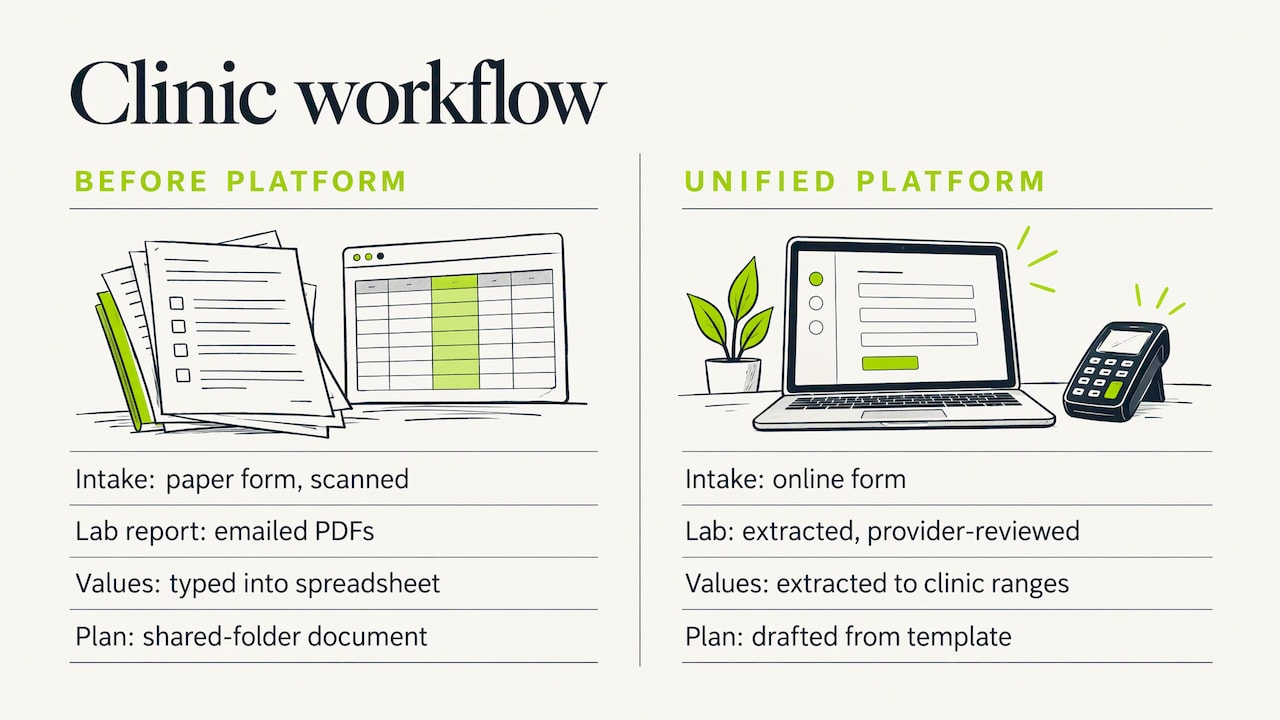
After moving to one platform, the member completes an online intake form, the lab report is extracted into the clinic's ranges and reviewed by the provider, the plan is drafted from a template, and a video follow-up is scheduled during the same visit. The membership payment runs through the clinic's Stripe account. The staff time per new member falls, and the provider spends the saved time on the conversation with the patient. The numbers will differ for every clinic, which is why the first measurement should be the clinic's own: minutes from lab receipt to reviewed result, and the share of members who complete their retest.
Our perspective
We build LongevityEHR for one kind of practice: the cash-pay clinic that measures, plans and follows up over months. In our view, the clinic's real asset is the loop between a result, a decision and the next measurement, and software should make that loop short.
That is why we keep labs, biomarkers, care plans, scheduling, memberships and the patient portal in one place. Each time a clinic has to move data between tools, the loop gets longer and the provider's attention goes to administration instead of the patient.
We also think a clinic's ranges, templates and brand should belong to the clinic. Our platform extracts lab values into the clinic's own biomarker ranges, builds care plans from the clinic's templates, and presents everything through a white-label portal with payments in the clinic's own Stripe account. Clinics can launch in days without custom development, so the first month goes to patients.
The result we design for is a practice that can add providers and patients without adding chaos.
Pricing and how to start
LongevityEHR is billed per seat, and every plan includes unlimited patients. Annual billing is 30% off.
| Plan | Monthly | Billed annually |
|---|---|---|
| Trial | $0 for 15 days | Not applicable |
| Core | $99 per seat a month | $69.30 a month ($831.60 a year) |
| Scale | $199 per seat a month | $139.30 a month ($1,671.60 a year) |
| Enterprise | Custom pricing | Custom pricing |
A clinic can begin with the 15-day trial, load its ranges and templates, and run a few real patients through intake, labs and plan before choosing a plan. The current plan details are on the pricing page.
Clinics that want to see the whole workflow in one place can start from the LongevityEHR homepage.

Run your longevity clinic on one system
- AI lab extraction with provider review
- Your ranges, every result as a trend
- Memberships through your own Stripe
15-day free trial. BAA on request.