
On this page
Key takeaways
- Healthcare is a primary target: the FBI counted 210 ransomware attacks on US healthcare in 2022, more than any other critical sector, and 112 million people were affected by breaches in 2023.
- Most clinic risk sits in a few places: phishing, stolen credentials, unpatched software and third-party vendors.
- Multi-factor authentication, tested backups, timely updates and a written downtime plan prevent or shorten most incidents.
- Fewer disconnected tools means fewer places for patient data to leak, so an all-in-one EHR that is HIPAA, with a BAA on request, is a security decision as much as an operations decision.
- The HIPAA Security Rule is under a proposed overhaul, so building these habits now puts a clinic ahead of any final rule.
Healthcare cybersecurity is the set of technical controls, vendor choices and written procedures that keep patient data private and clinical systems available. For a cash-pay longevity, functional medicine, concierge or hormone clinic, the most consequential decision is usually the software the practice runs on, because labs, biomarkers, care plans, scheduling, payments and the patient portal all live there. A single platform that is HIPAA, with a business associate agreement (BAA, the contract HIPAA requires when a vendor handles patient data for you) on request, shrinks the number of systems and vendors you must defend. This guide covers the threats, the controls, the incident plan and the vendor questions that matter at clinic scale.
Why cybersecurity is a patient care issue
A cyberattack on a clinic is not only an IT problem. CISA, the US federal cybersecurity agency, states that disruption of the healthcare digital ecosystem can affect patient safety and create openings for identity theft, because providers depend on digital systems to store records, carry out procedures and communicate with patients.
The World Health Organization describes the consequences in concrete terms: cancelled appointments, postponed treatment and stolen mental-health records published online. John Riggi, writing for the Agency for Healthcare Research and Quality, argues that cybersecurity is integral to patient safety because care delivery depends on technology being available, and a ransomware attack removes that availability.
Cash-pay clinics hold exactly the data attackers value: full lab panels, hormone and genetic results, intake histories, payment relationships and direct contact details for affluent, privacy-conscious patients. Small teams also tend to lack a dedicated security staff, which makes the choice of platform and a few disciplined habits more important, not less.
The threats that reach clinics
The figures below come from US government and health-sector sources. They describe the whole sector, but the attack methods apply to a ten-person practice as much as to a hospital.
| Threat | What it looks like in practice | Evidence |
|---|---|---|
| Ransomware | Files are encrypted, access is withheld, and stolen data is often threatened with release | Healthcare was the critical infrastructure sector with the most ransomware complaints to the FBI in 2022: 210 |
| Phishing and social engineering | An email or call convinces staff to share a password or approve a login prompt | HHS notes phishing can overcome multi-factor authentication through social engineering |
| Compromised credentials | A reused or stolen password opens the EHR or email | Health-ISAC ranked compromised credentials among the top 2024 threats |
| Third-party breaches | A vendor or software supplier is breached and your data goes with it | Health-ISAC found three of the top five 2025 concerns tied to third-party breaches and zero-day exploits |
| Software vulnerabilities | An unpatched system is exploited | HHS lists software and zero-day vulnerabilities among the top hospital threats |
Two details deserve attention. First, attackers are fast and human-directed: HHS reports that, in hospitals, human-directed attacks make up 71% of attacks and that attackers move beyond the initial intrusion point in about 1 hour 28 minutes. Second, theft now comes with pressure on patients. Health-ISAC documents how, after a December 2023 attack on a health system, a threat actor emailed patients demanding payment to delete their records. For a clinic whose patients value discretion, that is the scenario worth planning against.
The scale of exposure is also growing. According to the HHS Office for Civil Rights, 112 million people in the United States were involved in a data breach in 2023, more than double the 46.8 million in 2022.
Where the HIPAA rules stand
HIPAA's Security Rule requires covered entities and their business associates to protect electronic protected health information (ePHI). In January 2025 HHS published a notice of proposed rulemaking to strengthen the Security Rule, citing significant increases in breaches and cyberattacks and common deficiencies found in compliance investigations.
A proposal is not a final rule, and its timing and content can change, so check the HHS Office for Civil Rights site for the current status. The practical reading for a clinic is simple: the direction of travel is toward more specific, documented safeguards. A clinic that already runs a written risk assessment, enforces multi-factor authentication and keeps tested backups will not be scrambling later. This article is general information, not legal advice, and a healthcare attorney or qualified compliance professional should review your obligations.
Core controls for a small clinic
Europe's cybersecurity agency ENISA published a cyber hygiene booklet for the health sector in September 2025 aimed at hospitals and smaller clinics alike. Its central point is that regular updates, secure backups and multi-factor authentication can prevent the vast majority of common attacks. The guidance is European, but the controls are universal. A practical clinic checklist follows.
1. Require multi-factor authentication everywhere
Turn it on for email, the EHR, the payment dashboard and any file storage, either in each system or through your identity provider. Prefer app-based or hardware prompts over text messages, and train staff never to approve a prompt they did not initiate, since social engineering targets exactly that moment.
2. Keep software patched
ENISA advises installing the latest security patches on every device, isolating any device that cannot be patched, and scanning for outdated software. In a clinic that means laptops, front-desk computers, tablets, routers and any lab or wellness device on your network. Assign one named person to own the update schedule.
3. Back up and rehearse the restore
ENISA recommends at least one backup copy that is offline or resilient to ransomware. A backup only counts once you have restored from it, so schedule a restore test. ENISA's cyber hygiene booklet can help you set the structure for what to copy, how often and where to keep it.
4. Limit and log access to records
Give each person access to only what the job requires, and make sure access to patient records is logged and reviewable. ENISA's guidance on patient records also calls for alerts on unusual activity and checks on vendor service levels for cloud EHRs and hosted apps. Our guide to the EHR audit trail explains what an audit trail records and how long to keep it.
5. Train the whole team
WHO attributes healthcare's appeal to attackers partly to inadequate staff awareness and technical safeguards. Short, regular phishing exercises and a clear rule for reporting a suspicious message (no blame, no delay) cost little and close the most common door.
6. Secure communication with patients
Patient questions about lab results often arrive by text or personal email. Move them into a secured channel; our guide to HIPAA compliant messaging for cash-pay clinics covers how. For the broader privacy picture, see the healthcare data privacy guide.
Vendors are part of your attack surface
Health-ISAC's survey of nearly 200 health-sector professionals found that third-party breaches and supply chain attacks rank among the top concerns for 2025. Every extra tool in a clinic, such as a lab portal, a scheduling app, a separate video service, a spreadsheet of biomarkers and a membership billing tool, is another vendor holding patient data and another agreement to manage.
Six questions help when evaluating any software that touches patient data:
- Will the vendor sign a BAA?
- Does the platform keep patient data in one place, or does it hand data to several other services?
- Who in your clinic can see what, and is access recorded?
- How are patient-facing logins and the portal protected?
- How is patient data moved in, and moved out if you leave? Our EHR data migration plan walks through this.
- How do you stay able to see patient information if the system is down?
Consolidation is the strategic answer. When the care loop runs in one platform, you have one BAA to hold, one set of users to manage and one vendor relationship to review each year. The HIPAA compliant EHR security page describes how LongevityEHR approaches this.
Prepare for the day something goes wrong
Prevention reduces risk but cannot remove it. HHS's Operational Continuity-Cyber Incident checklist treats response planning as the foundation for limiting damage: it may not prevent downtime, but it can shorten the impact on finances and patient safety, and it anticipates outages lasting days or weeks.
The checklist is written for large hospitals, and a clinic can scale it down. In the first hours of an incident, the HHS document points to downtime procedures such as paper charts, printed critical information and a label process for patients and specimens. A one-page clinic version might include:
- Who decides. Name an incident lead and a backup, with personal phone numbers stored outside the affected systems.
- Downtime kit. Printed schedule for the next two weeks, blank intake and clinical note templates, and patient contact lists for urgent outreach. These printouts contain patient information, so keep them in a locked location, reprint them on a schedule and shred old copies.
- Patient identification. On paper, use at least two identifiers on every page, a practice the New York hospital association's cyber disruption toolkit recommends for downtime charts.
- Calls to make. Your attorney, your cyber insurer if you have one, your EHR vendor and law enforcement (the FBI or your local, state or tribal agencies, as the HHS checklist suggests). Breach notification duties under HIPAA are specific and time-bound, so involve counsel early.
- Practice. Run a short tabletop exercise once a year, walking through a ransomware scenario on a calm afternoon.
A fictional example shows why this matters. Imagine a hormone clinic whose front desk opens a convincing invoice email on Monday morning. By midday, the shared drive holding scanned lab PDFs is locked and the practice cannot see the week's appointments. A clinic with a printed schedule, a tested backup and a named incident lead resumes visits that afternoon on paper. A clinic without them cancels the week.
How the platform choice supports security
Security depends mostly on habits, but the platform sets the baseline. For a cash-pay clinic, the useful properties are fewer systems, clear data ownership and a vendor willing to sign a BAA.
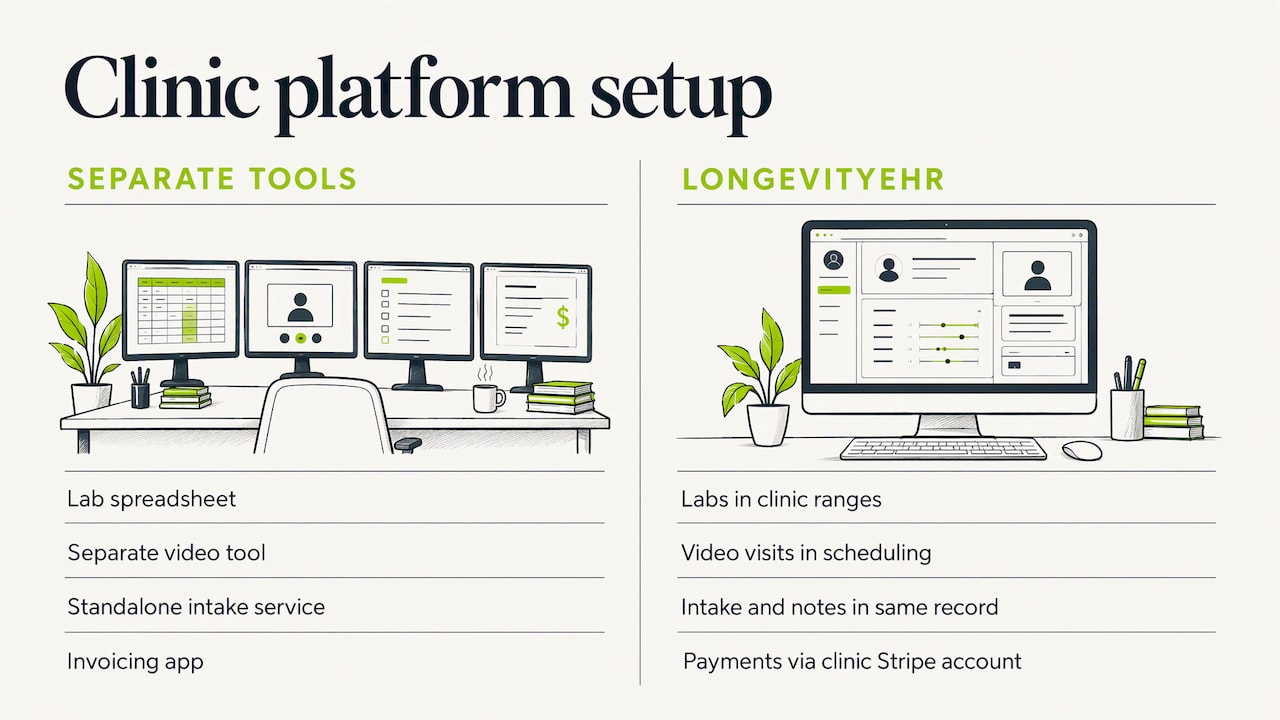
LongevityEHR is built as a single portal for the clinic's care loop. AI lab extraction places lab results into the clinic's own biomarker ranges, with provider review. Care plans are built from clinic templates, and clinical notes and intake forms sit in the same record. Scheduling includes video visits, and memberships and payments run through the clinic's own Stripe account. The patient portal is white-label, so patients log in to the clinic's brand rather than to a patchwork of outside tools. The platform is HIPAA, with a BAA on request.
That matters for the vendor risk described above. A clinic that once juggled a lab spreadsheet, a separate video tool, a standalone intake form service and an invoicing app can reduce this to one record system. Related reading: the telemedicine EHR integration guide and our piece on AI governance for cash-pay clinics.
Our perspective
We build for cash-pay clinics, and the pattern we care about is simple: every disconnected tool is another place patient data can end up. A longevity clinic collects some of the most detailed health information a practice can hold, and it does so with a small team that has no security department.
That is why we designed LongevityEHR as one connected loop: labs extracted into the clinic's own ranges, care plans from the clinic's templates, notes, intake, scheduling with video visits, memberships and payments through the clinic's own Stripe account, and a white-label portal. One platform, HIPAA, with a BAA on request, gives an operator one vendor to review and one place to manage access.
Security is never finished, and no software replaces MFA, backups and a rehearsed downtime plan. Our aim is to make the platform part of the clinic's answer, so the team's attention can go to patients.
Pricing for a clinic-sized deployment
LongevityEHR is priced per seat, and every plan includes unlimited patients. Annual billing is 30% off.
| Plan | Monthly | Billed annually |
|---|---|---|
| Trial | $0 for 15 days | Not applicable |
| Core | $99 per seat a month | $69.30 a month ($831.60 a year) |
| Scale | $199 per seat a month | $139.30 a month ($1,671.60 a year) |
| Enterprise | Custom pricing | Custom pricing |
Clinics can start with the 15-day trial, which includes every Core feature except in-app scheduling and bulk patient import, and compare plans on the LongevityEHR pricing page.
For a closer look at what a clinic gets in one place, see the EHR for longevity clinics overview.

Run your longevity clinic on one system
- AI lab extraction with provider review
- Your ranges, every result as a trend
- Memberships through your own Stripe
15-day free trial. BAA on request.
Sources
- CISA: Healthcare and Public Health Cybersecurity
- WHO: Cyber-attacks on critical health infrastructure
- AHRQ PSNet: Cybersecurity and How to Maintain Patient Safety
- HHS Cyber Gateway: Hospital Resiliency Landscape Analysis
- Health-ISAC 2025 Annual Threat Report
- Federal Register: HIPAA Security Rule To Strengthen the Cybersecurity of ePHI
- ENISA: Cyber Hygiene in the Health Sector
- HHS: Operational Continuity-Cyber Incident Checklist
- GNYHA Cyber Disruption Toolkit