
On this page
- What the evidence says about AI-drafted care plans
- Start with the data the draft will rest on
- Structure the request: what a good prompt contains
- A repeatable workflow, step by step
- What the provider checks before approving
- Safety, privacy and regulatory points for US clinics
- Matching the tool to a cash-pay clinic
- Plans and pricing
- Start with a 15-day trial
Key takeaways
- Studies show AI can produce complete, well-prioritized care plans quickly, but they also show weaker agreement with experts in complex cases, so every draft needs clinician review.
- Draft quality depends on the input: pertinent labs, biomarkers, history and goals, in a defined structure, without unnecessary identifiers.
- Prompts and templates are clinical work. One primary care team reported needing 8 to 10 rounds of revision with clinicians before outputs became consistently useful.
- Use tools under a BAA (business associate agreement), and keep staff from pasting patient data into consumer chatbots.
- Pricing for LongevityEHR starts with a 15-day trial at $0, and every plan includes unlimited patients.
AI can produce a first draft of a patient care plan in seconds, but a draft is only useful when it is built from the right inputs, written against the clinic's own templates and ranges, and approved by a clinician before the patient sees it. For cash-pay longevity, functional medicine, concierge and hormone clinics, the strongest setup keeps labs, biomarkers, notes, intake forms and care plans in one record, so the draft starts from structured data instead of a pasted summary. That is the design behind LongevityEHR care plans, where AI care plan drafting is available and the provider stays the author of record.
This guide covers what the evidence says about AI-drafted plans, what to feed the model, how to structure the request, how to review the output, and which privacy and safety rules apply in the United States. It is general information for clinic owners and operators, not medical, legal or billing advice. Have your clinical lead, compliance counsel and billing advisor review any workflow before you adopt it.
What the evidence says about AI-drafted care plans
The research is encouraging on speed and completeness, and clear about where the clinician comes in.
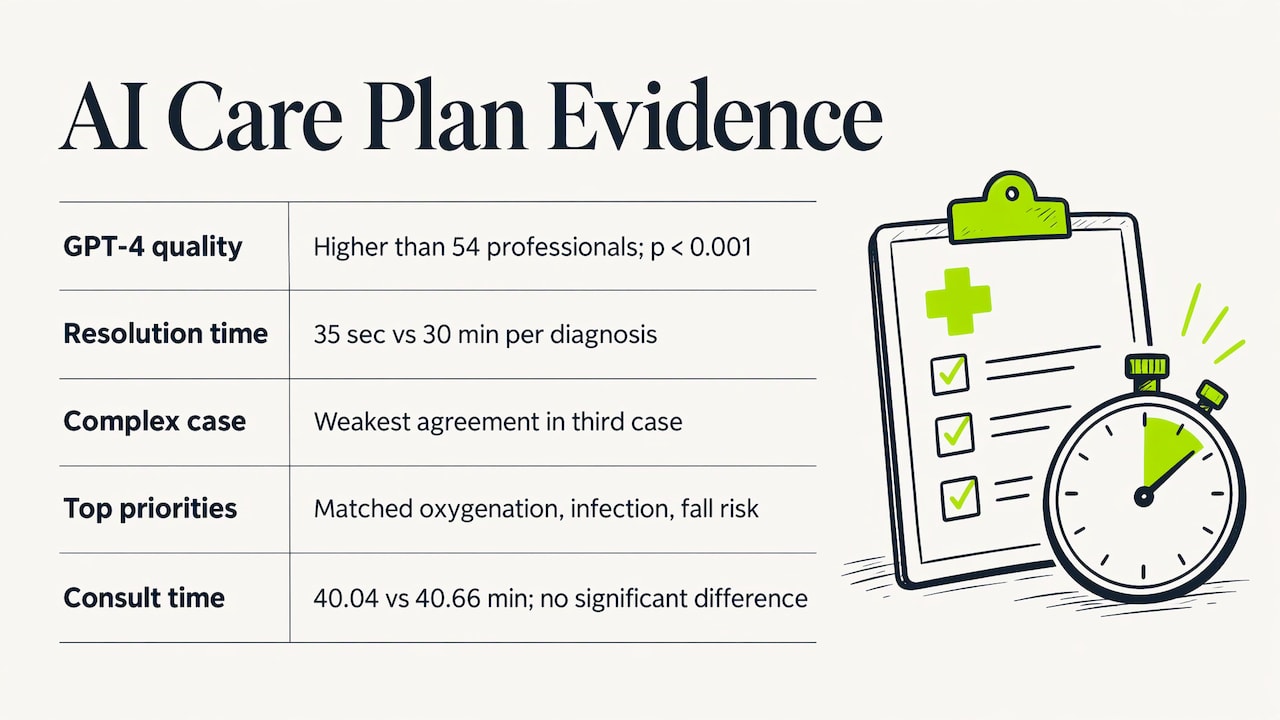
A 2025 comparative study in Nursing Reports found that GPT-4 scored significantly higher than 54 nursing professionals on care plan quality across three simulated cases (p < 0.001). The model resolved all three cases in 35 seconds, against an average of 30 minutes per diagnosis for the practitioners. Agreement with the expert panel was partial in the second case and weakest in the third, the most complex, where the model chose interventions that fit the clinical context less well. The authors conclude that human supervision is part of effective integration.
A 2024 peer-reviewed study tested the same idea on a single hypothetical case, an older patient with lung cancer. The AI-generated plan matched the gold-standard plan's top priorities: oxygenation, infection prevention and fall risk. Eleven of 16 labels (69%) were standardized nursing terms. The authors still stress that clinicians must evaluate AI recommendations against the patient's unique needs, context, safety and ethics.
Time savings are real but modest at the visit level. A Singapore trial of an LLM documentation tool found no significant difference in total consultation time (40.04 vs 40.66 minutes). It did find 5.77 minutes of documentation time saved per patient in moderate-complexity cases, and 4.6 minutes of documentation time saved for experienced physicians. Evaluators preferred the AI-assisted documentation in 57.1% of cases. The authors note that outcomes were limited to documentation time and quality.
The practical reading for a clinic: AI is well suited to producing the first structured draft, and the time you save is clinician time that can go to personalization and patient conversation.
Start with the data the draft will rest on
A care plan draft can only be as specific as the record behind it. In a longevity or hormone practice, the inputs that shape a plan are usually:
- Lab results and biomarkers. The reference range matters. A plan for a patient whose ApoB or fasting insulin sits outside a clinic's optimal range reads differently from one judged against a conventional lab range.
- Intake and follow-up forms. Goals, symptoms, lifestyle, medications and prior history, captured in a consistent format.
- Clinical notes. The provider's own assessment from the visit.
- Plan templates. The clinic's standard protocols and patient-facing language, so a draft sounds like your practice.
The 2024 care plan study structured its assessment with a six-domain framework: situation and background, physical, safety, psychosocial, spiritual and cultural, and recommendations. The framework included pertinent labs. The lesson carries over to any specialty: give the model a fixed structure for the patient's information so it does not have to guess what matters.
Lab data is the input most often left as a PDF. In LongevityEHR, AI lab extraction reads reports into the clinic's own biomarker ranges, with provider review, so the draft works from structured values. See AI lab extraction and the guide on how AI reads lab reports for what extraction involves and why review matters.
Structure the request: what a good prompt contains
The American College of Cardiology's prompt guide for clinicians recommends that a request specify the instruction, context, relevant but non-identifiable input data, desired format and purpose, constraints, evidence-based references, and privacy and ethical considerations. Applied to a care plan, that becomes:
| Element | What to specify | Example for a hormone or longevity clinic |
|---|---|---|
| Task | The document and audience | A 90-day plan the provider will review, then share with the patient |
| Context | Clinic model and scope | Cash-pay clinic, plan follows the clinic's template sections |
| Patient data | Only what the plan needs | Age band, goals, relevant biomarkers against clinic ranges, current medications |
| Format | Sections and length | Goals, interventions, monitoring schedule, retest timing, patient instructions |
| Constraints | What the draft must not do | No diagnosis, no dose changes without provider entry, flag missing data |
| Evidence | What it should cite | Name the guideline or source behind each recommendation |
A September 2025 tutorial on prompt engineering in clinical practice adds two habits worth copying: embed patient-specific variables such as comorbidities and guidelines, and keep a documented record of key prompt iterations and outputs so the process stays traceable.
Treat prompts and templates as clinical work
A January 2026 commentary in the Journal of the American Board of Family Medicine, describing how its authors built a primary care AI tool, reports that early prompts lacking detail produced output that was inconsistent in format, overly generic and unclear about goals. Reaching consistent, useful drafts took 8 to 10 iterations over several weeks with clinician subject matter experts, using a structured framework with explicit reasoning steps.
For a clinic, this argues for building templates once, with your clinical lead, and reusing them, rather than letting each provider improvise a prompt for each patient. Templates that live inside the EHR keep the structure the same across providers and locations.
A repeatable workflow, step by step
The sequence below turns drafting into a loop the whole practice can run the same way. Where LongevityEHR covers a step, it is noted.
1. Collect structured intake and goals
Use a standard intake and follow-up form so goals, symptoms and history arrive in the same fields every time. Free-text emails and scattered PDFs are where drafts go generic. LongevityEHR includes custom intake and follow-up forms, so the data a draft needs is captured in the record from the first visit.
2. Bring in labs against your own ranges
Upload the lab report and confirm the extracted values and the ranges applied. Where it goes wrong: a value misread from a scanned report, or a conventional range applied to a patient you manage to optimal targets. In LongevityEHR, AI extraction maps results into the clinic's own biomarker ranges, and the provider reviews them before they feed a plan.
3. Record the provider's assessment
Write the visit note first. The clinician's assessment is what separates a personalized plan from a generic one, and it gives the draft the clinical reasoning to follow. Clinical notes sit in the same patient record as labs and forms.
4. Generate the draft from a clinic template
Choose the template that matches the program, for example a hormone optimization plan or a metabolic health plan, and generate the draft. LongevityEHR builds care plans from clinic templates, and AI care plan drafting generates the first draft from them. The draft is a starting point for the provider, not a finished plan.
5. Review, edit and approve
The provider checks each recommendation against the patient's record, removes anything unsupported, adds anything missing and approves the plan. Section below covers what to check.
6. Share with the patient and schedule follow-up
Publish the approved plan to the patient through a branded portal, book the retest or follow-up, and track progress against the same biomarkers. LongevityEHR provides a white-label patient portal and scheduling with video visits, so the plan, the appointment and the next labs stay in one place.
7. Update the plan as new data arrives
A plan is a living document. When new labs or a follow-up note come in, revise the plan from the updated record and keep the earlier version for the chart. That is the loop described in more depth in the guides on proactive healthcare and the precision medicine workflow.
What the provider checks before approving
England's government guidance on AI in social care states the principle plainly: AI may organise information or prepare a draft, but analysis, conclusions and recommendations must reflect the practitioner's own professional judgement. The same logic holds in US medical practice, where the licensed provider is responsible for the plan.
A short review checklist makes that practical:
- Inputs. Do the labs, medications and history in the draft match the chart? Is anything missing that the draft treats as known?
- Ranges. Are values interpreted against the clinic's intended ranges?
- Priorities. Does the first intervention address the patient's stated goal and the most clinically significant finding?
- Safety. Are contraindications, interactions and monitoring steps present and accurate for this patient?
- Evidence. Can each recommendation be traced to a guideline, protocol or study your clinic accepts?
- Language. Is the patient-facing wording clear, in your clinic's voice, and free of promises about outcomes?
- Sign-off. Is the approving provider recorded, with the date?
The Society of General Internal Medicine has argued that tools should be built so verification is intuitive, and that errors and omissions, often called hallucinations or confabulations, are the main technical weakness of generative AI. Even small mistakes can affect clinician confidence and patient safety. A structured draft that sits beside the source data makes each item on the checklist quick to confirm.
Safety, privacy and regulatory points for US clinics
Automation bias and traceability
The FDA's January 29, 2026 clinical decision support software guidance describes automation bias, the tendency to over-rely on automated suggestions, as a risk that can lead to errors of commission or omission and increases in time-critical situations. For software to fall outside the device definition under section 520(o)(1)(E) of the FD&C Act, it must let the health care professional independently review the basis for its recommendations. The guidance recommends that output identify the basis of recommendations, the inputs used, and patient-specific knowns and unknowns such as missing data.
Whatever tool you choose, those are sound questions for a clinic to ask in selecting and configuring it: can the provider see which data the draft used, and what is missing? Is the draft clearly marked as a draft until a provider approves it? Your regulatory counsel can tell you how the guidance applies to your specific tool and use.
HIPAA, BAAs and shadow AI
Patient data in a care plan is protected health information. Any vendor that handles it for you is a business associate, and HIPAA requires a written agreement with it (45 CFR 164.504(e)). The practical risk for small clinics is staff pasting patient details into consumer chatbots outside any agreement. Set a written policy on which tools are approved, train staff on it, and use platforms where a BAA is available. LongevityEHR is HIPAA, with a BAA on request, and uses role-based access and tenant-isolated data. Details are on the security page, and the guides on healthcare data privacy and AI governance for cash-pay clinics walk through policy setup.
The ACC guide's advice to use non-identifiable input data is a good habit even inside an approved system: include what the plan needs and no more.
Pilot before you scale
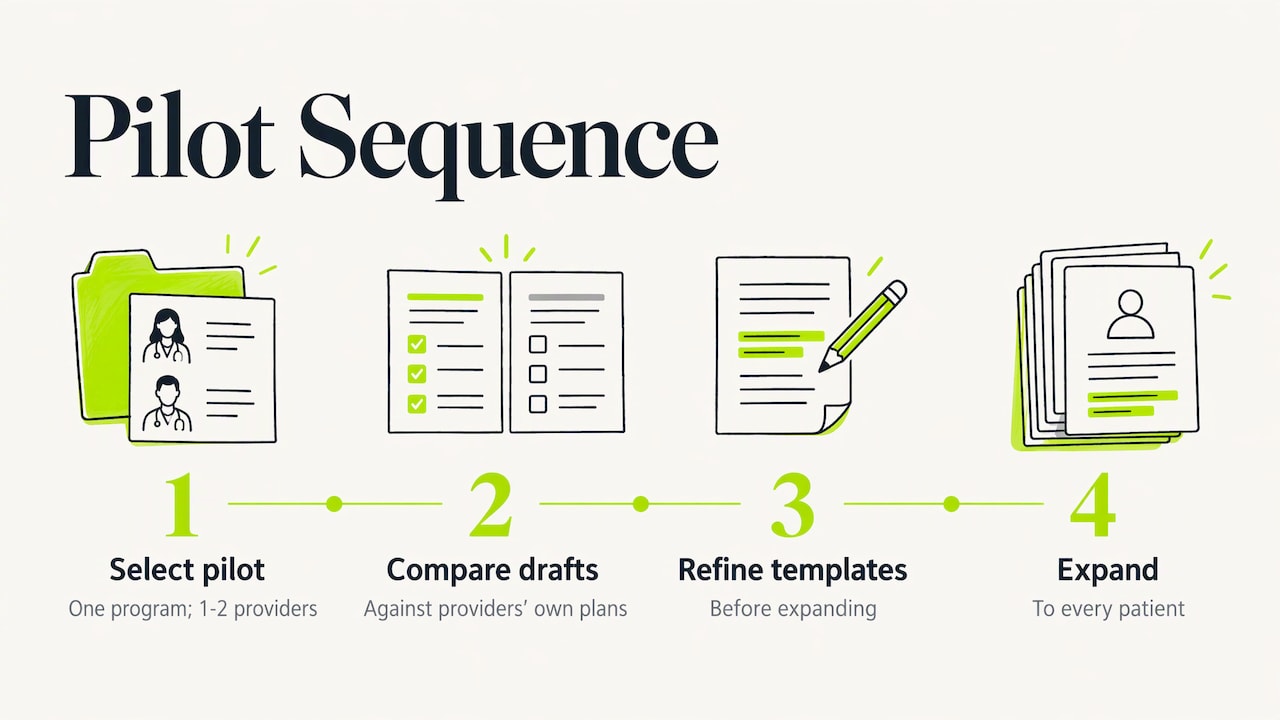
A clinical workflow roadmap for implementing AI models recommends silent validation and a pilot study before live integration, to verify production data feeds and confirm the tool performs as expected in your own workflow. For a clinic, that means starting with one program and one or two providers, comparing drafts with the plans those providers would have written, and refining templates before extending to every patient.
Matching the tool to a cash-pay clinic
A general-purpose chatbot can draft text, but it holds none of your clinic's data and none of your structure. Drafting inside the EHR keeps the plan tied to the record: labs in your ranges, the visit note, the intake form, the template and the approval, in one place.
The features that matter for this workflow in LongevityEHR are:
- AI lab extraction into the clinic's own biomarker ranges
- Care plans built from clinic templates
- Clinical notes and intake forms
- Scheduling with video visits
- Memberships and payments through the clinic's own Stripe account
- A white-label patient portal
Plans and pricing
LongevityEHR is priced per seat, every plan includes unlimited patients, and annual billing is 30% off.
| Plan | Monthly | Billed annually |
|---|---|---|
| Trial | $0 for 15 days | Not applicable |
| Core | $99 per seat a month | $69.30 per seat a month ($831.60 a year) |
| Scale | $199 per seat a month | $139.30 per seat a month ($1,671.60 a year) |
| Enterprise | Custom pricing | Custom pricing |
Current plan details are on the pricing page.
Start with a 15-day trial
If your clinic is ready to move from copied notes and spreadsheets to a care plan loop inside one record, LongevityEHR offers a 15-day trial at $0. The trial covers lab extraction (up to 10 lab PDFs), care plans and the patient portal, while in-app scheduling for step 6 starts on the Core plan. Clinics brand the patient portal, run memberships and payments through their own Stripe account, and can launch in days without custom development. See the EHR for longevity clinics overview or start from the pricing page.
Our view: the template is the product
We build for cash-pay clinics, and the pattern we see in the research matches how we designed the platform: the quality of an AI draft depends on the structure around it. A prompt written fresh for each patient is a fragile thing. A clinic template, written once by the clinical lead and applied to a record that already holds labs in the clinic's own ranges, is repeatable.
That is why we put care plans, lab extraction, notes, intake forms, scheduling and the patient portal in one system. The draft should not start from a blank page or a pasted summary. It should start from the patient's record, in the clinic's voice, with the provider's review as the final step before anything reaches the patient.
We also think the provider's judgement is the point of a cash-pay practice. Patients choose these clinics for time and attention. Our aim is for AI to take on the first draft so that the provider's time goes to the conversation, the adjustments and the follow-up.

Run your longevity clinic on one system
- AI lab extraction with provider review
- Your ranges, every result as a trend
- Memberships through your own Stripe
15-day free trial. BAA on request.
Sources
- Nursing care plan study with ChatGPT (PMC, 2024)
- The Integration of AI into the Nursing Process (Nursing Reports, 2025)
- Clinical and economic impact of a large language model in documentation (PMC, 2025)
- AI Prompt Generation Guide for Clinicians (ACC)
- Prompt Engineering in Clinical Practice: Tutorial (PMC, 2025)
- The Importance of Primary Care Subject Matter Experts (JABFM)
- Using AI in social care: a quick guide for practitioners (GOV.UK)
- Recommendations for Clinicians, Technologists, and Healthcare Organizations (SGIM, PMC)
- Clinical Decision Support Software: Guidance for Industry (FDA)
- Implementing AI Models in Clinical Workflows: A Roadmap (PMC)